ACHR News
search
Ask ACHR NEWS AI
cart
facebook twitter instagram linkedin youtube
  • Sign In
  • Subscribe
  • Sign Out
  • My Account
ACHR News
  • NEWS
    • Breaking News
    • New HVAC Products
    • Featured Products
    • Manufacturer Reports
    • HVAC Data
    • Legislation
    • ACHR NEWS Centennial
  • RESIDENTIAL
    • Air Conditioners
    • Furnaces
    • Residential Heat Pumps
    • Ductless
    • Residential IAQ
    • Testing, Monitoring, Tools
    • Components & Accessories
  • COMMERCIAL
    • Air Handlers
    • Rooftop Units
    • Chillers and Cooling Towers
    • Commercial Heat Pumps
    • Boilers and Hydronics
    • VRF/Ductless
    • Commercial IAQ
  • REFRIGERATION
    • Refrigerants
    • Refrigerant Regulations
    • Leak Management
  • CONTRACTOR PRO
    • Geothermal
    • Homeowner Study
    • VRF and VRV Ductless
    • Unitary Trends
  • EDUCATION
    • Training and Education
    • Business Management
    • Service and Maintenance
    • Continuing Education
    • Market Research >
      • HVAC Brand Awareness Report
      • VRV, VRF, VRVZ Report
      • Unitary Trends Report
      • Water Heat Professionals Report
    • Webinars
    • Sponsor Insights
    • eProducts Info
    • White Papers
  • EVENTS
    • HVAC Contractor Forum
    • Industry Events and Webinars
  • MEDIA
    • Videos
    • AHR Expo 2025 Videos
    • Podcasts >
      • ACHR News Podcast
      • HARDI Podcasts
      • AHR Expo Podcasts
      • ACCA Podcasts
    • Interactive Spotlights
    • Quizzes
    • eBooks
    • HVAC Talkback
  • HVAC GROUP
    • ACHR NEWS >
      • Current Issue
      • Digital Edition
      • Subscribe
    • Distribution Trends
    • SNIPS NEWS >
      • Join SNIPS NEWS
    • Engineered Systems News >
      • Join ES News
    • HVACR Directory
    • Contests
    • Newsletters
    • Contact
    • Advertise
    • My Account
NewsService and MaintenanceVentilationDuct ProductsFans

How to Adjust Blower Speeds Using Fan Law Two

Assuming high speed for cooling and low speed for heating no longer works with today’s equipment
By David Richardson
Blower Speed Adjustments
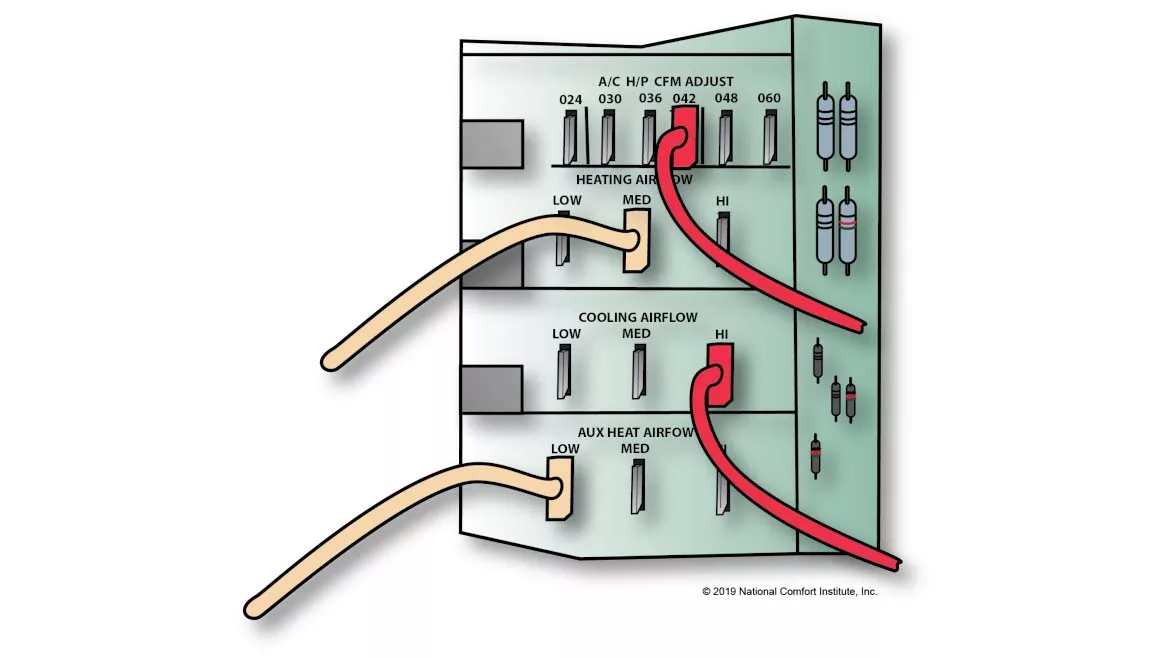
NEVER ASSUME: Don’t assume the factory blower settings are right for your installation. (Courtesy of National Comfort Institute)
December 25, 2023
✕
Image in modal.

Setting up a blower correctly is sometimes a mixture of luck and educated guessing. That’s because it’s tough to pinpoint exactly which blower speed is correct. Assuming high speed for cooling and low speed for heating no longer works with today’s equipment. Instead, you must set each blower to the equipment’s airflow needs.

READ MORE ABOUT

• Service and Maintenance

• Blowers

• Fans

Since setting up a blower requires a certain skill level, many won’t bother and leave the equipment set to factory specifications. It’s easier to assume the manufacturer set the blower correctly from the factory. Fortunately, there is a better way that involves using Fan Law Two.

I forgot about this method until my friend Jason Nikkel, with JN Electrical Temperature Control, from Bowersville, Georgia, reminded me. Our conversation was the spark for this article. Let’s review Fan Law Two and what you’ll need to use it to set blower speeds.


Reviewing Fan Law Two

Fan Law Two is a mathematical formula commercial air balancers use to predict static pressure changes with airflow adjustments. There are a couple of formula variations, but the one we’ll use in this article is:

(CFM2 ÷ CFM1)2 x SP1 = SP2

Once you know the Fan Law Two formula breakdown and flow, it’s easy to apply. The two abbreviations are the first pieces to understand. CFM stands for cubic feet per minute, or airflow, and SP stands for static pressure. In our application of the formula, we’ll use the total external static pressure (TESP).

Each abbreviation has a small subscript number at the bottom right. Abbreviations with a one (1) are the measured value in the formula. Abbreviations with a two (2) next to them are the design or target value you’re trying to determine.

Parentheses in the formula tell you to, “Do this part of Fan Law Two first.” There is also a superscript number two (2) outside the parentheses. This number means you must “square” the answer from inside the parentheses, or multiply the answer times itself. As an example, if you squared the number five, it equals 25 (5 x 5 = 25).


Gather the Essentials

Before you can use Fan Law Two to adjust blower speeds, you need to gather some essentials. First, you’ll need a quality static pressure test kit to measure TESP. A kit with all the basics should include:

  • Manometer (digital or analog);
  • Tubing;
  • Static pressure tips;
  • Step bit; and
  • Test port plugs.

Once you have test equipment, you’ll need the manufacturer’s fan table for the air-handling equipment you’re testing. Depending on the brand, you may find this information in the installation instructions, on the back of the blower panel, or through an internet search. If the equipment is obsolete or you can’t find the original manufacturer’s fan table, you can use NCI’s generic fan tables.

Looking for quick answers on air conditioning, heating and refrigeration topics? Try Ask ACHR NEWS, our new smart AI search tool. Ask ACHR NEWS →

Airflow data (CFM per Watts)

Airflow Data Table.

Click table to enlarge

FAN TABLE: You can see the changes in fan speeds as outlined in the article on this fan table. Red shows the “as-found” settings while blue shows the new speed to use according to Fan Law Two. (Courtesy of National Comfort Institute)

Finally, you need to know the heating and cooling airflow requirements. If you’re setting up a heat pump air handler, heating and cooling airflow are the same. However, if you have a gas furnace with cooling or dual fuel, you must set up blower airflow for each mode of operation.

We will use 400 cfm per ton as the cooling airflow example in this article. This airflow value will change based on equipment capacity and location. Make sure you know what works in your area. Gas heating airflow can be a little trickier. If you need help, here are four steps to estimate gas heating airflow that simplify the process.


Applying Fan Law Two to Blower Speed Adjustments

Let’s say you’re a service technician dispatched to a complaint about noise and poor cooling on a newer installation. When you arrive, you perform a visual inspection and find a split system with a two-ton outdoor unit. Inside, there is an 80% furnace with a constant torque (X-13) blower motor.

You look at the furnace nameplate and notice the maximum-rated TESP is 0.50-in. w.c. (inches of water column). As you record the furnace model number and look it up in the installation instructions, you notice the blower has five speeds and can handle a 3-ton outdoor unit. Further investigation shows that the installation crew set the cooling speed tap to the high-speed setting.

Next, you measure TESP at 1.10-in. w.c. and plot it along with the high-speed blower setting on the manufacturer fan table. This blower moves 1,275 cfm at 1.0-in. w.c. and consumes 504 watts. You know that 1,275 cfm is too much airflow for a 2-ton outdoor unit. It only needs around 800 cfm in your area.

The clues all lead to an improper blower setup. Now it’s time to estimate what TESP will be at 800 cfm, so you can predict the best blower speed choice. Your readings would fit into Fan Law Two as follows:

(CFM2 ÷ CFM1)2 x SP1 = SP2

  • CFM2 = 800 cfm (the target airflow);
  • CFM1 = 1275 cfm (the plotted airflow from the manufacturer fan table);
  • SP1 = 1.10 in. w.c. (the measured total external static pressure); and
  • SP2 = ?? in. w.c. (the static pressure you can expect to see at 800 cfm).

First, place all the numbers from above into the Fan Law Two formula. It should look like this:

(800 ÷ 1275)2 x 1.10 = SP2<>

Next, divide CFM2 (800) by CFM1 (1275). This equals .627. We’ll round the answer to .63.

0.632 x 1.10 = SP2

Then, square your answer by multiplying 0.63 times itself (0.63 x 0.63), which equals 0.396. We’ll round the answer to 0.40 to simplify the math. Ideally, you will jump straight to the next step on your calculator.

0.40 x 1.10 = SP2

Finally, multiply your measured TESP, or SP1 (1.10) times the squared airflow ratio, to determine SP2, or the new static pressure you can expect to see at 800 cfm.

0.44 in. w.c. = SP2

Now look at the manufacturer fan table to see which blower speed setting will move around 800 cfm at a 0.44 TESP. Since fan airflow is ± 10%, you can go as low as 720 cfm or as high as 880 cfm and still be within an acceptable range.

Fan table static pressure readings only show tenths of an inch of water column. You won’t find one that has a 0.44 column, so you’ll have to round and choose the closest option, 0.40. Your closest speed tap options in the 0.40 column are medium speed at 950 cfm or medium low at 775 cfm.

Since the medium-low speed option is within ± 10% of 800 cfm, you change the blower speed setting to medium-low. Now the blower should move approximately 775 cfm at 124 watts.

You button up the equipment and turn it on to recheck your airside measurements and calculations. As an extra precaution, you also check your superheat and subcooling to make sure the refrigerant charge doesn’t need any adjustments at the new airflow setting.


Put Fan Law Two to Work

The example above is just one use of Fan Law Two. Another potential application is for equipment setup and commissioning. If the installers used this procedure in the story above, there would have been no customer complaint or callback.

If you have a static pressure kit, you can use Fan Law Two now. If you don’t have a static pressure kit, that is your first step. Once you have one, test your own installations during startup. It’s also a great learning experience to test your office systems and work the math to make speed tap adjustments.

I hope you see the potential for this formula. It will make your life easier and help you predict changes to blower speed settings with more accuracy and reliability.

KEYWORDS: airflow management blowers Duct Dynasty fan motors National Comfort Institute (NCI) troubleshooting and HVACR

Share This Story

Looking for a reprint of this article?
From high-res PDFs to custom plaques, order your copy today!


David richardson
David Richardson serves the HVAC industry as Vice President of Training for National Comfort Institute, Inc. (NCI). NCI specializes in training focused on improving, measuring, and verifying HVAC and Building Performance. If you’re an HVAC contractor or technician interested in learning more about building science applied to HVAC, contact David at ncilink.com/ContactMe.

Recommended Content

JOIN TODAY
To unlock your recommendations.

Already have an account? Sign In

  • HVAC-enrollment

    The Trades Are Back: HVACR Programs See Nearly 30% Enrollment Spike

    A new wave of future technicians is entering the pipeline.  
    Training and Education
    By: Matt Jachman
  • 2025 Top 40 Under 40

    2025 Top 40 Under 40 HVACR Professionals List

    The 11th annual Top 40 Under 40 list highlights those...
    HVAC Contracting
    By: Hannah Belloli-Oster
  • LG Ductless Mini-Split Systems

    The 9 Types of Heat Pumps

    As the U.S. moves toward electrification, heat pumps are...
    Heat Pumps
    By: Joanna R. Turpin
Subscription Center
  • Create an Account
  • Start a Subscription
  • Manage My Account
  • Sign Up for Newsletters
  • Visit Customer Service
  • Update Preferences

More Videos

Sponsored Content

Sponsored Content is a special paid section where industry companies provide high quality, objective, non-commercial content around topics of interest to The News audience. All Sponsored Content is supplied by the advertising company and any opinions expressed in this article are those of the author and not necessarily reflect the views of The News or its parent company, BNP Media. Interested in participating in our Sponsored Content section? Contact your local rep!

close
  • Piggy Bank
    Sponsored byWatercress Financial

    Energy Prices, Inflation, and HVAC: What Today’s Homeowners Care About

  • Refrigerated Food
    Sponsored bySolstice Advanced Materials

    R-455A Refrigeration: A Cold Storage Solution for the Future

  • Airex Rooftop Units
    Sponsored byAirex Manufacturing Inc

    Consolidating Roof Penetrations: A Growing Trend in Multifamily HVAC Design

Popular Stories

HVAC-Price-Increase-graphic

HVAC Price Increase List: June 2026

Trump-Section-232.jpg

Trump Reduces Section 232 Tariffs on HVAC Equipment to 15%

R410A-Refrigerant-Cylinder.jpg

Refrigerant Recovery is a Revenue Opportunity

Heat-pump-cutaway.jpg

PFAS Rules and A2L Building Codes Continue to Evolve

Midea-training.jpg

HVAC Workforce Crisis Expands Beyond Technicians to Instructor Shortages

View The ACHR NEWS
Centennial Anniversary Timeline

The ACHR News Timeline Chart
Submit a Letter
Submit a letter to our editors.

Events

November 6, 2025

Next-Gen Data Center Cooling: HVAC Innovation and Real-World Solutions

On Demand As AI workloads and high-density computing push traditional cooling methods to their limits, the data center industry is accelerating the adoption of next-generation HVAC technologies.

June 17, 2026

Decarbonization Without Disruption

This webinar will explore practical HVAC decarbonization strategies that minimize disruption while maximizing long-term performance and ROI.

View All Submit An Event

Poll

Summer Staff

Are you fully staffed for the summer season?
View Results Poll Archive

Products

BNI Mechanical/Electrical Square Foot Costbook, 2026 Edition

BNI Mechanical/Electrical Square Foot Costbook, 2026 Edition

See More Products
Decarbonization Without Disruption - Free Webinar - 6/17/2026

Related Articles

  • Set Outside Airflow with Fan Law Two

    Set Outside Airflow with Fan Law Two

    See More
  • Extra Edition - Technical

    Why and How to Adjust a TXV/TEV

    See More
  • Start Predicting Static Pressure Changes by Applying Fan Law 2 - The ACHR News

    Start Predicting Static Pressure Changes by Applying Fan Law 2

    See More

Related Products

See More Products
  • front cover only.jpg

    How to Market Your HVAC Business

  • Using Schematic Diagrams to Troubleshoot HVAC/R Electrical Circuits

  • drafting.gif

    Sheet Metal Drafting Using Solidworks, 1/e

See More Products

Related Directories

  • National Comfort Institute-NCI

    National Comfort Institute (NCI) is a High-Performance HVAC professional training, certification, and membership organization. NCI offers a full range of advanced technical and sales training options.
  • Universal Fan & Blower

    Centrifugal and axial FRP composite corrosion resistant industrial and commercial fans.
  • Twin City Fan & Blower

    Commercial and industrial fans and blowers, plenum and plug fans, power roof ventilators, pressure blowers, radial tip fans. Industry leading designer and manufacturer of centrifugal fans and blowers, axial fans and power roof ventilators.
×

Sign Up. Stay Informed.

The #1 trusted source for the HVACR industry since 1926

SUBSCRIBE
  • RESOURCES
    • Advertise
    • Contact Us
    • Advisory Board
    • Classifieds
    • Submit a Letter
    • Directories
    • Store
  • ACCOUNT CENTER
    • Create an Account
    • Start a Subscription
    • Manage My Account
    • Sign Up for Newsletters
    • Visit Customer Service
    • Update Preferences
  • SERVICES
    • Marketing Services
    • Reprints
    • Market Research
    • List Rental
    • Survey/Respondent Access
  • STAY CONNECTED
    • LinkedIn
    • Facebook
    • Instagram
    • YouTube
    • X (Twitter)
  • PRIVACY
    • PRIVACY POLICY
    • TERMS & CONDITIONS
    • DO NOT SELL MY PERSONAL INFORMATION
    • PRIVACY REQUEST
    • ACCESSIBILITY

Copyright ©2026. All Rights Reserved BNP Media, Inc. and BNP Media II, LLC.

Design, CMS, Hosting & Web Development :: ePublishing