
Airex Manufacturing Inc We engineer airtight, code compliant HVAC wall penetration systems that stop air leakage, moisture intrusion, pest entry, and insulation failure—while delivering a clean architectural finish.


Consolidating Roof Penetrations: A Growing Trend in Multifamily HVAC Design
Fewer penetrations. Better details. Less risk.
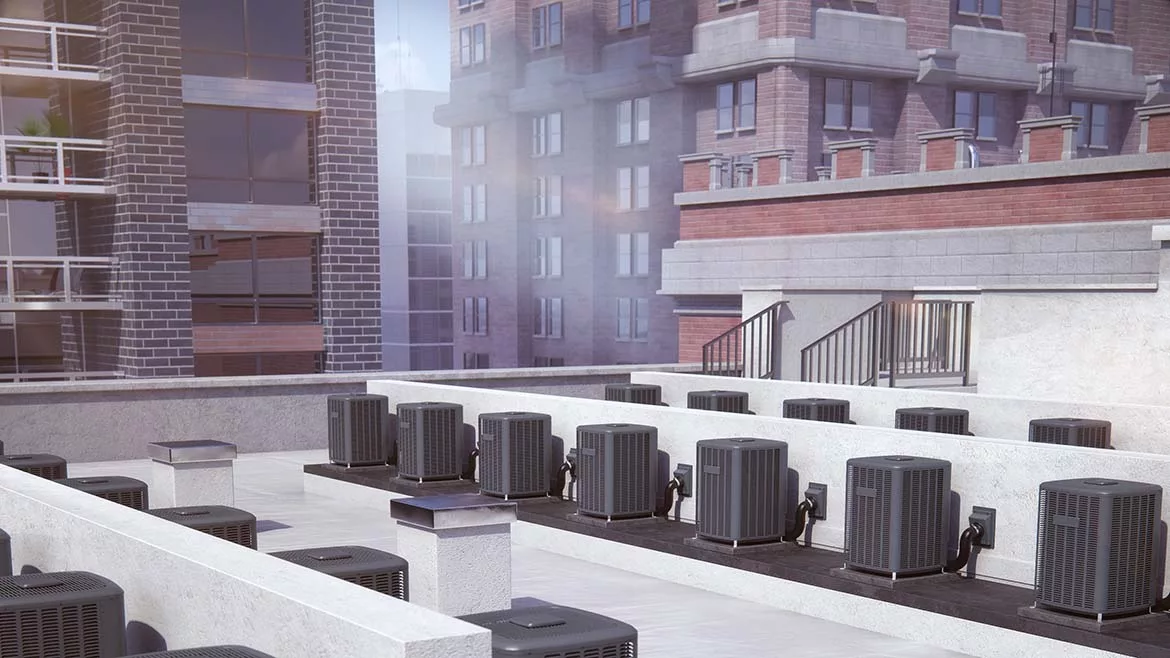
It’s often the smallest details that cause the biggest problems. In new construction, the roof may account for just 2% of the total building cost — yet it represents 75–80% of post-construction litigation. A large share of those disputes ties back to water intrusion around the very points where mechanical systems have to break through the envelope: roof and wall penetrations.
For engineers and multifamily HVAC designers, those penetrations are a necessary evil. Condensing units need to land on the roof. Line sets, controls, and power all have to get from the occupied space to the equipment. Every time there’s a punch through the envelope, a new long-term liability is created that has to be controlled by design, and not left to field improvisation.
Historically, the industry has accepted a patchwork approach: multiple small penetrations scattered across the roof, each with its own flashing detail, each relying on whatever sealants, mastics, or fillers happen to be on the truck that day. In some cases, field crews will even stuff gaps around piping with expanding foam or similar “gap fillers” as a quick way to “close the hole.”
On paper, these details might look minor. In the field, they add up to a lot of risk.
But, there’s a better strategy that minimizes the number of penetrations, moves those penetrations to vertical surfaces wherever possible, and uses a tested, mechanical sealing system that can handle vibration, movement, and the beating that comes with severe weather, for the life of the building.
That’s where the Titan Outlet and E-Flex Guard from Airex Manufacturing shine.
Rethinking Rooftop Penetrations: Horizontal vs. Vertical
From a water-management standpoint, the roof deck is a worst-case scenario. Water sits there. Drains clog. Snow drifts. Ponding happens. If there’s a weakness in the membrane, it will show up sooner rather than later.
That’s why roofing codes and standards put such emphasis on proper flashing of roof penetrations and on using approved sealants and mastics at the horizontal plane. Those decisions belong with the roofing system and the roofing contractor.
Mechanical engineers and HVAC designers have much more leverage when they leverage routing strategies — determining how many times it is necessary to penetrate the roof, where those penetrations need to occur, and opting to bring the systems up through a single, properly detailed housing.
One of the most effective ways to reduce leak risk is to move the critical transition off the horizontal roof and onto a vertical surface, wherever possible, into parapet walls, curb walls, or site-built doghouses or stations.
In that configuration, the roofer’s job is straightforward: flash and seal a single, larger curb or housing that is designed to be part of the roof system. The mechanical contractor then brings refrigerant lines, condensate, and electrical up through that protected box and exits through a vertical wall, where water naturally sheds and weatherproofing is easier to maintain.
Airex’s Titan Outlet and E-Flex Guard are designed to own that vertical transition and turn it into a repeatable, engineered detail instead of a one-off field fix.
A Better Strategy for Multifamily and Multi-Unit Rooftops
As the unit count climbs on multifamily and mixed-use rooftops, so does the risk.
Too many penetrations is another flashing detail that could go south, another line item for the engineer, and an increased risk for the owner. Then there are other failures, like uncontrolled movement from refrigerant lines during expansion/contractor and equipment start/stops, compressor-inducted vibration, and the headache that may arise when someone needs to perform service.
On a multifamily or mixed-use project with dozens of condensing units on the roof, the difference between a convenient approach and a planned, consolidated penetration strategy can mean the difference between a handful of large, well-detailed openings and dozens of small, harder-to-control penetrations.
The most robust rooftop strategy deploys by bringing piping up through a shaft, parapet wall, curb wall, or doghouse/station, transitioning through a vertical surface using a tested sealing system, and standardizing the detail.
The Airex Pro-System Kit — combining Titan Outlet and E-Flex Guard — is purpose-built to support exactly this kind of strategy. It gives engineers a single, specifiable solution that can be rolled out across an entire portfolio of multifamily and light commercial projects.
Enter the Airex Pro-System Kit
The Airex Pro-System Kit replaces improvisation at the vertical penetration with a repeatable, engineered assembly that is designed specifically for refrigerant piping in modern code environments.
Titan Outlet™ is a wall-mounted outlet seal that provides a compression gasket around HVAC piping at the point of exterior wall or parapet penetration. Instead of cutting a rough opening and filling the void, the engineer details a specific termination device that:
- Manages the transition from interior to exterior
- Allows for movement and vibration
- Provides a defined interface between the building envelope and the refrigerant lines
E-Flex Guard™ is a UV- and weather-resistant PVC cover that protects exterior refrigerant pipe insulation and maintains vapor barrier integrity. It is designed to encapsulate and protect the insulation itself, which is required by energy codes to remain intact, continuous, and protected from physical damage.
Together, Titan and E-Flex allow engineers to:
- Route multiple line sets through a single, protected chase or housing
- Terminate those line sets on a vertical surface with a gasketed, mechanical assembly
- Protect the insulation and piping from sun, weather, and physical abuse over time
The result is a sealed, supported, and serviceable solution that integrates cleanly with the roof system and significantly reduces the variability that normally comes with field-built penetrations.
The A2L Equation: New Refrigerant, New Challenges
With many new builds utilizing next-generation A2L equipment, electrification and decarbonization are driving more heat pump capacity onto rooftops, especially in the multifamily and light commercial sectors.
For engineers, this could equate to larger line sets and thicker insulation to meet new efficiency standards.
A2Ls also come with come building code wrinkles that are finally getting sorted out.
In the 2021/2024 IMC, §1109.2.5 accidentally limited the “no-shaft” exception to A1 systems, even though ASHRAE 15-2022 (and the 2024 UMC) allow the same exception for all refrigerants when total charge is below Table 1103.1 limits for the smallest space the piping passes through. The 2027 IMC (M75-24) brings the IMC back in line, and many jurisdictions are already allowing teams to follow ASHRAE now via a simple modification/alternative approval. For multifamily, the stakes are real: forcing A2L lines into shafts can also trigger §1109.3.2 drainage and ventilation (sometimes with detection), which adds cost and energy use. Developers peg the hit at roughly $250,000 per 300-unit building, with committee estimates in the range of ~$1,000 per run per floor or ~$22,400 per mechanical room avoided when the exception applies.
All of these requirements boil down to one simple fact — performance at the penetration matters. A2Ls might be the most futuristic refrigerant to date, but the lines will still vibrate and expand and contract, just like older refrigerants. Penetration seals need to be able to accommodate this movement and vibration, something that a job-built box with stiff gaskets or generic fillers aren’t designed for.
The single best solution that, in some cases, even goes above and beyond requirements is the Titan Outlet™ + E-Flex Guard™. This gives engineers a specifiable, tested penetration detail for A2L-era designs—mechanical compression sealing at the wall, plus UV- and impact-resistant jacketing that protects insulation and piping from weather and physical damage while remaining serviceable.
In short, here are some of the things engineers and contractors need to keep in mind when penetrating the roof:
- Detail the transition. Treat every refrigerant penetration as part of the air barrier. Specify the device, not just “seal as required.”
- Use a mechanical, gasketed seal. Penetrations must allow thermal expansion and compressor-induced vibration without cracking or tearing.
- Protect the lines. Meet ASHRAE 15 by protecting piping inside walls with steel plates, and protecting exterior runs from hail, snow, ice, and impact.
- Preserve the insulation system. IECC/ASHRAE 90.1 require outdoor insulation to be UV-resistant, physically protected, and serviceable.
- Avoid field fillers. Expanding foams and generic mastics aren’t long-term primary seals for refrigerant penetrations and often aren’t approved for this use.
- Right-size the strategy. Consolidate roof penetrations into a parapet/curb/doghouse, then terminate through a vertical surface with a tested assembly.
Engineered for the Real World
The Titan + E-Flex system is not a collection of unrelated parts. It is a purpose-built product line designed around the specific demands of refrigerant piping and the current code landscape.
Titan Outlet™ Features
- Durable ASA polymer body with an over-molded Santoprene elastomeric sleeve
- Gasketed seal that conforms to irregular surfaces and allows for movement and vibration
- Fastened with ICC-ES listed, Miami-Dade approved hardware
- Forms a mechanical connection (not adhesive-based) with E-Flex Guard via stainless steel clamp
- UL-rated for outdoor exposure (UL 746C, F1), flame tested (UL 94 HB), and meets ASTM standards for air and water sealing
E-Flex Guard™ Features
- UV-resistant PVC jacketing to protect pipe insulation from solar and physical damage
- Dual-bonded hook-and-loop fasteners, welded and stitched for longevity and reusability
- Class II vapor retarder (ASTM E96), fire-rated (ASTM E84 / UL 723), antimicrobial, and reusable
- Available in sizes up to 1.5" insulation thickness for new high-efficiency heat pump and VRF standards
From a code perspective, the system helps support compliance with:
-
IECC 2021/2024 and ASHRAE 90.1:
- Continuous air barrier integrity at penetrations
- Proper protection of outdoor insulation from UV, moisture, and physical damage
-
ASHRAE 15 and emerging A2L refrigerant language:
- Requirements to protect piping from physical damage, including hail, snow, and ice
- Clarified expectations around shaft construction and protection, as code bodies update earlier A2L ventilation and detection requirements
- IBC Chapter 15 and roofing standards:
- Cleaner separation between roof membrane flashing responsibilities and mechanical penetration responsibilities
Airex has tested its components to ASTM air-leakage and water-penetration standards, giving engineers performance data they can rely on instead of guessing how a job-built detail will behave over time.
Proven Durability
Howard Ahern, National Sales and Technical Manager at Airex Manufacturing, has heard from contractors who installed Titan-based systems more than a decade ago that still look like they were installed last week.
The polymers used in Titan outlets have been proven in other harsh outdoor applications long before they were adapted for rooftop penetration work — including as the encasing material for roadside emergency phone boxes. If a Titan outlet can sit on a roof in Palm Springs, where surface temperatures can hit 124°F in the sun, and not show fading or cracking after 25 years, that’s meaningful data for an engineer signing off on details.
Airex backs the system with a 10-year warranty, reflecting confidence that the assembly will last well beyond typical project warranty periods and deliver a measurable reduction in risk over the long term.

By Howard Ahern
Howard Ahern brings over 43 years of industry experience to his role as National Sales and Technical Manager at AIREX Manufacturing Inc. Known for his deep technical expertise and field driven insight, Howard consistently delivers tailored, high performance solutions that meet the diverse needs of contractors, distributors, engineers, code officials, and energy professionals nationwide.
Sources
- Roof/water‑intrusion litigation context and roof share of problems: Architect Magazine. [architectm...gazine.com]
- U.S. roof claim costs and drivers (2024): Verisk Roofing Realities Trend Report. [verisk.com]
- IBHS perspective on roof‑driven catastrophe losses and water entry dynamics: IBHS program pages and studies. [ibhs.org], [diversifiede.com], [prnewswire.com]
- Moisture intrusion causes around penetrations/flashing: CLM Magazine. [theclm.org]
- FM/NRCA guidance on perimeter/corner fastening and roof system robustness: NRCA summary of FM 1‑29 updates; FM data sheets. [nrca.net], [fm.com]
- A2L code landscape (IMC 2024 adoption status, 2027 proposal M75‑24; ASHRAE 15 alignment; ACCA): ACHR News; ICC hearing doc; V3/Johnson commentary; IMC Chapter 11; ACCA blog. [achrnews.com], [buildingcode.blog], [v3ce.com], [codes.iccsafe.org], [hvac-blog.acca.org]
- Energy code expectations for insulation protection outdoors: Title 24/IECC‑aligned guidance and trade resources. [energycodeace.com], [aeroflexusa.com]
- Multifamily risk/insurance pressures: NMHC State of Multifamily Risk Survey. [nmhc.org]
Looking for a reprint of this article?
From high-res PDFs to custom plaques, order your copy today!


