ACHR News
search
Ask ACHR NEWS AI
cart
facebook twitter instagram linkedin youtube
  • Sign In
  • Subscribe
  • Sign Out
  • My Account
ACHR News
  • NEWS
    • Breaking News
    • New HVAC Products
    • Featured Products
    • Manufacturer Reports
    • HVAC Data
    • Legislation
    • ACHR NEWS Centennial
  • RESIDENTIAL
    • Air Conditioners
    • Furnaces
    • Residential Heat Pumps
    • Ductless
    • Residential IAQ
    • Testing, Monitoring, Tools
    • Components & Accessories
  • COMMERCIAL
    • Air Handlers
    • Rooftop Units
    • Chillers and Cooling Towers
    • Commercial Heat Pumps
    • Boilers and Hydronics
    • VRF/Ductless
    • Commercial IAQ
  • REFRIGERATION
    • Refrigerants
    • Refrigerant Regulations
    • Leak Management
  • CONTRACTOR PRO
    • Geothermal
    • Homeowner Study
    • VRF and VRV Ductless
    • Unitary Trends
  • EDUCATION
    • Training and Education
    • Business Management
    • Service and Maintenance
    • Continuing Education
    • Market Research >
      • HVAC Brand Awareness Report
      • VRV, VRF, VRVZ Report
      • Unitary Trends Report
      • Water Heat Professionals Report
    • Webinars
    • Sponsor Insights
    • eProducts Info
    • White Papers
  • EVENTS
    • HVAC Contractor Forum
    • Industry Events and Webinars
  • MEDIA
    • Videos
    • AHR Expo 2025 Videos
    • Podcasts >
      • ACHR News Podcast
      • HARDI Podcasts
      • AHR Expo Podcasts
      • ACCA Podcasts
    • Interactive Spotlights
    • Quizzes
    • eBooks
    • HVAC Talkback
  • HVAC GROUP
    • ACHR NEWS >
      • Current Issue
      • Digital Edition
      • Subscribe
    • Distribution Trends
    • SNIPS NEWS >
      • Join SNIPS NEWS
    • Engineered Systems News >
      • Join ES News
    • HVACR Directory
    • Contests
    • Newsletters
    • Contact
    • Advertise
    • My Account
NewsVentilation

Estimate Required Gas Heating Airflow in Four Steps

Contractors don’t need to rely on temperature rise to assume correct airflow

By David Richardson
Estimate Required Gas Heating Airflow in Four Steps
It’s a good idea to perform a visual inspection before you begin any measurements. Knowledgeable eyes are one of your most valuable test instruments.
April 29, 2020

Our industry uses ranges like 350 to 400 cfm (cubic feet per minute) per ton to estimate required cooling and heat pump airflow. With a few pieces of information, you can use similar ranges for gas furnaces to estimate heating airflow.

Instead of relying on temperature rise to assume you have the right airflow, you can determine airflow requirements upfront. Let’s look at how you can estimate gas heating airflow in four simple steps.

READ MORE ABOUT

• Ventilation

• Airflow Management


Step One: Gather Nameplate Information

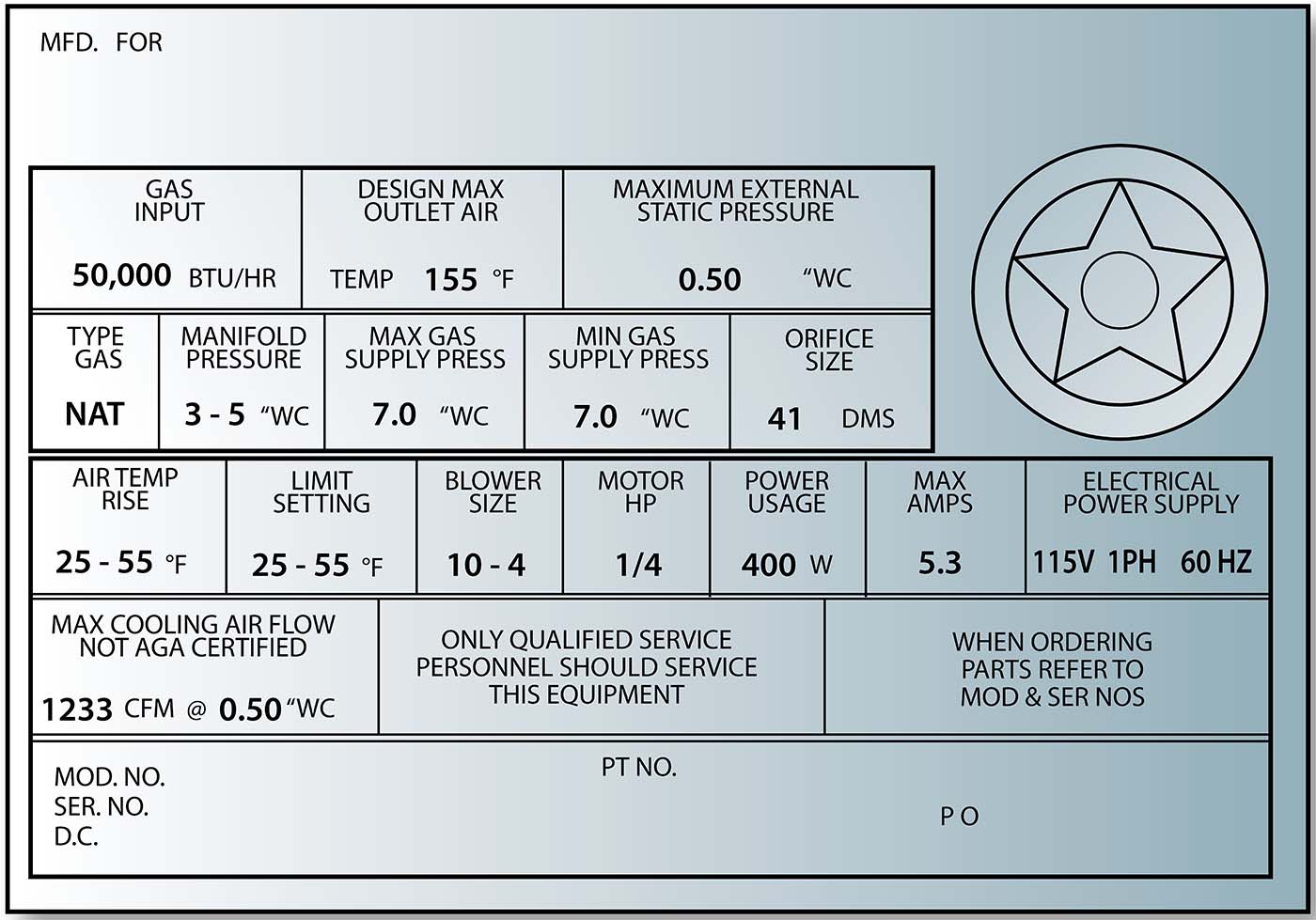
Before you can estimate heating airflow, you need to determine the furnace type. Is it a natural draft (70 percent), fan-assisted (80 percent+), or condensing (90 percent+) furnace? Next, look at the furnace nameplate. You’ll need three pieces of information from it for heating airflow calculations. They are:

  • Rated Btu/hr (British thermal units per hour) input capacity
  • Model number (to determine fan-rated tonnage and the correct fan table to use)
  • Maximum-rated TESP (total external static pressure).

You need the furnace type and rated Btu input capacity to estimate required heating airflow. The model number and maximum-rated TESP come into play in the fourth step where you measure static pressure and compare required airflow (what you need) to plotted fan airflow (what you have).
ORBIS beverage pallets.

Click chart to enlarge

You’ll need to gather three pieces of furnace nameplate information to estimate heating airflow. Each nameplate is a little different.


Step Two: Visual Inspection

While gathering furnace nameplate information, it’s a good idea to remove the blower compartment door and perform a visual inspection. Locate the blower speed settings for the furnace and record them for future use.

If the furnace has a PSC (permanent split capacitor) blower motor, determine the heating speed taps used on the circuit board or fan relay. Single-stage furnaces are the easiest; they use one heating speed. Two-stage furnaces use two blower speeds for low-heat and high-heat.

If the furnace has an ECM (electronically commutated motor) blower assembly, you’ll need the manufacturer’s equipment installation manual or specifications. Use information in these documents to interpret dip switch settings on the control board or determine airflow settings from the controller of a communicating system.

Once you have your blower speed settings, inspect the blower wheel vanes to assure they’re clean and undamaged. If the vanes are compacted with dirt, airflow drops substantially. It’s estimated an 1/8-inch coating of dust on a blower wheel reduces fan airflow as much as 30 percent.

Looking for quick answers on air conditioning, heating and refrigeration topics? Try Ask ACHR NEWS, our new smart AI search tool. Ask ACHR NEWS →

Clean the blower wheel if it’s dirty. If you’re testing a condensing furnace, also look at the secondary heat exchanger while the blower assembly is out. If the blower is dirty, chances are high the secondary heat exchanger is too. Now is the perfect time to take care of it.


Step Three: Estimate Heating Airflow

Required heating airflow is determined per 10,000 Btu of rated furnace input. Think of this like cfm per ton for cooling operation. To estimate heating airflow, take the furnace rated Btu input and divide by 10,000. Next, multiply this number by the following airflow factors based on each furnace type.

  • Natural Draft Furnaces (70 percent): 100 cfm per 10,000 rated Btu input
  • Fan-Assisted Furnaces (80 percent+): 130 cfm per 10,000 rated Btu input
  • Condensing Furnaces (90 percent+): 150 cfm per 10,000 rated Btu input

Example: You are dispatched to service a condensing furnace and want to know how much airflow it needs. You look at the furnace nameplate and see the furnace’s rated input is 60,000 Btu. Divide 60,000 by 10,000 to get the result (60,000 ÷ 10,000 = 6).

Since this is a condensing furnace, you know it needs 150 cfm per 10,000 Btu rated input. You multiply six times 150 cfm (150 x 6 cfm) to see this furnace needs approximately 900 cfm of airflow moving across the heat exchanger.


Step Four: Compare Estimated to Plotted

Once you know your estimated heating airflow, you can turn the furnace on and measure TESP to plot fan airflow on the furnace’s fan table. You can compare the amount of airflow you need to what you have.

To measure TESP on a gas furnace, you’ll need to install test ports where air enters and exits the equipment and then measure pressures at each location. Once you have the readings, add the two pressure readings together to determine measured TESP and record the reading.

Next, locate the furnace’s fan table. It’s usually located in the installation instructions. Find the appropriate fan table that matches your furnace’s model number. On the fan table, locate the heating fan speed in use and lightly circle it.

Next, find the column that is closest to your measured TESP and lightly circle it. You should have two points circled on the fan table at this point.

Use a straight edge and line up your measured TESP and the fan speed. The point where they intersect indicates how much air the fan is moving. Record the airflow so you can compare it to your required heating airflow. A properly operating fan should deliver +/- 10 percent of required airflow near the equipment’s maximum-rated TESP that you found on the nameplate.

In the previous example, you needed 900 cfm for the 60,000 Btu input condensing furnace you’re testing. Let’s say your plotted fan airflow is 600 cfm. If you compare this to your required heating airflow, you’re only moving 67 percent of what you need (600 cfm ÷ 900 cfm= 67% percent).

A furnace only moving 67 percent of its required airflow needs your help. Don’t be surprised if the primary limit switch is cycling and the heat exchanger has been overheating.


Next Steps

As you begin to test and compare airflow readings, you may discover you need the same amount of airflow for cooling and heating. While this might seem like a lot of steps, it is much more intimidating on paper than it is to do it. With a little practice, you can perform these steps in less than five minutes.

Now it’s your turn. Check heating airflow on your next call and see how close you are. I think you’ll be surprised at the amount of airflow issues you discover. Additional testing helps pinpoint whether it’s an issue with the coil, filter, or duct system.

Once you have airflow testing down, add equipment temperatures to your airflow readings. You can plug them into the sensible heat formula (cfm x ∆t x 1.08) to see how close the furnace is to delivering its rated Btu output. It will open your eyes to another level of diagnostics and the opportunity to better serve your customers.

KEYWORDS: airflow management Duct Dynasty ductwork gas furnaces HVAC service ventilation control

Share This Story

Looking for a reprint of this article?
From high-res PDFs to custom plaques, order your copy today!


David richardson
David Richardson serves the HVAC industry as Vice President of Training for National Comfort Institute, Inc. (NCI). NCI specializes in training focused on improving, measuring, and verifying HVAC and Building Performance. If you’re an HVAC contractor or technician interested in learning more about building science applied to HVAC, contact David at ncilink.com/ContactMe.

Recommended Content

JOIN TODAY
To unlock your recommendations.

Already have an account? Sign In

  • HVAC-enrollment

    The Trades Are Back: HVACR Programs See Nearly 30% Enrollment Spike

    A new wave of future technicians is entering the pipeline.  
    Training and Education
    By: Matt Jachman
  • 2025 Top 40 Under 40

    2025 Top 40 Under 40 HVACR Professionals List

    The 11th annual Top 40 Under 40 list highlights those...
    HVAC Commercial Market
    By: Hannah Belloli-Oster
  • LG Ductless Mini-Split Systems

    The 9 Types of Heat Pumps

    As the U.S. moves toward electrification, heat pumps are...
    News
    By: Joanna R. Turpin
Subscription Center
  • Create an Account
  • Start a Subscription
  • Manage My Account
  • Sign Up for Newsletters
  • Visit Customer Service
  • Update Preferences

More Videos

Sponsored Content

Sponsored Content is a special paid section where industry companies provide high quality, objective, non-commercial content around topics of interest to The News audience. All Sponsored Content is supplied by the advertising company and any opinions expressed in this article are those of the author and not necessarily reflect the views of The News or its parent company, BNP Media. Interested in participating in our Sponsored Content section? Contact your local rep!

close
  • Piggy Bank
    Sponsored byWatercress Financial

    Energy Prices, Inflation, and HVAC: What Today’s Homeowners Care About

  • Refrigerated Food
    Sponsored bySolstice Advanced Materials

    R-455A Refrigeration: A Cold Storage Solution for the Future

  • Airex Rooftop Units
    Sponsored byAirex Manufacturing Inc

    Consolidating Roof Penetrations: A Growing Trend in Multifamily HVAC Design

Popular Stories

HVAC-Price-Increase-graphic

HVAC Price Increase List: June 2026

Trump-Section-232.jpg

Trump Reduces Section 232 Tariffs on HVAC Equipment to 15%

Refrigerants-and-gauge.jpg

HVAC Industry Warns of Counterfeit Refrigerants Entering U.S. Supply Chain

Heat-pump-cutaway.jpg

PFAS Rules and A2L Building Codes Continue to Evolve

Midea-training.jpg

HVAC Workforce Crisis Expands Beyond Technicians to Instructor Shortages

View The ACHR NEWS
Centennial Anniversary Timeline

The ACHR News Timeline Chart
Submit a Letter
Submit a letter to our editors.

Events

November 6, 2025

Next-Gen Data Center Cooling: HVAC Innovation and Real-World Solutions

On Demand As AI workloads and high-density computing push traditional cooling methods to their limits, the data center industry is accelerating the adoption of next-generation HVAC technologies.

June 17, 2026

Decarbonization Without Disruption

This webinar will explore practical HVAC decarbonization strategies that minimize disruption while maximizing long-term performance and ROI.

View All Submit An Event

Poll

Summer Staff

Are you fully staffed for the summer season?
View Results Poll Archive

Products

BNI Mechanical/Electrical Square Foot Costbook, 2026 Edition

BNI Mechanical/Electrical Square Foot Costbook, 2026 Edition

See More Products
Decarbonization Without Disruption - Free Webinar - 6/17/2026

Related Articles

  • Checking Furnace Heating Output.

    Check Furnace Heating Output in Four Steps

    See More
  • Fan airflow diagram. - The ACHR News

    Add Fan Airflow to Static Pressure Readings in Four Simple Steps

    See More
  • ComfortMaxx Air report - The ACHR News

    HVAC Contractors Can Recommend Duct Upgrades in Four Simple Steps

    See More

Related Products

See More Products
  • ghpm.png

    Gas Heating: Furnaces, Boilers, Controls, Components

  • 0880690186-228x228.jpg

    Airflow in Ducts

  • EHEP002028.jpg

    Principles of Heating, Ventilation, and Air Conditioning in Buildings, 1st Edition

See More Products

Related Directories

  • FourMation Sales

    FourMation Sales is a Manufacturer's Rep Serving the Plumbing, Heating and Mechanical Industries. We operate in MN, WI, ND, and SD.
  • HUG Hydronics In-Floor Heating

    HUG Hydronics makes in-floor heating simple! We have all you need from walk-in PEX pipe insulation (HeatSheet), to PEX, organizers, layout service, and our revolutionary distribution system that installs in 1 hour!
  • First Step USA Inc DBA Beenimax

    Beenimax supplies dependable HVAC parts and accessories, delivering fast shipping, competitive prices, and quality solutions for heating, cooling, and refrigeration professionals nationwide.
×

Sign Up. Stay Informed.

The #1 trusted source for the HVACR industry since 1926

SUBSCRIBE
  • RESOURCES
    • Advertise
    • Contact Us
    • Advisory Board
    • Classifieds
    • Submit a Letter
    • Directories
    • Store
  • ACCOUNT CENTER
    • Create an Account
    • Start a Subscription
    • Manage My Account
    • Sign Up for Newsletters
    • Visit Customer Service
    • Update Preferences
  • SERVICES
    • Marketing Services
    • Reprints
    • Market Research
    • List Rental
    • Survey/Respondent Access
  • STAY CONNECTED
    • LinkedIn
    • Facebook
    • Instagram
    • YouTube
    • X (Twitter)
  • PRIVACY
    • PRIVACY POLICY
    • TERMS & CONDITIONS
    • DO NOT SELL MY PERSONAL INFORMATION
    • PRIVACY REQUEST
    • ACCESSIBILITY

Copyright ©2026. All Rights Reserved BNP Media, Inc. and BNP Media II, LLC.

Design, CMS, Hosting & Web Development :: ePublishing