ACHR News
search
Ask ACHR NEWS AI
cart
facebook twitter instagram linkedin youtube
  • Sign In
  • Subscribe
  • Sign Out
  • My Account
ACHR News
  • NEWS
    • Breaking News
    • New HVAC Products
    • Featured Products
    • Manufacturer Reports
    • HVAC Data
    • Legislation
    • ACHR NEWS Centennial
  • RESIDENTIAL
    • Air Conditioners
    • Furnaces
    • Residential Heat Pumps
    • Ductless
    • Residential IAQ
    • Testing, Monitoring, Tools
    • Components & Accessories
  • COMMERCIAL
    • Air Handlers
    • Rooftop Units
    • Chillers and Cooling Towers
    • Commercial Heat Pumps
    • Boilers and Hydronics
    • VRF/Ductless
    • Commercial IAQ
  • REFRIGERATION
    • Refrigerants
    • Refrigerant Regulations
    • Leak Management
  • CONTRACTOR PRO
    • Geothermal
    • Homeowner Study
    • VRF and VRV Ductless
    • Unitary Trends
  • EDUCATION
    • Training and Education
    • Business Management
    • Service and Maintenance
    • Continuing Education
    • Market Research >
      • HVAC Brand Awareness Report
      • VRV, VRF, VRVZ Report
      • Unitary Trends Report
      • Water Heat Professionals Report
    • Webinars
    • Sponsor Insights
    • eProducts Info
    • White Papers
  • EVENTS
    • HVAC Contractor Forum
    • Industry Events and Webinars
  • MEDIA
    • Videos
    • AHR Expo 2025 Videos
    • Podcasts >
      • ACHR News Podcast
      • HARDI Podcasts
      • AHR Expo Podcasts
      • ACCA Podcasts
    • Interactive Spotlights
    • Quizzes
    • eBooks
    • HVAC Talkback
  • HVAC GROUP
    • ACHR NEWS >
      • Current Issue
      • Digital Edition
      • Subscribe
    • Distribution Trends
    • SNIPS NEWS >
      • Join SNIPS NEWS
    • Engineered Systems News >
      • Join ES News
    • HVACR Directory
    • Contests
    • Newsletters
    • Contact
    • Advertise
    • My Account
HVAC ContractingTechnical

Why and How to Adjust a TXV/TEV
By Bryan Orr
Extra Edition - Technical
July 23, 2018

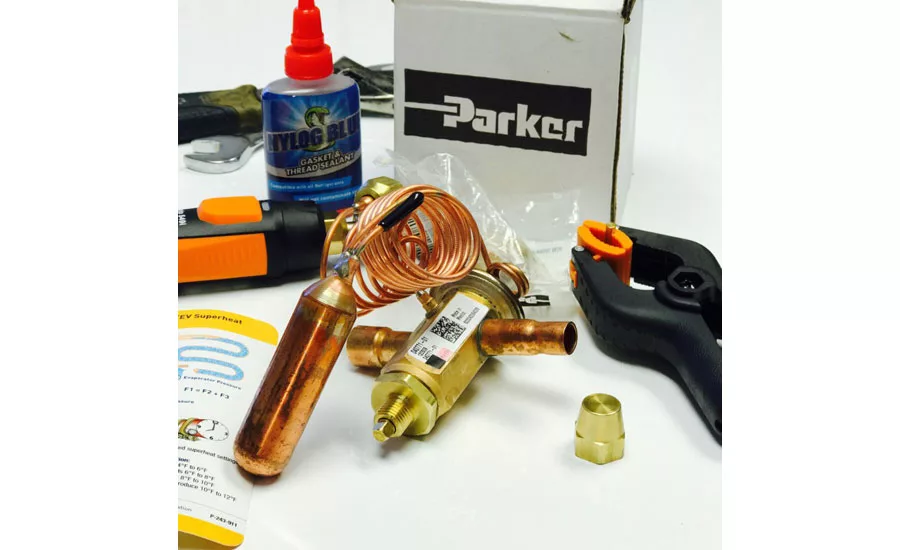
As I've talked about before, a TXV is designed to maintain a specified and constant superheat at the outlet of the evaporator coil. It does this through a balance of forces between the bulb pressure (opening force), equalizer pressure (closing force), and spring (closing force). It is the spring pressure that can be adjusted on some valves, but why and when would this be done?

For the quick, cut to the chase version, turning the adjustment on the bottom of an adjustable valve clockwise equals higher superheat while turning it counterclockwise equals lower superheat. However, before you start messing with the adjustment, I suggest you read on.

First, the valve must be an adjustable type. Many valves on small equipment are not adjustable and have no hex cap at the base.

Here are some other items you need to consider first.

PROPER SUBCOOL

Before an expansion valve can function properly and do its job, it must have a full line of properly subcooled liquid refrigerant all the way to the inlet. On a split system, checking the subcooling at the condensing unit is a good start but you also need to make sure there isn’t a significant temperature drop all the way up the expansion valve inlet. Keep in mind that some valves have a screen right at the valve inlet, so a restriction even at that point will cause operational issues.

REQUIRED PRESSURE DROP  

For an expansion valve to function there needs to be a significant pressure differential between the evaporator design pressure and the liquid pressure entering the expansion valve (In many cases 100 PSIG +). During cooler times of the year, the outdoor condensing pressure/temperature may drop to the point that the required difference in pressure may not exist, and in these cases, the valve may no longer be able to maintain the target superheat. While low ambient controls may be employed to rectify the issue in some cases, in many cases, you must simply be aware that the valve will not function as expected.

IMPROPER BULB PLACEMENT 

Ensure that the bulb is mounted on the suction line flat and tight with a proper strap. It is never a bad idea to insulate the bulb. Anytime it is exposed to ambient air, it is a necessity.

Looking for quick answers on air conditioning, heating and refrigeration topics? Try Ask ACHR NEWS, our new smart AI search tool. Ask ACHR NEWS →

WHEN TO CONSIDER ADJUSTMENT 

Now you are at the point where you can consider whether the valve could use some adjustment. First, read your superheat right at the evaporator outlet in the same general location as the TXV bulb and equalizer. In most cases ,the superheat at that point should be 5-8 degrees, but refer to manufacturers specs when in doubt. In some cases, you will not have a pressure port at the evaporator, so you must rely on a pressure reading outside. Use common sense when assessing the situation and realize that there may be some pressure drop on a 100 foot line set and there should be very little in a 10 foot line set. Make some allowance according to the situation.

If the system is running very low or very high suction pressure and /or superheat readings are way out of range, it is very unlikely that adjusting the valve will remedy it. Usually, valve adjustments are only for small superheat changes up or down.

THE FORCES AT PLAY

The bulb pressure is the opening force of the valve, so when the bulb is warmer, it exerts more opening force resulting in a more “open” orifice. And, when it’s cooler, it exerts less opening force resulting in a more “closed” orifice.

The equalizer is a closing force, so the higher the suction line pressure, the more the valve is forced closed while the lower the suction line pressure the more the valve is forced open.

The spring is also a closing force and on an adjustable valve increasing the spring tension/force results in lower flow and higher superheat, decreasing the spring tension/force results in more flow and lower superheat. In short, counterclockwise equals lower superheat, clockwise equals higher superheat.

MAKING AN ADJUSTMENT

Before you adjust anything, the system must have been running for a good long while, and you have observed that the superheat has stabilized. You must then check the entire system and surmise that everything else is functional — that the valve is being provided with a fully liquid, properly subcooled, high enough pressure feed of refrigerant. If at that point you find it is out of range, then you can make adjustments by following these steps:

  • Carefully remove the hex cap from the base of the valve with a properly sized wrench and a backing wrench exposing the adjustment screw;
  • Turn 1/2 turn at a time clockwise to increase superheat or counter-clockwise to decrease superheat;
  • After a 1/2 turn adjustment, replace the panels and allow the system to run and stabilize;
  • Recheck the superheat and not the change; and
  • Repeat as needed until the maximum setting is reached. Never force the adjustment screw too far, it should require minimal force to turn other than possibly initially to “unstick” the screw.

Adjusting a TXV / TEV is an advanced skill for a technician who has a good grasp on their readings and the forces at play. Tread carefully.

Publication date: 7/23/2018

Want more HVAC industry news and information? Join The NEWS on Facebook, Twitter, and LinkedIn today!

KEYWORDS: superheat and subcooling TXV (thermostatic expansion valve)

Share This Story

Looking for a reprint of this article?
From high-res PDFs to custom plaques, order your copy today!


Podcast studio

Bryan Orr is the vice president at Kalos Services Inc. and founder of the HVAC School. 

Recommended Content

JOIN TODAY
To unlock your recommendations.

Already have an account? Sign In

  • HVAC-enrollment

    The Trades Are Back: HVACR Programs See Nearly 30% Enrollment Spike

    A new wave of future technicians is entering the pipeline.  
    Training and Education
    By: Matt Jachman
  • 2025 Top 40 Under 40

    2025 Top 40 Under 40 HVACR Professionals List

    The 11th annual Top 40 Under 40 list highlights those...
    HVAC Commercial Market
    By: Hannah Belloli-Oster
  • LG Ductless Mini-Split Systems

    The 9 Types of Heat Pumps

    As the U.S. moves toward electrification, heat pumps are...
    Heat Pumps
    By: Joanna R. Turpin
Subscription Center
  • Create an Account
  • Start a Subscription
  • Manage My Account
  • Sign Up for Newsletters
  • Visit Customer Service
  • Update Preferences

More Videos

Sponsored Content

Sponsored Content is a special paid section where industry companies provide high quality, objective, non-commercial content around topics of interest to The News audience. All Sponsored Content is supplied by the advertising company and any opinions expressed in this article are those of the author and not necessarily reflect the views of The News or its parent company, BNP Media. Interested in participating in our Sponsored Content section? Contact your local rep!

close
  • Piggy Bank
    Sponsored byWatercress Financial

    Energy Prices, Inflation, and HVAC: What Today’s Homeowners Care About

  • Refrigerated Food
    Sponsored bySolstice Advanced Materials

    R-455A Refrigeration: A Cold Storage Solution for the Future

  • Airex Rooftop Units
    Sponsored byAirex Manufacturing Inc

    Consolidating Roof Penetrations: A Growing Trend in Multifamily HVAC Design

Popular Stories

HVAC-Price-Increase-graphic

HVAC Price Increase List: July 2026

price-raising-practices.jpg

Rising Costs Force Contractors to Take a Harder Look at Pricing

DOE-sign.jpg

HVAC Groups Support DOE’s Rulemaking to Cut Energy Efficiency Mandates

Tradeswomen on the job

Celebrating the Women Shaping HVACR’s Future

Industry-Ethics_-Service-Calls.jpg

HVAC Contractor Agrees to $300K Settlement Over Alleged Deceptive Sales Practices

View The ACHR NEWS
Centennial Anniversary Timeline

The ACHR News Timeline Chart
Submit a Letter
Submit a letter to our editors.

Events

November 6, 2025

Next-Gen Data Center Cooling: HVAC Innovation and Real-World Solutions

On Demand As AI workloads and high-density computing push traditional cooling methods to their limits, the data center industry is accelerating the adoption of next-generation HVAC technologies.

July 22, 2026

Designing VRF Systems Using A2L Refrigerant

In this session, we will cover how to design VRF systems for the U.S. market using new A2L refrigerants. These systems provide an advanced zoning solution by using inverter technology to deliver precise heating and cooling control across multiple zones and spaces.

View All Submit An Event

Poll

Summer Staff

Are you fully staffed for the summer season?
View Results Poll Archive

Products

BNI Mechanical/Electrical Square Foot Costbook, 2026 Edition

BNI Mechanical/Electrical Square Foot Costbook, 2026 Edition

See More Products
Designing Systems Using A2L Refrigerant - Free Webinar - 7/22/2026

Related Articles

  • Blower Speed Adjustments

    How to Adjust Blower Speeds Using Fan Law Two

    See More
  • Trucking, Shifting Expectations Drive HVACR Distributors to Adjust - The ACHR News

    Trucking, Shifting Expectations Drive HVACR Distributors to Adjust

    See More
  • Web Exclusive

    How to Diagnose a Thermostatic Expansion Valve Failure

    See More

Related Products

See More Products
  • front cover only.jpg

    How to Market Your HVAC Business

  • Understanding TXV Refrigeration Systems: Superheat and Subcooling DVD

  • The ACHR News - December 15 2025

    ACHR NEWS December 15, 2025, Issue

See More Products

Related Directories

  • Howe Corp.

    Howe manufactures flake ice making equipment for use with virtually any refrigerant including natural such as R-744, and R-717, Ice storage bins, Condensing units for our ice flakers.
  • A to Z Sales & Marketing

    We strive to revolutionize indoor living through innovative solutions that improve air quality, enhance comfort, and promote sustainable living for people around the world.
  • Alliance to Save Energy

    Coalition of business, government, environmental, consumer leaders promoting the efficient and clean use of energy worldwide to benefit consumers, the environment, the economy, national security.
×

Sign Up. Stay Informed.

The #1 trusted source for the HVACR industry since 1926

SUBSCRIBE
  • RESOURCES
    • Advertise
    • Contact Us
    • Advisory Board
    • Classifieds
    • Submit a Letter
    • Directories
    • Store
  • ACCOUNT CENTER
    • Create an Account
    • Start a Subscription
    • Manage My Account
    • Sign Up for Newsletters
    • Visit Customer Service
    • Update Preferences
  • SERVICES
    • Marketing Services
    • Reprints
    • Market Research
    • List Rental
    • Survey/Respondent Access
  • STAY CONNECTED
    • LinkedIn
    • Facebook
    • Instagram
    • YouTube
    • X (Twitter)
  • PRIVACY
    • PRIVACY POLICY
    • TERMS & CONDITIONS
    • DO NOT SELL MY PERSONAL INFORMATION
    • PRIVACY REQUEST
    • ACCESSIBILITY

Copyright ©2026. All Rights Reserved BNP Media, Inc. and BNP Media II, LLC.

Design, CMS, Hosting & Web Development :: ePublishing