A Little TLC Can Extend the Life of Condensing Units
Regular maintenance helps maximize equipment longevity and ensure optimal performance
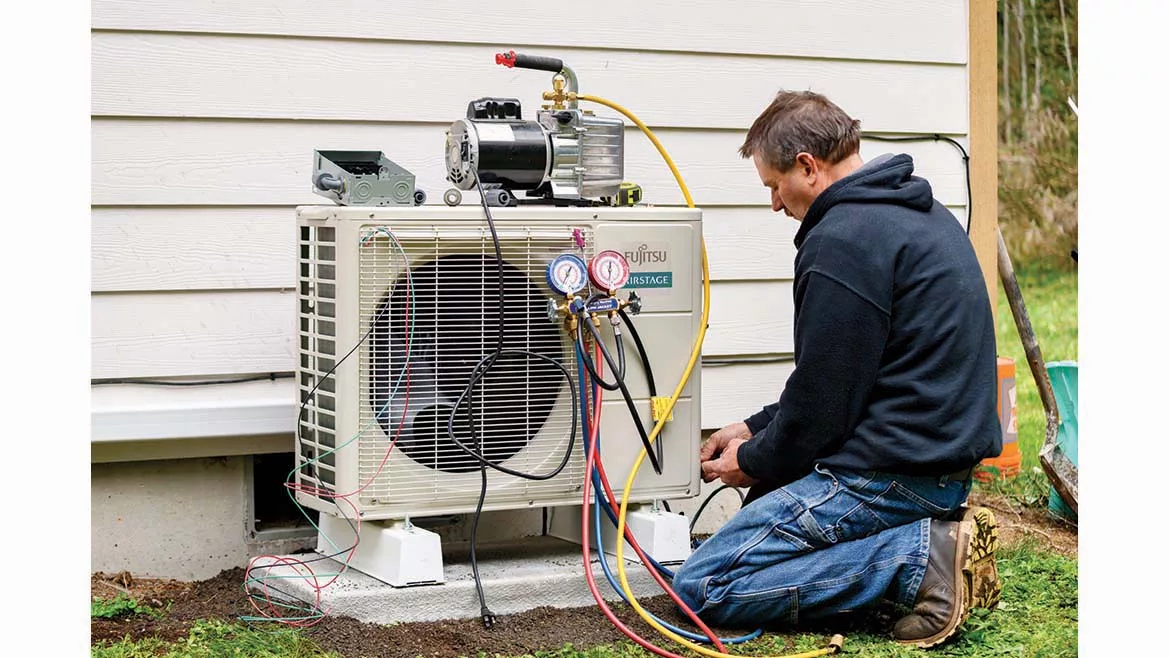
In the current economic climate, end users are becoming increasingly cost-conscious, prompting a shift in the way they approach their HVAC systems. Rather than opting to replace their systems, many customers are trying to extend the lifespan of their existing units through regular maintenance and repairs.
As a result, maintaining condensing units is more crucial than ever. Proper upkeep not only helps customers maximize their equipment's longevity, but also ensures optimal performance, providing a win-win situation for both the client and the contractor.
Scheduled Maintenance
To ensure a residential cooling system operates correctly, Bud Link, lead senior technical service advisor at Nortek, recommends that preventive maintenance be performed at least once a season. “By doing this, the homeowner can have peace of mind that they will avoid unnecessarily high utility bills, lack of cooling when they need it most, and avoid damage to the compressor or fan motor that can be detrimental to the lifespan of the system,” he said.
Twice-a-year maintenance may be even better, said Josh Barr, director of technical services at Daikin Comfort Technologies North America Inc., once prior to heating season and another prior to cooling season. He added that light commercial applications might require quarterly maintenance, depending on the environment in which the systems are installed.
In either case, if regular maintenance is neglected, reduced system efficiency might occur, said Barr.
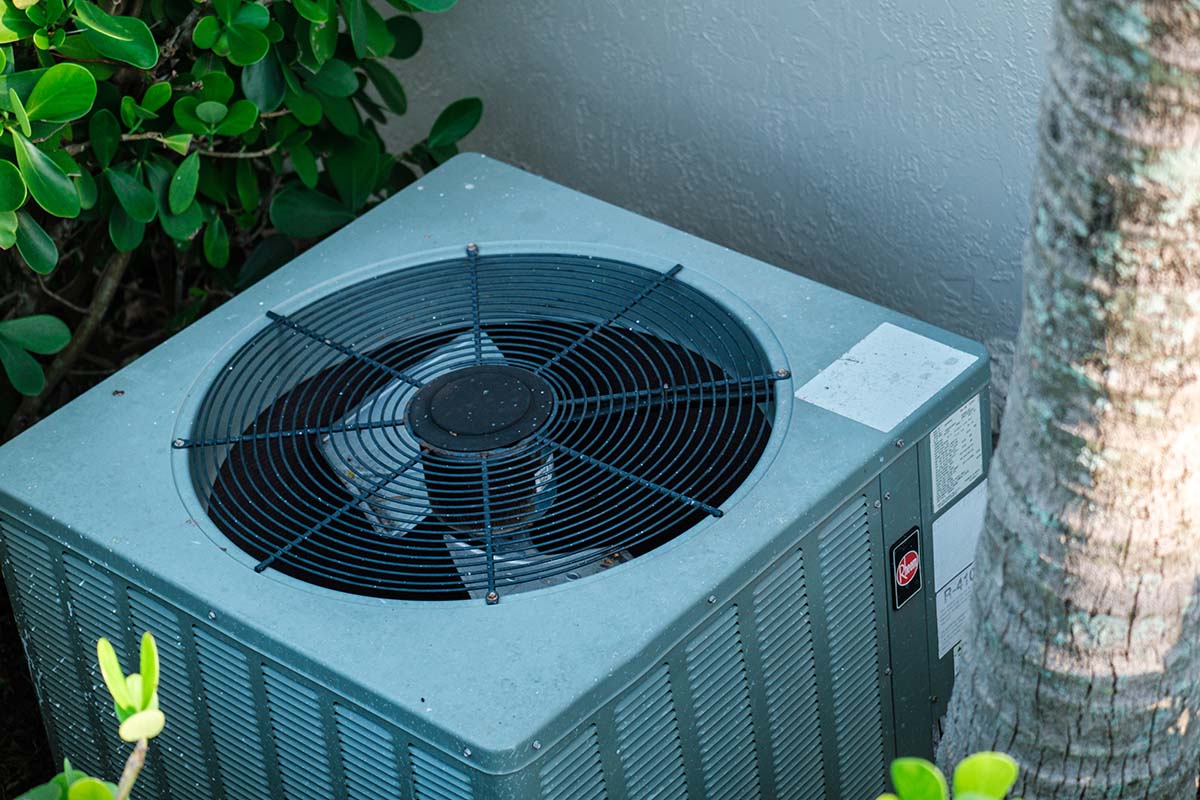
SYSTEM EFFICIENCY: If condensing unit maintenance is neglected, it could cause reduce the efficiency of the system. (Courtesy of Rheem)
“Dirty heat exchangers and filters can force the system to consume more power to maintain desired space temperature. Also, these added power requirements can put major components such as the compressor under unnecessary strain and reduce the lifespan of the equipment,” he said.
Technicians conducting maintenance on condensing units should begin with a general inspection of the condition of the outdoor unit, said Barr, which includes checking for rust, dirt, and obstructions both inside and outside of the condensing unit. He added that it’s common to find underperforming outdoor condensing units due to leaves and other materials that have been sucked into the condensing coil and become caught between the coil guard and coil.
Looking for quick answers on air conditioning, heating and refrigeration topics? Try Ask ACHR NEWS, our new smart AI search tool. Ask ACHR NEWS
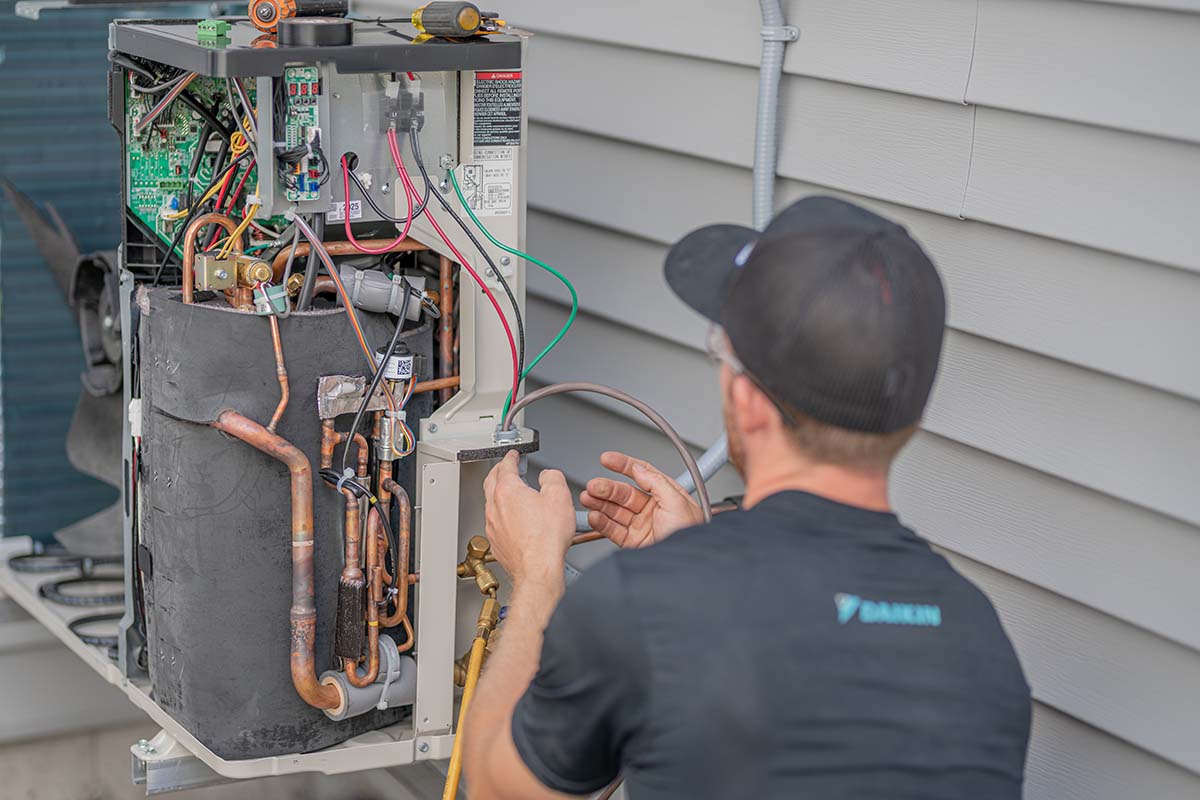
GENERAL INSPECTION: Technicians conducting maintenance on condensing units should begin with a general inspection of the condition of the unit. (Courtesy of Daikin)
“Once all visible debris is removed, spray the coils with water, from both the inside and outside, which will help remove the small dirt and debris between the coil fins,” said Barr. “Visually inspect the condenser fins and use an appropriate fin comb to improve any fins that are damaged or bent.”
Once the outdoor coil is meticulously cleaned, technicians should inspect the contactors for signs of damage such as pitting or burning, which could harm the compressor, said Jose De La Portilla, senior manager of education and training at Rheem Mfg. If pitted or burned, they should be replaced. Wires should also be checked and tightened, he noted, to prevent potential heat buildup that can damage the wiring system.
Technicians should then thoroughly examine the condenser fan motor for oil stains around the shaft, which indicate potential leaks from the bearing that could lead to motor failure, said De La Portilla.
“Technicians should also manually spin the fan blade to detect any irregularities in rotation, which may indicate wear on the motor,” he said. “In addition, control components within the outdoor unit need to be cleaned to remove any dirt, dust, debris, or cobwebs, with special attention paid to potential pest ingress points to prevent electrical component damage.”
Inspecting the unit for oil leaks around the condenser coil, fittings, and service valves is also essential, noted De La Portilla, and if service valve caps are missing, they should be replaced to prevent gasket leaks in Schrader valves.
“Technicians must also check and tighten Schrader cores if necessary to prevent refrigerant leaks. Capacitors within the unit should be tested for proper functioning, as weak or failing capacitors can lead to system breakdowns.”
It is also important for technicians to check the compressor amperage, as this will let them know whether or not the compressor is running at full capacity, said Ruben Marcucci, senior director of aftermarket at Fujitsu General America.
“Pressure gauge tests will also alert the technician whether the system is working efficiently, or if the system is lacking refrigerant.”
To determine the overall condition and performance of the system, Link noted that technicians should also check liquid and suction pressures; superheat and subcooling; voltage and amperage; temperature differential across the indoor coil; indoor airflow; dirty filters; and verify that blower speed settings are correct.
Wear and Tear
Even if a condensing unit is properly maintained, certain components will wear out over time and have to be replaced. According to Marcucci, these can include air filters on ductless systems, refrigerant pipe insulation, power contactors, and capacitors.
In fact, one of the top failures in the summertime is the capacitor, said Link.
“Technicians can use a meter to check the capacitor(s) for proper microfarad readings. They should also look for any swelling of the capacitor and replace if necessary. Fan motors and contactors are also prone to wear and tear. Early detection of problems can be found by checking the fan motor, blade, and set screw for any damage or loose components and making adjustments as needed.”
Barr added that technicians should look for visible signs of wear and damage in the condensing unit, such as pipes or wiring rubbing against copper, imbalanced fan blades, or abnormal sounds. “Testing the component against the manufacturer’s published service criteria is the best method to determine if the component is strong or failing,” he said. “A replacement may be considered if a system runs all day long to maintain space temperature, which means that the system efficiency is no longer adequate, or if the outdoor unit fails to start.”
Another sign that a condensing unit might need to be replaced is if the breaker repeatedly trips, which could indicate a shorted or grounded compressor, said Link. This can be verified with an ohmmeter.
“Other signs that could indicate a replacement is needed is an excessively noisy compressor, which could indicate internal damage,” he said. “Check the system pressures, superheat, subcooling, supply and return temperatures, voltage, and amperage for signs of problems with the compressor or other possible causes. The condenser coil could also be damaged or leaking, which may require a costly repair or replacement if it can’t be repaired.”
If considering a replacement, the age of the condensing unit comes into play, said De La Portilla, who added that the national average lifespan of a system is about 10 to 15 years.
“There may be some visual indicators like corrosion attacking the outdoor unit, causing aluminum fins to fall apart, which would also reduce heat transfer,” he said. “However, that is still not a guarantee that the condensing unit should be replaced. Depending on the age and overall conditions, sometimes the coil itself can be replaced without changing the entire unit, and it must be evaluated before determining if a condensing unit needs to be replaced.”
Lead senior technical service advisor
Nortek
Replacement
If replacement is necessary, contractors should understand that it may be more difficult to find an R-410A condensing unit in the near future, given the transition to A2L refrigerants such as R-32 and R-454B. As part of the AIM Act, new R-410A systems will no longer be manufactured after December 31, 2024, however, as De La Portilla noted, there is a provision in the final rule that allows manufacturers to continue to make R-410A condensing units and sell them as a service component.
“This means that manufacturers won’t sell the entire system, but the condensing unit can be sold to replace one that failed without needing to replace the entire system,” he said. “Likewise, if the indoor coil fails, manufacturers can sell one as a service part for a repair versus replacing an entire system.”
Ultimately, it’s up to manufacturers to decide whether or not they plan to continue producing R-410A condensing units in the future. Although EPA regulations allow the continued manufacturing of these units for service purposes after January 1, 2025, Link believes it is unlikely that most OEMs will continue manufacturing this equipment after that date.
“The DOE has addressed this in a recently published notification of proposed rule on the test procedure for central air conditioners and heat pumps,” he said. “DOE has clarified that it will only certify R-410A split systems after January 1, 2025, through a procedure known as ‘outdoor unit with no match’ (OUWNM). This pathway to certification severely restricts the size of the indoor coil that is permitted to be rated with split-system air conditioners and heat pumps. The practical outcome of this clarification is that it is extremely likely that most, if not all, manufacturers will cease the manufacturing of R-410A split-system condensing units by January 1, 2025.”
Looking for a reprint of this article?
From high-res PDFs to custom plaques, order your copy today!