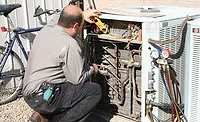
Why Air Conditioning Systems Freeze and How to Fix Them
Understanding the basics will help your service team

Let’s start with the basics.
Water freezes at 32° F at sea level and atmospheric pressure. When any surface is below that temperature, and the air around it contains moisture, ice/frost will begin to form. In some situations, ice is to be expected, such as in refrigeration evaporators and exposed portions of the refrigeration suction line and the metering device outlet in refrigeration applications. Frost and freezing are also likely in heat pumps operating in heat mode. The outdoor coil on a heat pump becomes the evaporator coil, and during low outdoor ambient conditions, it is expected that the outdoor coil will eventually freeze and require defrost.
The reason that frost/ice is inevitable in some applications is due to the laws of thermodynamics (moving heat). To get heat from one place to another, you need to have a difference in temperature. So inside of a freezer where you hope to get the box temperature to 0°F, the coil temperature needs to be below 0° to transfer heat out of the freezer and into the coil and then down the suction line to the compressor. If you have a freezer with a design coil temperature difference of 10° and a design superheat of 8°, the coil will be at -10°F and the suction temperature at the evaporator outlet will be -2°F.
On a heat pump running in heat mode, you will commonly find an evaporator (outdoor coil) that runs 20° – 30° colder than the outdoor temperature. This means that if it is 30° outside, the outdoor coil temperature could easily be 0°F. In these cases, ice is normal and periodic defrost is expected and required.
Some systems we work on and install will freeze. Air conditioning is not one of them.
In an air conditioning system, we must keep the evaporator temperature above 32°F. We can easily know the evaporator temperature by looking at our suction saturation temperature (suction gauge temperature for the particular refrigerant). For R-22, 32° is 57.73 PSIG at sea level, R-410a is 101.58 PSIG, and R-407C is 67.80 PSIG. If we don’t keep our evaporator coils above these coil pressures/temperatures, the system will freeze. The rate at which it will freeze is a function of:
- Time: The longer it runs at or below 32°, the more frost/ice will build.
- Moisture: The more humidity the air contains as it passes over the coil.
- Temperature Difference: The colder the coil, the faster ice will build.
- Air Velocity / Dwell Time: The faster the air moves over the coil, the slower ice will build, and the slower it moves, the quicker it will build.
- Coil Design: Closer fins will freeze faster
The ice buildup always starts in the evaporator and works its way outside. If you have a frozen compressor, you have a frozen evaporator. When you find a frozen system, take your time and get it fully defrosted. Take care to manage the ice melt water and keep it away from motors and boards where it can cause damage and a shock hazard. Some towels and a shop vac are great to have handy when defrosting a unit. When possible allow it to defrost slowly and naturally to prevent damage.
So what circumstances can result in low coil temperature?
Looking for quick answers on air conditioning, heating and refrigeration topics? Try Ask ACHR NEWS, our new smart AI search tool. Ask ACHR NEWS
Low Evaporator Load
Low load is often equated with low airflow, and it usually is low airflow, but there is a bit more to the story than that.
An air conditioning system has one final design result, one big end goal that we are shooting for: Matching the refrigeration effect to the evaporator load.
We must match the quantity of refrigerant moving through the evaporator coil to the amount of heat the evaporator coil is absorbing.
That is our mission, and that is the primary reason we measure superheat. Superheat gives us a look at how well we are matching refrigerant flow to heat load. High superheat means underfeeding; low superheat means overfeeding.
There is an issue though. We could have a correct superheat and still have a coil temperature of under 32°, and this is not acceptable in an air conditioning system. When the coil absorbs less heat than designed, the coil temperature and suction pressure drop. In cases where a TXV or EEV is controlling suction superheat, the suction pressure will drop even further as the valve attempts to keep the superheat from plummeting.
This is why we must size a system and its ductwork appropriately for one another, as well as for the space, climate, and even altitude. If we install a system that requires 1200 CFM of airflow to properly balance the refrigeration effect to the load at 75° design indoor temperature and that system is only receiving 900 CFM of airflow, you run an excellent likelihood of freezing. This is especially true when the outdoor temperature drops or the customer decides to drop the thermostat lower than usual.
Low load is often due to low airflow, low indoor ambient conditions, and equipment oversizing. Low load conditions will have symptoms of low suction pressure, low superheat, low head, and high evaporator Delta T. Start by looking for the obvious, dirty coils, dirty filters, dirty blower wheels, blocked returns, mismatched equipment, improper blower settings, closed registers, and undersized ducts. You can then move on to performing static pressure tests to locate more difficult issues.
Low load is the most common cause of persistent freezing and should be top of mind when a technician is diagnosing a freezing system
Low Refrigerant In the Evaporator
System undercharge or underfeeding due to restricted refrigerant flow (restricted filter driers, plugged screens, failed expansion valves, or undersized pistons) can also result in freezing over time. Low refrigerant can result in fewer molecules of refrigerant in the evaporator coil, which results in lower coil pressure because the coil contains both saturated liquid at the beginning of the coil as well as superheated vapor towards the end. This type of freezing requires time because less refrigerant in the coil equals less refrigeration (cooling) effect.
If the coil temperature is below 32° in an undercharged situation, the coil will simultaneously build frost as the beginning of the coil after the metering device and underfeed the coil resulting in high superheat. Over time as the frost builds, it will start to block the opening of the coil which blocks airflow and insulates that portion of the coil from airflow which reduces the coil load. Eventually, once the coil is blocked with frost, almost all of the load is removed from the coil and you have a low refrigerant issue that led to a low load issue that resulted in a complete freeze up.
Once you defrost the system and test, you will find that low refrigerant charge conditions result in low suction, low subcool, high superheat, and low head pressure. Refrigerant restrictions will be low suction, high superheat, high subcooling.
Often once you resolve the charge issue, you may also find another low load issue as well that contributed to the freezing. In many cases when low charge is the cause, the customer will notice the issue before the system is frozen solid.
Low refrigerant will often result in a partially frozen coil more than a full block of ice. Remember, low coil refrigerant can be restriction related or low charge, but if it’s low charge you will have low subcooling, and if restriction it will have high subcooling.
Low Outdoor Ambient
When a cooling system is operated during low outdoor temperatures the condensing temperature and head pressure will drop. If the head pressure drops low enough the suction pressure will also drop, resulting in freezing. The only way to resolve this cause is to install some type of head pressure control, such as fan cycling or fan speed control, to keep the head pressure from dropping significantly.
Blower Issues
If the indoor blower shuts off, the coil temperature will drop. Sometimes a blower motor will have internal issues or controls issues that cause it to shut off periodically. This can cause intermittent freezing that can be hard to diagnose. Checking controls, belts, blower amperage, bearings, and motor temperature can all help in diagnosing these issues. Sometimes leaving an amperage data logger on the motor along with a coil or supply air temperature sensor can give you the ammunition you need to pinpoint an intermittent issue.
When diagnosing a freezing situation don’t jump to conclusions, get all the ice defrosted before making a diagnosis and keep a sharp eye out for airflow and design issues. Freezing is often due to more than one issue combined that act to turn your customer’s air conditioner into an ice machine.
Looking for a reprint of this article?
From high-res PDFs to custom plaques, order your copy today!