ACHR News
search
Ask ACHR NEWS AI
cart
facebook twitter instagram linkedin youtube
  • Sign In
  • Subscribe
  • Sign Out
  • My Account
ACHR News
  • NEWS
    • Breaking News
    • New HVAC Products
    • Featured Products
    • Manufacturer Reports
    • HVAC Data
    • Legislation
    • ACHR NEWS Centennial
  • RESIDENTIAL
    • Air Conditioners
    • Furnaces
    • Residential Heat Pumps
    • Ductless
    • Residential IAQ
    • Testing, Monitoring, Tools
    • Components & Accessories
  • COMMERCIAL
    • Air Handlers
    • Rooftop Units
    • Chillers and Cooling Towers
    • Commercial Heat Pumps
    • Boilers and Hydronics
    • VRF/Ductless
    • Commercial IAQ
  • REFRIGERATION
    • Refrigerants
    • Refrigerant Regulations
    • Leak Management
  • CONTRACTOR PRO
    • Geothermal
    • Homeowner Study
    • VRF and VRV Ductless
    • Unitary Trends
  • EDUCATION
    • Training and Education
    • Business Management
    • Service and Maintenance
    • Continuing Education
    • Market Research >
      • HVAC Brand Awareness Report
      • VRV, VRF, VRVZ Report
      • Unitary Trends Report
      • Water Heat Professionals Report
    • Webinars
    • Sponsor Insights
    • eProducts Info
    • White Papers
  • EVENTS
    • HVAC Contractor Forum
    • Industry Events and Webinars
  • MEDIA
    • Videos
    • AHR Expo 2025 Videos
    • Podcasts >
      • ACHR News Podcast
      • HARDI Podcasts
      • AHR Expo Podcasts
      • ACCA Podcasts
    • Interactive Spotlights
    • Quizzes
    • eBooks
    • HVAC Talkback
  • HVAC GROUP
    • ACHR NEWS >
      • Current Issue
      • Digital Edition
      • Subscribe
    • Distribution Trends
    • SNIPS NEWS >
      • Join SNIPS NEWS
    • Engineered Systems News >
      • Join ES News
    • HVACR Directory
    • Contests
    • Newsletters
    • Contact
    • Advertise
    • My Account
NewsService and MaintenanceVentilationDuct Products

One Simple Test to Discover Restrictive Duct Systems

Duct systems are a critical system is often overlooked

By David Richardson
Restrictive Duct System Test
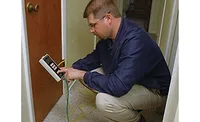
You can confirm a restrictive duct system in less than 30 seconds with a single pressure test.
August 18, 2020

It’s tough to talk with a customer about the poor shape of their duct system. Unfortunately, it’s the part of an HVAC system that most homeowners don’t consider, yet it determines how well their equipment works.

What if there were a quick and simple test that made this conversation easier? What if it can also help you discover airflow issues before you inherit them? Interested? Let’s look at a duct pressure test that can get you and your customers on the same page regarding their duct system and its importance.

READ MORE ABOUT

• Ductwork

• Duct Testing

• Service & Maintenance


Test Instruments and Accessories

Before you can measure duct pressures, you need a pressure testing kit that includes:

  • Manometer — analog or digital
  • Static pressure tips and tubing — neoprene or silicone
  • 3/8-inch test port plugs
  • Small drill/impact gun with a step bit or 3/8-inch drill bit with a sheath/stop
  • Scratch awl — for cleaning out internal duct liner/insulation
  • Carrying case for all your goodies.

You can typically put together a complete kit for around $200. Don’t skip on purchasing any of these items; they each have a purpose.


Find the Maximum Rated TESP

Before you begin to use your test instruments, find the air handling equipment nameplate. It has important information you’ll need. Air handler and package unit nameplates are often on the blower panel. You’ll have to look a little harder for a gas furnace nameplate. It’s inside the burner compartment.

Each nameplate has a maximum rated total external static pressure (TESP). The standard rating for most residential systems is .50 inches w.c. (inches of water column). However, other pressure ratings range from .30 up to 1.0, so look carefully.

Once you locate this rating, write it down. You will soon need it to determine a number to compare your measured duct pressures against.


Install Duct System Test Ports

Next, you need to install test ports in the return and supply ducts. The most common locations are in the return and supply plenums where air enters and exits the equipment.

Looking for quick answers on air conditioning, heating and refrigeration topics? Try Ask ACHR NEWS, our new smart AI search tool. Ask ACHR NEWS →

Once you locate suitable test sites, drill a 3/8-inch hole into the supply and return plenums. When testing metal duct systems, use a drill bit with a stop to prevent it from penetrating too far into the duct. If you test fiberglass duct board, you can use a scratch awl to install the test ports. If possible, measure at least 2 feet away from the fan discharge to avoid turbulence and inaccurate pressures.

Whenever you do a duct pressure test, I recommend you use the phrase “installing test ports.” Don’t tell a homeowner you plan to drill holes in their system. Despite your best intentions, they don’t want you to drill holes in their HVAC system. It might not seem like much, but that slight phrase change can make a big difference.


Measure Duct System Pressures

Now it’s time to measure duct pressures. Connect one end of the pressure tubing to the static pressure tip. Next, connect the opposite end of the tubing to the manometer port.

Know your manometer. Some styles have a negative (-) and positive (+) port that affects where your hose connects. Supply ducts are positive pressure, while return ducts are negative. If you use an analog manometer, place it on a level surface and adjust it to zero before you take any measurements.

Next, adjust the thermostat so the blower runs on its highest speed. Insert the static pressure tip into the return duct test port and record the pressure reading from your manometer. Remove the static pressure tip from the return duct and insert it into the supply duct test port. Record the supply duct pressure reading from the manometer.

Let’s say you test a gas furnace and condensing unit. You measure duct pressures and record .30 inches w.c. in the return duct and .07 inches w.c. in the supply duct. At first glance, these pressures don’t mean a lot. However, once you have a number to compare them against, they reveal much more.


Diagnose Duct System Pressures

Once you measure duct system pressures, you can compare them to something called a pressure budget. Pressure budgets help you find out how restrictive the ducts are to airflow. Remember the maximum rated TESP that you wrote down earlier? Use that number to create your duct system pressure budgets.

Here is how they work: NCI has found that well-performing duct systems often run less than 40 percent of the air handling equipment’s maximum rated TESP. Since there are two sides to a duct system (return and supply) you need to divide this pressure in half. As a result, the return duct pressure shouldn’t exceed 20 percent of the maximum rated TESP. Also, the supply duct pressure shouldn’t exceed 20 percent of the maximum rated TESP.

As an example, let’s say the nameplate rating is .50 inches w.c. To get your return duct and supply duct pressure budgets, multiply .50 times 20 percent (.50 x 20 percent = .10). Use this target to compare against your duct pressure measurements. Ideally, you don’t want your return or supply duct pressures to exceed .10. The side of the duct system that exceeds this pressure the most is where the greatest airflow restrictions hide.

Since you already have duct pressure measurements from the previous step, you can see the most restrictive side of the duct system. The return duct pressure was .30 inches w.c. and supply duct pressure was .07 inches w.c. When you compare these readings to the .10 inches w.c. pressure budget, you can see the return duct pressure is three times higher.

As you investigate, you will find restrictions somewhere in the return duct system. Look for sharp duct fittings, poorly installed flexible ducts, undersized return ducts, or something blocking off the floor return grille.

You also can see that the supply duct pressures are lower than .10 inches w.c. You may think that’s a great sign. It might be. However, keep looking to be sure.


Low Duct System Pressures

When duct pressures look too good to be true, they probably are — especially if one side of the duct system is in terrible shape. When you encounter low pressure on one side of the duct system, check for duct leakage and/or disconnected ducts.

You will also encounter times when both sides of the duct system have low duct pressures. If you find this, perform a visual equipment inspection. A dirty blower wheel moves less airflow and leads to reduced pressures.

Another source of low duct pressure is when a variable-speed air handler runs in the “fan on” position. The blower operates at approximately 50 percent of programmed airflow in this position. Once the fan ramps up to 100 percent airflow, duct pressures increase.


Keep Duct Pressures in Context

While duct pressures are a simple way to identify duct restrictions, they have limitations. One drawback is how they react to changes in airflow. As airflow decreases, so will the duct pressures. This is one reason it’s a good idea to gather additional pressure readings if you’re in doubt.

Sometimes you need to incorporate additional tests to further diagnose airflow problems. However, duct pressures are a great first step to look beyond the equipment. Remember, the duct system determines true HVAC system efficiency. Duct pressures give you a small glimpse into how much of an impact they truly have.

KEYWORDS: diagnostics for HVACR Duct Dynasty duct testing ductwork troubleshooting and HVACR

Share This Story

Looking for a reprint of this article?
From high-res PDFs to custom plaques, order your copy today!


David richardson
David Richardson serves the HVAC industry as Vice President of Training for National Comfort Institute, Inc. (NCI). NCI specializes in training focused on improving, measuring, and verifying HVAC and Building Performance. If you’re an HVAC contractor or technician interested in learning more about building science applied to HVAC, contact David at ncilink.com/ContactMe.

Recommended Content

JOIN TODAY
To unlock your recommendations.

Already have an account? Sign In

  • HVAC-enrollment

    The Trades Are Back: HVACR Programs See Nearly 30% Enrollment Spike

    A new wave of future technicians is entering the pipeline.  
    News
    By: Matt Jachman
  • 2025 Top 40 Under 40

    2025 Top 40 Under 40 HVACR Professionals List

    The 11th annual Top 40 Under 40 list highlights those...
    HVAC Light Commercial Market
    By: Hannah Belloli-Oster
  • LG Ductless Mini-Split Systems

    The 9 Types of Heat Pumps

    As the U.S. moves toward electrification, heat pumps are...
    News
    By: Joanna R. Turpin
Subscription Center
  • Create an Account
  • Start a Subscription
  • Manage My Account
  • Sign Up for Newsletters
  • Visit Customer Service
  • Update Preferences

More Videos

Sponsored Content

Sponsored Content is a special paid section where industry companies provide high quality, objective, non-commercial content around topics of interest to The News audience. All Sponsored Content is supplied by the advertising company and any opinions expressed in this article are those of the author and not necessarily reflect the views of The News or its parent company, BNP Media. Interested in participating in our Sponsored Content section? Contact your local rep!

close
  • Piggy Bank
    Sponsored byWatercress Financial

    Energy Prices, Inflation, and HVAC: What Today’s Homeowners Care About

  • Refrigerated Food
    Sponsored bySolstice Advanced Materials

    R-455A Refrigeration: A Cold Storage Solution for the Future

  • Airex Rooftop Units
    Sponsored byAirex Manufacturing Inc

    Consolidating Roof Penetrations: A Growing Trend in Multifamily HVAC Design

Popular Stories

Refrigerants-and-gauge.jpg

HVAC Industry Warns of Counterfeit Refrigerants Entering U.S. Supply Chain

U.S. Supreme Court building

95% Furnace Efficiency Rule to Get New Hearing

Midea-training.jpg

HVAC Workforce Crisis Expands Beyond Technicians to Instructor Shortages

Data_Center_facility.jpg

HVAC Manufacturers Respond to Growing Data Center Backlash

HVAC Minute retail refrigeration system

EPA Final Rule’s Impact on R-410A Deadlines

View The ACHR NEWS
Centennial Anniversary Timeline

The ACHR News Timeline Chart
Submit a Letter
Submit a letter to our editors.

Events

November 6, 2025

Next-Gen Data Center Cooling: HVAC Innovation and Real-World Solutions

On Demand As AI workloads and high-density computing push traditional cooling methods to their limits, the data center industry is accelerating the adoption of next-generation HVAC technologies.

June 23, 2026

HVAC Duct Sealing Mastics: Why Selection Matters

In this webinar we will detail what HVAC material buyers and technicians need to know when selecting duct mastics, including matching mastic to substrate, alternatives to liquid mastic, and where UL 181 Listings fit into real world installations.

View All Submit An Event

Poll

Summer Staff

Are you fully staffed for the summer season?
View Results Poll Archive

Products

BNI Mechanical/Electrical Square Foot Costbook, 2026 Edition

BNI Mechanical/Electrical Square Foot Costbook, 2026 Edition

See More Products
HVAC Duct Sealing Mastics: Why Selection Matters - Free Webinar - 6/23/2026

Related Articles

  • Static-pressure-testing

    Static Pressure Test a Building to Expand Your Diagnostics

    See More
  • Mike Agugliaro

    One Simple Way to Make Better, Faster Decisions in Your Business

    See More
  • Confronting Restrictive Air Filters

    Duct Dynasty: Confronting Restrictive Air Filters

    See More

Related Products

See More Products
  • understandingD.jpg

    Understanding Manual D® — Residential Duct Systems

  • 1987.gif

    HVAC Duct Systems Inspection Guide

  • Manual D® - Residential Duct Systems.jpg

    Manual D® - Residential Duct Systems [ANSI/ACCA 1 Manual D - 2016]

See More Products

Related Directories

  • Fabric Duct Systems Inc.

    Engineers and manufacturers Q-SOX brand fabric duct for HVAC/R air distribution. Q-SOX is a proven solution for better Indoor Air Quality (IAQ) and warm or cool air circulation.
×

Sign Up. Stay Informed.

The #1 trusted source for the HVACR industry since 1926

SUBSCRIBE
  • RESOURCES
    • Advertise
    • Contact Us
    • Advisory Board
    • Classifieds
    • Submit a Letter
    • Directories
    • Store
  • ACCOUNT CENTER
    • Create an Account
    • Start a Subscription
    • Manage My Account
    • Sign Up for Newsletters
    • Visit Customer Service
    • Update Preferences
  • SERVICES
    • Marketing Services
    • Reprints
    • Market Research
    • List Rental
    • Survey/Respondent Access
  • STAY CONNECTED
    • LinkedIn
    • Facebook
    • Instagram
    • YouTube
    • X (Twitter)
  • PRIVACY
    • PRIVACY POLICY
    • TERMS & CONDITIONS
    • DO NOT SELL MY PERSONAL INFORMATION
    • PRIVACY REQUEST
    • ACCESSIBILITY

Copyright ©2026. All Rights Reserved BNP Media, Inc. and BNP Media II, LLC.

Design, CMS, Hosting & Web Development :: ePublishing