HVAC Manufacturers Respond to Growing Data Center Backlash
Community protests have delayed $156 billion in data center investments
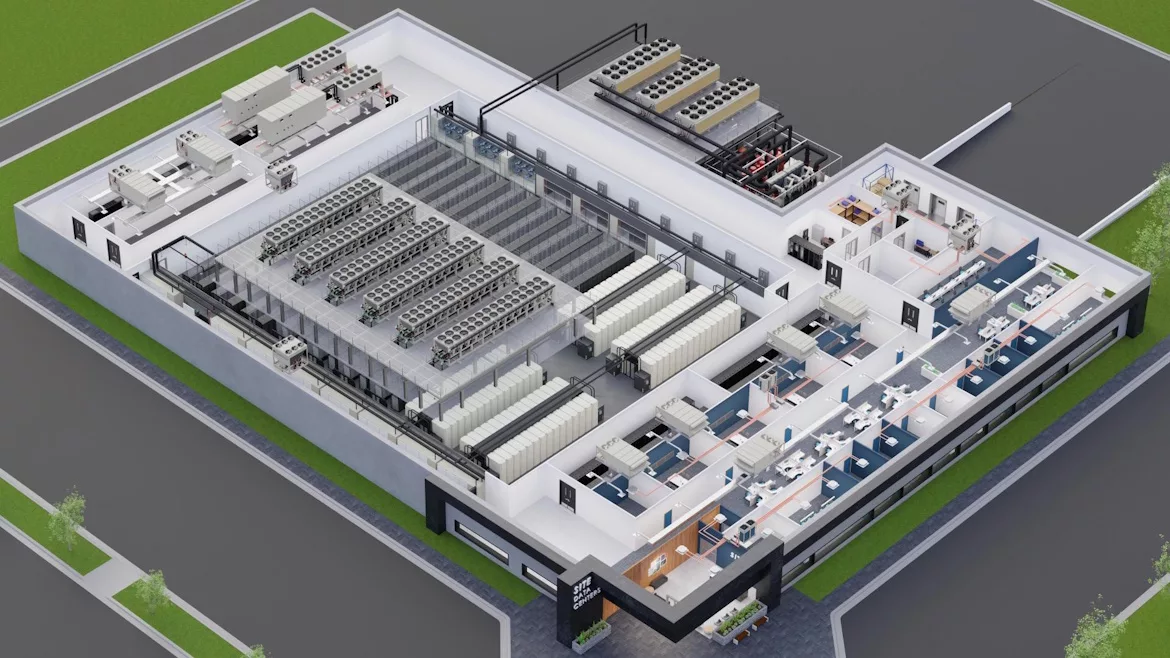
DATA CENTER BACKLASH: HVAC manufacturers are prioritizing efficiency and transparency when responding to public pushback on data centers.
By 2030, data centers could require $6.7 trillion in global infrastructure investment, according to McKinsey & Company. For the HVAC industry, capturing part of that growth means navigating increasing public resistance to data centers over concerns tied to energy use, water consumption, utility costs, and noise.
It’s a delicate balance, and one that major manufacturers are navigating by encouraging transparency, education, and developing new equipment at an accelerated pace.
“The most important thing that the industry and our communities hear is that we're listening, we're innovating at a pace that's far more rapid than we ever have in the past,” said Aaron Lewis, chief commercial officer, global data center solutions at Johnson Controls. “We intend to always provide the most sustainable solutions and be the voice of our communities to our customers.”

BETTING ON DATA CENTERS: The York YK-HT, previewed at the 2026 AHR Expo, is a solution for eliminating water usage when cooling data centers. (Photo by Chris Gray/BNP Media)
Data Center Backlash
Deloitte forecasts AI data center power demand to rise 30-fold, from 4 gigawatts in 2024 to 123 GW by 2035. Inevitably, that means more communities will protest them, citing concerns about water consumption, noise, utility costs, and property values.
According to Data Center Watch, 48 data center projects were delayed or blocked due to local opposition in 2025, totaling over $156 billion in potential investments. This occurred across 42 states and accelerated in the back half of 2025.
Much of the resistance comes from residents and activist groups. In Prince William, Virginia, a $24.7 billion project was delayed due to widespread opposition.
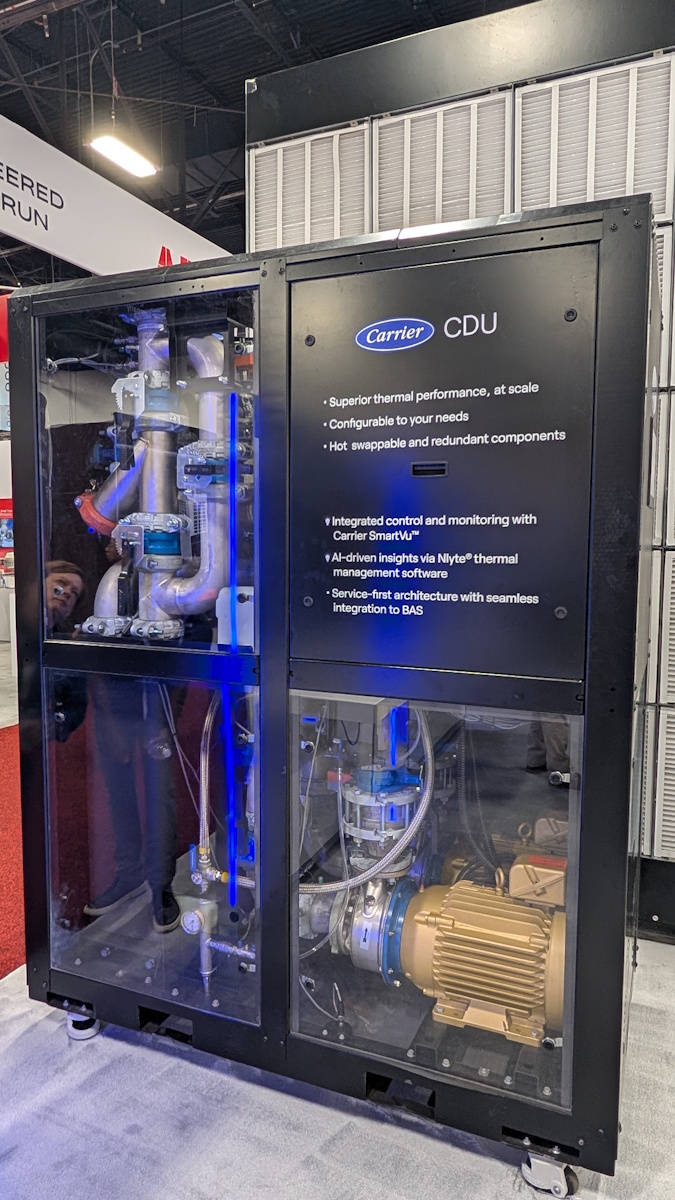
KEEPING COOL: Carrier’s Coolant Distribution Unit products range from 1.3 to 5 megawatts for chip-level cooling and chiller performance. (Photo by Chris Gray/BNP Media)
“Data center growth is happening in a more visible environment today, with understandable questions around energy use, water, and overall impact,” said Matt Orcutt, vice president, strategy and systems product management, commercial HVAC Americas, Trane. “At Trane, we see that as a reason to lead with even greater clarity around sustainability and performance.”
Looking for quick answers on air conditioning, heating and refrigeration topics? Try Ask ACHR NEWS, our new smart AI search tool. Ask ACHR NEWS
A proposal announced by Sen. Bernie Sanders and Rep. Alexandria Ocasio-Cortez aims to put a moratorium on the construction of AI data centers. The temporary ban, the legislators say, would give the federal government time to create safeguards for AI.
State and local governments are also acting. In Michigan, a bipartisan group of lawmakers proposed a halt to the construction of all data centers through April 1, 2027.
“There’s greater scrutiny during permitting and within local communities, so owners are increasingly looking for solutions that are not only capable, but also efficient and measurable,” said Greg Jeffers, vice president, data center solutions at Daikin Applied Americas.
Manufacturers Respond
HVAC manufacturers are responding to backlash by focusing on project-specific solutions that meet efficiency goals. They’re also pushing for education at the local level so communities are better informed.
“While public scrutiny is part of the broader context, the emphasis on efficiency is largely driven by operational and economic realities, and that’s what we are seeing shape decision-making on the ground,” said Jeffers.
Here are a few ways HVAC has addressed the most common problems levied against data centers:
Water Usage
Many newer data centers are reducing water use with closed-loop systems, where water is recycled through heating loops. Newer facilities are shifting toward radiators or dry coolers over cooling towers.
“As AI workloads intensify and rack densities rise, cooling strategies are evolving with them. Liquid cooling is one example of how the industry is adapting to higher-density environments and changing thermal demands,” Orcutt said.
Utility Costs
HVAC manufacturers are helping optimize the power usage effectiveness of data centers. Previously, OEMs provided standard commercial equipment for data centers. Today, equipment is purpose-built for data centers to better match temperature requirements.
"We just made an acquisition of a company called Alloy ... that's going to help us be far more efficient ... retrieving the heat from the servers and from the chips ... or discharging the heat from the chiller,” said Lewis.
Jeffers said there is growing interest in approaches that make better use of energy. This includes opportunities for waste heat reuse as more data centers investigate producing their own power. This could assuage concerns over energy consumption.
“In practice, those opportunities tend to be highly site-specific and depend on having the right infrastructure and end-use demand in place,” he said.
Noise Levels
Manufacturers are emphasizing quieter cooling technologies, including magnetic-bearing chillers and variable-speed fan systems designed to reduce noise pollution.
“We're looking much more clearly at the sound, not just at full load in the middle of the day, but when people are at their houses, when they're in their backyards ... in the mornings before school, in the evenings when they get home,” said Lewis. “Generally, those are your off periods.”
Overall, Orcutt said it’s about providing transparency around performance. That includes closed-loop system architecture, products, and AI-enabled controls.
“As a technology partner, we take a systems-level approach from co-design through deployment and optimization, helping customers align performance needs with long-term operational and sustainability goals,” he said.
Evolving Technology
Despite these developments, backlash continues to grow. It comes down to the limited public understanding of rapidly developing cooling technology. Lewis said that in his 30 years as an engineer in the industry, he has never seen new innovations released at the pace they are now.
"Two things I think we need to do is, we need to do a better job of communicating all around, top to bottom, all the great things that have been done … but also we need to promote some of the positive attributes,” Lewis said.
Jeffers agreed, saying due to that speed, flexibility is becoming paramount to ensure cooling technology doesn’t become outdated or incapable of scaling.
“The projects that will hold up best over time are those designed with adaptability in mind, as cooling technologies and density requirements continue to evolve,” Jeffers said.
Orcutt said thanks to advancements in HVAC technology, Trane doesn’t view sustainability and growth as competing priorities. Instead, the future depends on solving for both.
“More broadly, these shifts reinforce the value of systems-level thinking — not just about individual pieces of equipment, but about how efficiency, resilience, scalability, serviceability and long-term performance come together,” Orcutt said.
The Air-Conditioning, Heating, Refrigeration Institute is also developing North America’s first Environmental Product Declaration Program for the HVACR and water heating industry. The AHRI Certified EPD Program, known as ACE, calls for standardized lifecycle data to enable more accurate measurements and the reduction of environmental impacts.
What Should Contractors Do?
Contractors working on these projects can help address backlash as well. Manufacturers are recommending the same approach they’re taking: be as transparent as possible.
“For contractors, data centers and AI factories represent a meaningful opportunity to apply system expertise across installation, service and long-term support,” Orcutt said. “As these projects become more complex, there is growing value in capabilities that extend beyond execution alone — including integration, maintainability, scalability, and long-term performance.”
Jeffers said Daikin Applied Americas said that as systems become more complex, cross-functional alignment becomes essential for contractors.
“Design and engineering firms must evaluate new cooling technologies constantly to make sure they can be successfully deployed. This happens by making the right thermal architecture decisions upfront,” said Jeffers.
A positive attribute to tout is the job opportunities data centers create, both for HVAC and communities. Lewis said data centers themselves don't employ many people, but all the infrastructure required to service them can support hundreds and thousands of local jobs.
“The best way to really understand how we can impact the communities, what's most important around saving water or electricity? That information is going to come from the contractors that are on the ground on these sites,” Lewis said.
Looking for a reprint of this article?
From high-res PDFs to custom plaques, order your copy today!