
ClimateMaster is a leading manufacturer of geothermal and water-source heat pump systems for residential, commercial, and institutional buildings. The company designs energy-efficient HVAC solutions that use renewable ground or water sources to provide heating, cooling, and hot water while helping reduce energy consumption and environmental impact.


Residential Tax Credits Are Ending, But Demand Continues
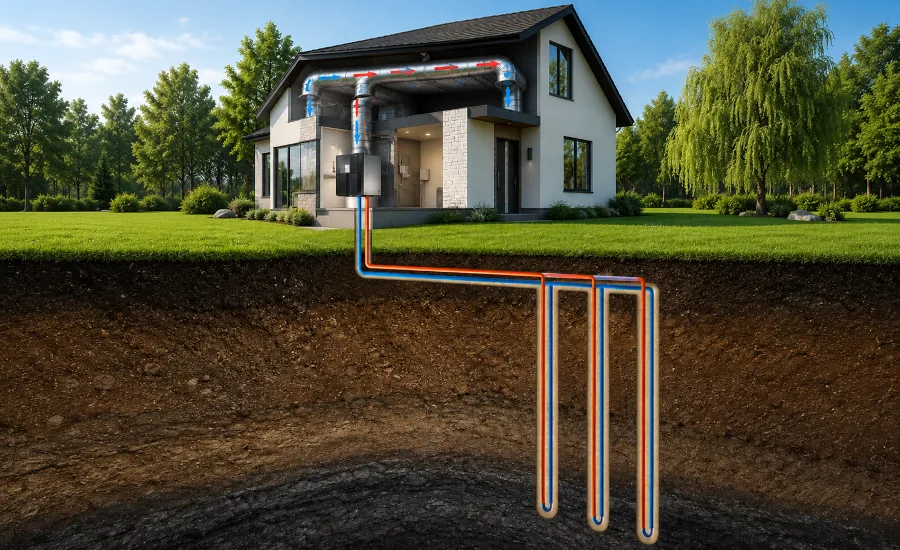
Except for a brief time in 2017 when a clerical error took them away, residential geothermal contractors have enjoyed selling homeowners on the technology with the help of tax credits since 2005.
Unfortunately for the industry, the One Big, Beautiful Bill Act sunset those 30% installation tax credits in 2025. When the tax credits went away in 2016, the industry saw a 45% decrease in sales. So, it would be tough to blame some folks for being pessimistic about geothermal sales numbers in 2026.
But this is not 2017 and demand for geothermal continues.
“The feedback we're getting from dealers so far is there’s still a lot of interest. There are still people that buy the system,” said Dan Ellis, the CEO of Climate Control Group.
Geothermal energy has been around since the 1970s, so in fact the industry has experienced more years without tax incentives than with. It was no coincidence that the industry saw significant growth in the 1970s when there was an oil crisis.
The popularity of geothermal can often depend on the state of energy costs.
“If energy costs rise, geothermal certainly is an answer,” Ellis said. “A good example is electricity got up to $180 a kilowatt hour in New England this winter due to severe weather. Those kinds of things are what really grabs people’s attention.”
In fact, the largest growth the geothermal industry ever had in the residential market was post-hurricane Katrina when natural gas tripled.
“People just came out in droves, and the industry had huge growth. There were no incentives. It was natural growth based on external circumstances. So various things can drive the market: the general economy, the cost of energy, and obviously the availability of incentives,” Ellis said.
But it was not all bad news from the big, beautiful bill. The legislation now allows third parties to own a residential system and lease it to a homeowner. And with that comes tax incentives on the state and utility level.
This creates an opportunity for the lessor company to take advantage of the tax incentive and pass that through as lower lease rates. They're still getting the benefit in that package as if they had done it.
Another key aspect spurring growth is financing. Much like general residential HVAC sales, financing is critical in geothermal sales because it directly affects whether homeowners can afford to say “yes” to a system.
“If you look at any other industry selling to consumers, having financing vastly expands the market. I really think that we could be entering a new era of growth. If you look at the solar industry, when they introduced solar leasing, it took off. Where they had the tax credit, they could sell people's systems, but it was leasing that turned the market. So now that's the only way to reach the market,” Ellis said. “I think it's actually a brand-new opportunity for our industry. I'm really excited about that.”
Don’t be surprised if there will be more leasing opportunities in the geothermal industry. Currently, one of the largest ones combines utility incentives called G-RECS. That stands for Geothermal Renewable Energy Credit.
A GREC is basically a tradable environmental credit tied to the renewable energy produced by a geothermal heating and cooling system.
“There are credits that accrue to the power supply side of the industry, transmission, distribution, and generation. There is another big opportunity for the G-RECs in that they're being incorporated into the leases. When you put those together with the incentives, we have created a phenomenally low lease rate,” Ellis said.
With all these new moving parts, the tax credits could now be viewed as a bit antiquated. It was simply a flat 30% and were around so long the growth with those had stalled. These new incentives with leasing are promoting a new growth area for both the residential geothermal market and contractor.
“We are excited about that opportunity,” Ellis said.
That excitement certainly stems from the products Climate Control Group produces as well as the advancement of geothermal technology.
Geothermal heat pumps are 3.5 - 5 times as efficient as the most efficient fossil fuel furnace. Instead of burning combustible fuel to make heat, they simply move heat that already exists. By doing so, they provide 3.5 - 5 units of energy for every unit used to power the heat-pump system.
A system for the typical home will cost more than if you bought a separate forced-air furnace and central air conditioning system. But you wouldn’t be comparing “apples to apples”. To make an accurate comparison of costs you need to consider the following:
• Payback, or how long it takes to recover the difference in costs between the two systems using energy savings. Payback for most geothermal heat pump systems runs three to five years.
• Energy efficiency of the two systems. To get an accurate picture, make sure efficiency claims are substantiated. Your lifestyle and how well your home is insulated affect how economical a system will be.
• Total operating savings from heating, cooling and domestic hot water must be combined to get an accurate picture of total energy savings.
• Energy costs and availability, both present and future.
• Maintenance costs and system reliability.
• System lifespan.
With or without tax credits, the geothermal market is an area of profit and growth for residential HVAC contractors who want to grow their businesses.
Looking for a reprint of this article?
From high-res PDFs to custom plaques, order your copy today!


