Here is the potential problem: A contractor quotes a customer on the compressor replacement, and he agrees to repair the cooler at the quoted price. Then, as the technician is completing the job — or even after he has finished replacing the compressor — he finds out there is another system problem.
Consider the same system as last month’s column — a medium-temperature refrigeration system incorporating a liquid high-side receiver, a TXV as the metering device, and R-134a refrigerant — but the measured and calculated values are listed in Table 2, along with this detailed system analysis.
The three-day event featured educational sessions and panel discussions that covered everything from technology and market trends to regulatory updates to what the future of the refrigeration industry may look like.
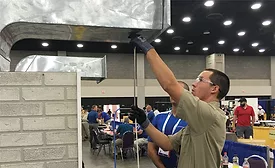
The HVAC competition showcased nine test events in which 31 secondary and 22 post-secondary contestants vied for top honors. Contestants represented first-place winners from previous state competitions.
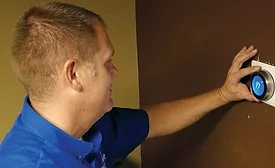
It’s a well-known fact that HVAC — the smart thermostat — is the first point of entry into smart-home sales. And with more than half of U.S. households predicted to own a smart speaker by 2022, according to a late 2017 study by Juniper Research, it’s a prime opportunity for HVAC contractors.
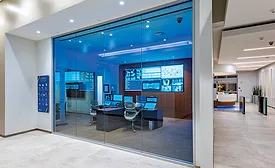
One of the most obvious effects of commercial IoT, in terms of HVAC systems, is convergence of technology: bringing different systems within the building together into one ecosystem.
It started with smart thermostats. Now, in today’s world of smartphones, smart speakers, and Wi-Fi connections in 89 percent of U.S. households (as of 2017), smart homes are expanding in scope beyond heating and cooling controls — the first major foray into the smart-home concept — as manufacturers work to keep up with customer demand for continuous connection.
The first reason not to measure static pressure is because hooking up a refrigeration manifold to the system tells you everything you need to know. Don’t worry about the fact that this practice often leads to leaks, can introduce non-condensables, and can cause potential refrigerant contamination.
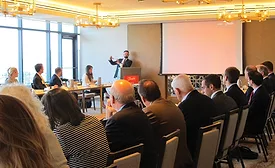
For the past 12 years, experts from across the country have gathered in the same room for a dinner table style discussion on the most critical issues and trends impacting the HVACR industry. During the 31st Danfoss Envisioneering™ Symposium that recently took place in Washington, D.C., that topic was Resilience Solutions in Buildings & Energy.