Buildings: the Next Frontier in the Internet of Things (IoT)
Automation in commercial HVAC brings whole-building focus
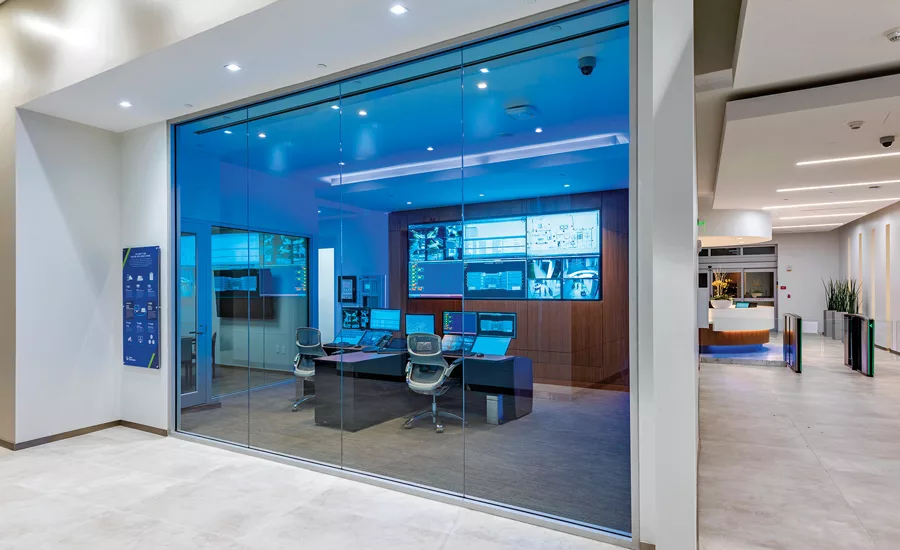
REAL WORLD DEMO: The UTC Center for Intelligent Buildings showcases smart-home products developed by leveraging the IoT to bring together technologies from different building systems.
For building owners and the contractors and maintenance teams who carry out day-to-day operations and upkeep, commercial IoT means more data, more uses for that data, and more visibility into what’s working and what’s not. It allows for more proactive maintenance, as well as quicker access to new technology.
“Buildings are the next big frontier for IoT and data,” said Sudhi Sinha, vice president and general manager, data-enabled business, Johnson Controls Inc. “For example, approximately 500 million tweets are sent every day. We see a tremendous amount of data being created by building systems from a few thousand buildings during that same time frame of tweets. Johnson Controls has about 5,000 connected buildings (small, medium, and large buildings), and we are connecting 175 million records from those buildings today.”
COME TOGETHER
One of the most obvious effects of commercial IoT, in terms of HVAC systems, is convergence of technology: bringing different systems within the building together into one ecosystem.
“We are at the beginning of a broad, sector-wide trend right now where building systems and technologies that had traditionally been separated from one another in the design and planning stages are converging … and building owners and developers are looking for new ways to deliver enhanced user experiences for occupants,” said Chris Opie, vice president, platform management, commercial HVAC, UTC Climate, Controls & Security.
Sinha agreed, adding that the trend is being driven by customer demand.
“We have customer expectations that are asking for new capabilities, solutions, and new outcomes, which are best served through a convergence of multiple IoT technologies,” he said.
For example, when it comes to optimizing for energy purposes and for operating cost, it requires sensor technology, communication technology, artificial intelligence, and machine learning, according to Sinha.
Looking for quick answers on air conditioning, heating and refrigeration topics? Try Ask ACHR NEWS, our new smart AI search tool. Ask ACHR NEWS
AI has been around for 50-60 years, so it’s not new, he said — but its widespread awareness and adoption is. Ironically, technology itself is creating demand for more technology, to make sure the systems work together.
“The convergence of technology or multiple technologies is really changing how we think of the world,” Sinha said.
UTC Climate, Controls & Security recently opened its UTC Center for Intelligent Buildings in Palm Beach Gardens, Florida, to showcase a variety of new products enabled by technology convergence and the IoT. One example is demand-based ventilation, where ventilation rate within a controlled space can be adjusted based on the number of cellphones (hence, the number of people) within that space.
“With this approach, we get a gain in reported occupant comfort, as well as energy savings of approximately 14 percent,” Opie reported.
Another example is occupancy-based HVAC schedule optimization that leverages information from a Lenel security system to learn occupancy patterns and then adjusts HVAC schedules based on how the building is actually being used. Both solutions were developed by leveraging the IoT to bring together technologies from different building systems.
DO YOU SEE WHAT I SEE?
IoT technology for buildings brings visibility to these systems and the data they create, and it puts that data to work.
Jerry Huson, controls engineer, Bosch, said more companies are now selling packaged or complete system-based product lines: not just a microwave and a refrigerator, for example, but a microwave and a refrigerator with a system that tracks what’s happening with these devices and can manage their efficiency.
“With HVAC, you can package heaters, boilers, cooling together and be able to manage all of that and save the end user money,” Huson said.
In the case of residential systems, that means the data from each device, once hidden from the homeowner, is becoming more available, so manufacturers can use it to improve the lives of their customers. On the commercial side, it usually ties into a building management system, which is then used to gain visibility into all components in the building, from lighting to security to heating and cooling.
Many of the components in commercial HVAC and refrigeration systems have been generating a lot of data for a long time, he continued: think variable frequency drives, which generate a trove of data on motor performance, energy consumption, and a host of other categories. Wi-Fi can help unleash better control and better efficiency overall, according to Huson.
“Some of that data is pulled into the BMS system, but most of it just isn’t used or even looked at,” said John Sheff, business development manager — utility programs & end user strategy at Danfoss. “IoT has the potential to utilize that data.”
Danfoss is working to address this discrepancy via the Synchronized Hydronic Loop, which focuses on how Danfoss components, placed at various points in a hydronic HVAC system, work together to achieve continuous equilibrium in the system.
“As we develop this idea further, the IoT technology in these components will allow us to generate data on how that loop is synchronized, providing relevant insight for building managers,” he said. “I think that is the potential that’s driving the demand for IoT-enabled technology.
“The power of IoT is that the building is suddenly visible from the cloud,” Sheff continued.
That’s a trend he’s been seeing in the industry: moving from connected equipment to adding cloud-based platforms, by which data can be accessed and analyzed to make it relevant for the end user.
“The challenge is to provide meaningful insight into the building’s performance,” he said. “If the manager has to access a dozen platforms and analyzes all the data herself, IoT can lose its usefulness. Clearly, it’s not good enough to give your customers a ‘data dump’ and let them figure out which data are useful and which are irrelevant.”
With the Synchronized Hydronic Loop, the end goal is to link those components together and aggregate the data each produces in a meaningful way.
“We want to reduce complexity by looking at the hydronic system holistically, as opposed to analyzing the performance of individual components like chillers, pumps, and valves,” Sheff said. “These components impact each other’s performance, and we need to understand those relationships in real time.”
For building managers, the most evident use of data from IoT products is the ability to monitor energy consumption and then take action to improve the bottom line, said Huson. That could affect how the HVAC system is managed, the types of improvements made in the building, or the next equipment purchase.
As manufacturers of all types of IoT equipment gain the ability to create their own platforms, the market will become increasingly more crowded, Huson predicted.
“This used to be a space owned by the BMS and controls companies. Buildings were a black box of sorts, and it took years of experience with a building for a facilities manager to understand how it was performing. Building owners had to rely on their software to gain insight into their building’s performance,” he said. “Now, they can access their rooftop units, VFDs, and pumps through their phones.”
While this gives greater access, it can also add an additional layer of difficulty.
“As we develop our Synchronized Hydronic Loop platform, we need to make sure we’re adding value and not just noise to this already crowded space,” said Sheff. “We need to be sure we can integrate with the BMS systems and controls platforms so that we’re making building optimization easier for owners, not more complex.”
PROACTIVE MAINTENANCE
Using IoT products also speeds up reaction time, both for the building manager in terms of proactive maintenance and for the manufacturer in providing software updates that will help customers derive the maximum value from their systems.
Paul Rauker, vice president and general manager at Daikin Applied Intelligent Solutions, compared the evolution of commercial IoT to the evolution of Microsoft Office.
“Microsoft Office used to be bought as a software package … you had the latest Office for the next 18 months, and you had to wait until the next release to have more functionality,” he said.
Now it operates on the Software as a Service model, where customers pay monthly/annually, which provides them an ongoing license and continual updates.
“With IoT, it’s more of a two-way street enablement,” said Rauker. “It allows us to continually interact with our customers while they push us to continue to deliver value via new functionality and capabilities.”
On the end user’s side, IoT allows the customer to be more proactive and less reactive.
“In the past, you needed to wait for equipment to break, whereas today, you can have the equipment send alerts to the thermostat, to someone’s cellphone … you can know when there’s a high pressure alert and can take action before the component fails, which can greatly reduce the end cost to the consumer,” said Mike Caneja, product manager, Bosch.
Manufacturers are developing algorithms with an eye toward predictive maintenance, he added.
“Component and system manufacturers are trying to predict when equipment requires maintenance, or is about to require maintenance or service, and that way, we can provide a seamless experience to the end user,” he said.
When the manufacturer has access to a system’s data via IoT technology, they’re able to provide customer support more quickly. Carrier now includes an option to add secure and reliable wireless communications to equipment with product integrated controls, with the ability to remotely monitor and analyze key operating characteristics measured by sensors within the equipment. The data is transmitted in near real-time to a secure cloud platform that can then provide advanced notifications, predictive diagnostics, short-term and long-term performance trending, benchmarking, and recommendations for suggested proactive interventions to improve energy efficiency and reduce maintenance costs.
Similarly, Johnson Controls offers products such as the Connected Converged Security, which brings together disparate data streams to create response scenarios and address cyber-security risks, and the Johnson Controls Enterprise Management (JEM), which brings together different building systems and domains, such as HVAC, meters, security, and understanding space.
“For example, in convenience stores, we are not only connecting the HVAC system, but we are also connecting their point-of-sale systems and their food and beverage systems,” said Sinha. “It’s a combination of sensor and data technologies and analytics capabilities, which is changing some outcomes.”
Sheff said the rise of IoT is changing the way Danfoss looks at their own products.
“IoT is forcing us to look at our products as part of a system and evaluate how they impact each other in that system,” he said. “No longer can we view our drives as separate from our compressors and PICVs. Right now, we see them as interconnected mechanically and individually to the BMS. In the foreseeable future, however, they will connect directly to each other, sharing performance information and optimizing based on real-time data.”
WHO’S BUYING?
Right now, the biggest audience for commercial IoT is large commercial or institutional building owners, said Sheff: hospitals, universities, and government or corporate campuses with the budgets, scale, and personnel to focus on long-term performance and operations across their portfolio of buildings.
“We try to focus on customers who are not first-cost driven, meaning they’re assessing the total cost of ownership rather than the initial sticker price,” he said. “That’s where the savings from IoT comes into play.”
Those savings mean different things to different people, said Goncalo Costa, director of regional business unit, Bosch.
“You have the contractor that does the actual installation of the product — who’s looking for, through IoT, tools that make the installation and setup of the entire equipment quicker,” he said. “So for him, time is money.”
With an IoT-enabled unit, for example, Bosch can track the data, and bring it up if there’s a problem. “Instead of the traditional beat-around on the phone for 45 minutes with a service operator, we can say ‘let’s take a look, and we’ll get back with you.’ We don’t just tell you there’s a problem, we tell you what the problem is,” he said.
Then there’s the building owner and the building management team, who want to be able to monitor the system remotely from a troubleshooting and energy consumption perspective.
“A lot of the customers who usually go for these products are definitely energy-conscious individuals,” Costa said. “Traditional HVAC solutions are a poor return on investment and can be 40 to 50 percent of [a building’s] energy consumption. If they can drop that, that goes straight to their bottom line. You’ll see customers using these products to save money and the planet.”
In the future, Sheff thinks smaller businesses will end up being a large consumer of IoT products as well.
“The technology available to residential consumers, like smart thermostats, contains powerful software that can aggregate multiple zones and locations very efficiently and cost-effectively,” he said.
For example, the Danfoss HVAC Micro Drive comes with a pre-programmed sequence for modulating rooftop unit supply fans.
“This saves a lot of energy and is cost-effective for small businesses when combined with utility rebates,” said Sheff. “Right now, it is not connected and takes command directly from a traditional thermostat. But we are currently talking with smart thermostat companies about how we can integrate these products so that small business customers can get the savings only a larger customer has access to now.”
Rauker agreed there’s a lot of potential in the small- to mid-size building market (100,000 square feet or less in size), where building owners do not have on-site staff and need ways to effectively manage the building.
“A key part of our solutions is to provide a strong user experience: enabling ‘non-tech’ people — like building owners or managers — to use our equipment,” he explained. “Otherwise, they will have to employ someone who has knowledge and experience with building control solutions.”
As more business owners adopt IoT-enabled technology and validate the results in the industry, Rauker predicts a groundswell of interest.
“When the name gets out there, it’ll move,” he said. “Granted, the HVAC industry is very slow to change … traditionally, we’re focused on equipment and how to make it more efficient. OEMs and manufacturers are focused on solutions, and as we bring in full solutions, we’re going to see the adoption rate increase similar to a hockey stick curve.
“If we look at 2020, 50 percent of the workforce will be millennials,” Rauker added. “If you think about that, everything they’ve done is reliant on technology … I think that will have a positive impact on accelerating adoption in the industry.”
Publication date: 7/30/2018
Want more HVAC industry news and information? Join The NEWS on Facebook, Twitter, and LinkedIn today!
Looking for a reprint of this article?
From high-res PDFs to custom plaques, order your copy today!