Review Scammers Target HVAC Companies with Extortion
Protect your business from fake reviews

REVIEW SCAM: Scammers are targeting HVAC businesses, along with others in the home services industry, with a scheme to extort money using fake reviews.
John Towner, owner of Silicon Valley Comfort in California, was inundated with 25 one-star reviews on Google last July. The reviews tanked his rating and suppressed his visibility in search results. Things worsened when he received a strange message on WhatsApp from someone named Ahsan.
Listed as residing in Pakistan, Ahsan claimed a competitor paid them to post the negative reviews, and that they could remove those reviews if Towner paid $100.
After pleading with Ahsan, Towner convinced the scammer to pull down the reviews. Unfortunately, the damage was done. Towner said his business continues to suffer from fewer customers, and he has yet to recover his online presence.
“My reputation means the world to me,” Towner said. “I’m usually in the top three in most of my little local areas. Now I’m not, and I can’t be found.”
Towner is one of many victims, in the HVAC industry and beyond, of a review scam that extorts money out of business owners who depend on positive reviews to remain in front of customers. He hopes other contractors can learn from his experience.
“It sucks, dude. It sucks pretty bad,” he said. “It’s happening to a lot of different companies across the world, not just HVAC, but moving companies and a lot of different places.”
Fake Review Scams
Kay Dean is a former federal criminal investigator and the founder of Fake Review Watch, a site dedicated to exposing corruption in online consumer review platforms. Dean said extortion through fake reviews has been happening for years, with scammers often targeting smaller businesses like Towner’s that rely on good reviews to draw customers.
Looking for quick answers on air conditioning, heating and refrigeration topics? Try Ask ACHR NEWS, our new smart AI search tool. Ask ACHR NEWS
“The service industry are typical targets; however, I’ve seen medical and dental professions targeted,” she said in an email to ACHR NEWS.
She said the issue has grown so out of hand that Google recently launched a form specifically for reporting negative review extortion.
The scam typically takes the form of a contractor receiving multiple negative reviews, usually within the same length of time. A scammer then approaches the business via social media to claim someone ordered bad reviews for the business, and they can help remove them — for a price, of course.
Dean said Google’s platform is full of fake reviews, both positive and negative. Google reports that in 2024, 188 million reviews were removed due to being fake or misleading.
“Unfortunately, Google seems to place much of the responsibility on the business to go through the hassle of reporting these reviews and enduring the stress of lowered ratings and possibly lower revenues, even if only for a short time,” Dean said.

EXTORTION: Screenshots of the communications John Towner of Silicon Valley Comfort received after his HVAC business was hit with dozens of one-star reviews. (Courtesy of Silicon Valley Comfort)
What to Do When Facing a Review Scam
If a contractor is the victim of a review scam or extortion, Dean advises taking the following steps:
- Don't engage with the scammer. Block their number when they reach out to you. Don't pay.
- Flag the reviews with the review platform.
- Document everything and take screenshots or a video of the reviews and any communications from the scammer.
“Don’t do what I did and try to talk the guy into taking them down,” Towner said. “Don’t pay for them, for sure, and just wait for Google to do what they’ve got to do.”
Crystal Williams, founder of Lemon Seed Marketing, agrees that if contractors find themselves in this situation, never pay to have fake reviews removed. The payment doesn’t guarantee removal of the reviews. Not only that, but the scammer might request additional payments once they know you’ll meet their demands.
Instead, after documenting the reviews and any communications, contact the appropriate platform, such as Google, to report that you’re receiving false reviews as part of an extortion scheme. Provide the documentation related to the messages.
“You have to treat this like fraud, like someone used your credit card, right? Not like a customer service opportunity,” she said.
Even if a contractor has the perfect report and evidence to show they’re the victim of a review scam, it takes time to remove negative reviews. As an example, Williams said it can take a week or more before Google responds.
“Google is not just going to remove something because it's negative. It has to violate policy, so anything you can do to show the fake engagement, the extortion, the messages, really will help your case,” she said.
If things continue to escalate, or the review platform isn’t responding, Williams said it’s time to seek legal counsel.
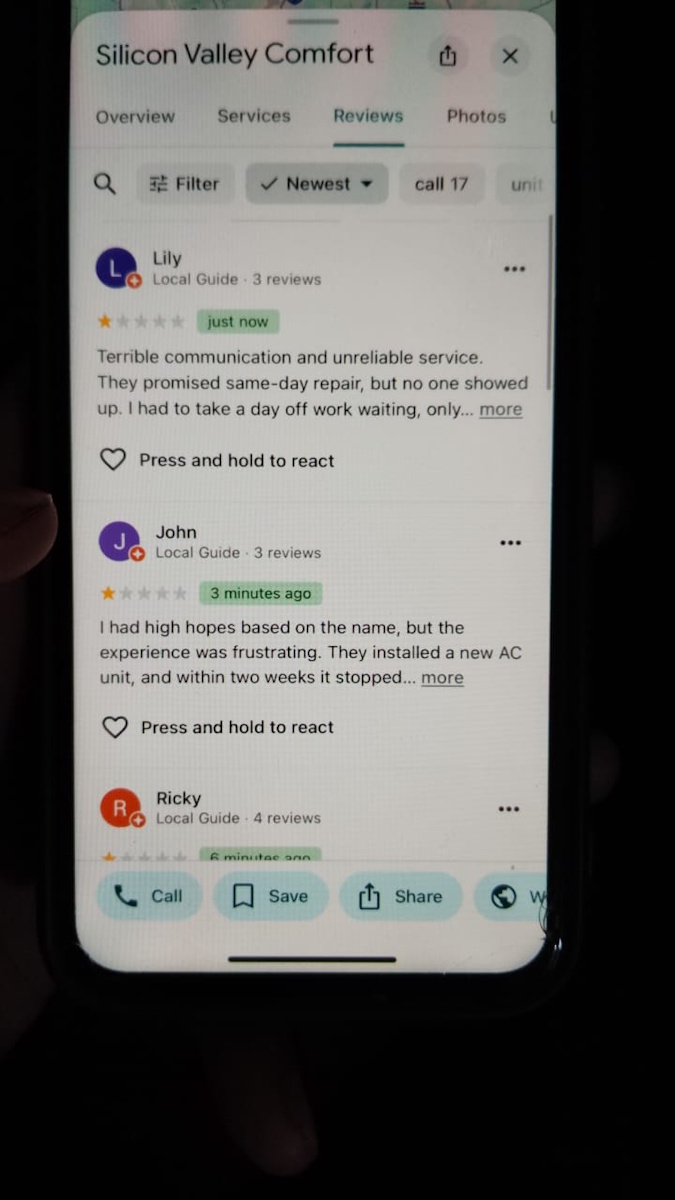
FAKE REVIEWS: Screenshots of bogus reviews posted to Silicon Valley Comfort’s Google Reviews. (Courtesy of Silicon Home Comfort)
How to Identify Fake Reviews
If a contractor suspects they’re the victim of a review scam, they need to determine which reviews are legit and which are fake.
Williams said one red flag to watch for is the language of the review. For example, if it’s vague, short comments like “horrible service” or mentions names, services, or places that don’t match up with your company, odds are it’s fake.
It’s also worth the time to check your CRM or other records to determine if the person is a customer. Verify if names or dates of service match up with the reviewer’s information.
Other red flags to watch for include:
- If the reviewer has a new account or a locked profile that hides their review history
- If the profile photo doesn’t match the reviewer or is used by other reviewers
- If the review was posted along with other negative reviews in a short timespan
Engaging with Reviews
One of the main rules that contractors should follow is to treat every review with importance, whether it is positive or negative. For a favorable review, post a reply thanking the customer for their business.
When it’s a negative review from a legit customer, respond with a sympathetic reply and let the customer know you’ll be reaching out to them.
As Towner can attest, bad reviews can feel personal. Williams warns against becoming emotional when responding to a bad review and posting replies to them. Don’t respond until you’re ready to do so in a calm, measured way.
“The biggest thing I tell people is do not get in a public battle back and forth,” Williams said.
Generating Positive Reviews
One last strategy is to have so many positive reviews that negative ones don’t damage your rating. Williams said one way to gain more is to automate asking for reviews, such as with a CRM or FSM.
Having technicians request them also prompts customers to leave a nice review.
“Most people, especially with a good experience, they're looking for an opportunity to brag on you, and so they want people to know they chose the right company,” Williams said.
Dean warns, however, that malicious individuals are looking to capitalize on businesses desiring more five-star reviews, so only seek reviews from legitimate sources.
“Often, [scammers] will approach a business owner via social media offering their services,” Dean said. “Don't engage with individuals offering these services and block them if possible. If you use a marketer, make sure that they are not procuring fake positive reviews.”
This happened to Towner, with his scammer offering to add positive reviews for money. He wisely refused. When he was once again a victim of a negative review scam last January, he simply flagged them for Google to address.
“One time there was eight [one-star reviews], one time it was four of them. And it was not a single customer that I had worked for,” he said. “I do what you were supposed to do, and then Google took care of them.”
Legislative Action to Curb Fake Reviews
Often, legislation is slow to catch up, especially in the realm of technology. However, Congress is taking actions that could aid business owners frustrated by online review scams.
One bipartisan bill introduced in the Senate, called the Sunset Section 230 Act, would repeal Section 230 of the Communications Decency Act. The provision protects major tech companies from legal responsibility for third-party or user-generated content on their platforms.
A companion proposal, Sunset to Reform Section 230 Act, was introduced in the House of Representatives. Both bills are currently before committees.
“This is an opportune time for HVAC industry leaders to be lobbying for updated legislation which would hold tech companies and review platforms accountable for the fraud facilitated on their platforms,” said Kay Dean, founder of Fake Review Watch.
She said review platforms have created a lax environment where “cheating is essentially rewarded and honest businesses are harmed.”
Proponents of Section 230, including NetChoice, argue that the law is designed to ensure online services can host speech without being challenged by lawsuits over content they didn’t create.
“Without it, tech companies would face expansive liability for anything their users do,” wrote Robert Winterton, vice president of public affairs for NetChoice. “By threatening to hold a website directly liable for the law-breaking actions of any user, multiple levels of American government could have powerful leverage to threaten social media sites into removing speech that a particular politician or political party dislikes.”
Looking for a reprint of this article?
From high-res PDFs to custom plaques, order your copy today!