ACHR News
search
Ask ACHR NEWS AI
cart
facebook twitter instagram linkedin youtube
  • Sign In
  • Subscribe
  • Sign Out
  • My Account
ACHR News
  • NEWS
    • Breaking News
    • New HVAC Products
    • Featured Products
    • Manufacturer Reports
    • HVAC Data
    • Legislation
    • ACHR NEWS Centennial
  • RESIDENTIAL
    • Air Conditioners
    • Furnaces
    • Residential Heat Pumps
    • Ductless
    • Residential IAQ
    • Testing, Monitoring, Tools
    • Components & Accessories
  • COMMERCIAL
    • Air Handlers
    • Rooftop Units
    • Chillers and Cooling Towers
    • Commercial Heat Pumps
    • Boilers and Hydronics
    • VRF/Ductless
    • Commercial IAQ
  • REFRIGERATION
    • Refrigerants
    • Refrigerant Regulations
    • Leak Management
  • CONTRACTOR PRO
    • Geothermal
    • Homeowner Study
    • VRF and VRV Ductless
    • Unitary Trends
  • EDUCATION
    • Training and Education
    • Business Management
    • Service and Maintenance
    • Continuing Education
    • Market Research >
      • HVAC Brand Awareness Report
      • VRV, VRF, VRVZ Report
      • Unitary Trends Report
      • Water Heat Professionals Report
    • Webinars
    • Sponsor Insights
    • eProducts Info
    • White Papers
  • EVENTS
    • HVAC Contractor Forum
    • Industry Events and Webinars
  • MEDIA
    • Videos
    • AHR Expo 2025 Videos
    • Podcasts >
      • ACHR News Podcast
      • HARDI Podcasts
      • AHR Expo Podcasts
      • ACCA Podcasts
    • Interactive Spotlights
    • Quizzes
    • eBooks
    • HVAC Talkback
  • HVAC GROUP
    • ACHR NEWS >
      • Current Issue
      • Digital Edition
      • Subscribe
    • Distribution Trends
    • SNIPS NEWS >
      • Join SNIPS NEWS
    • Engineered Systems News >
      • Join ES News
    • HVACR Directory
    • Contests
    • Newsletters
    • Contact
    • Advertise
    • My Account
HVAC ContractingNewsService and MaintenanceIndoor Air QualityVentilationResidential Indoor Air QualityCommercial Indoor Air Quality

Measure System Temperatures to Diagnose Uncomfortable Rooms

Advice for when HVAC equipment isn’t heating properly
By David Richardson
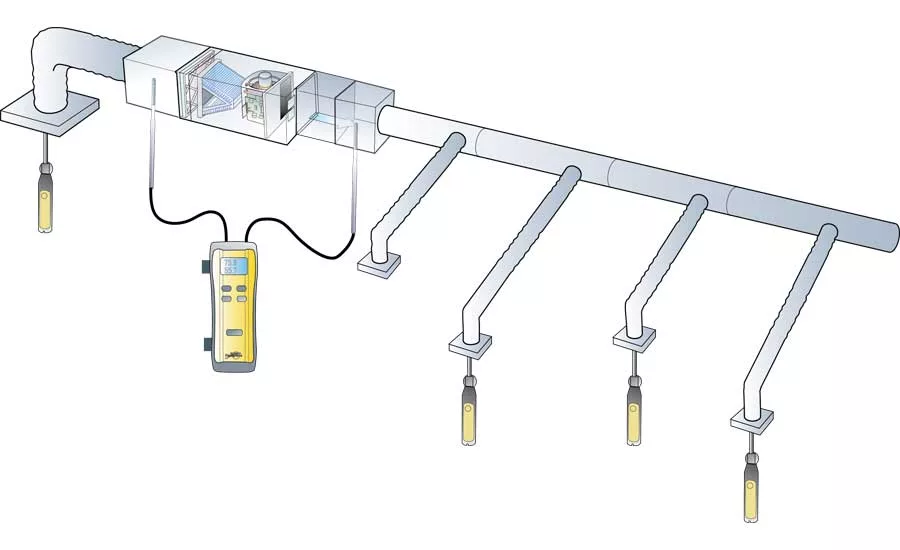
Measure System Temperatures.

Measure temperatures at the equipment and system to enhance your comfort diagnostics. Image courtesy of David Richardson

January 11, 2021

It’s the middle of winter, and you’re probably getting calls from homeowners who want larger HVAC equipment. Their current system runs constantly and can’t keep a few rooms warm and comfortable. When most contractors receive these calls, they investigate and often find correctly sized equipment for the home’s heating needs that is operating fine.

So, what could hinder an HVAC system from heating a home on those coldest days? While there are many factors, you can frequently find one source of trouble when you measure system temperatures. Let’s look at how you can use a return grille and supply register temperature measurement to uncover one source of uncomfortable rooms.

READ MORE ABOUT

• Temperature Control

• Service & Maintenance


Equipment and System Assumptions

A common assumption made in our industry is that equipment heating output and system heating output (the latter of which includes the duct system) are the same. This is rarely the case in real-world conditions. When a manufacturer rates their equipment, it is in a perfect laboratory environment. Yet once the equipment gets installed in a customer’s home, everything changes. Most installation conditions are far from perfect.

One major component of any installation to consider is the duct system. It determines system performance more than the heating equipment. If you focus too much on the equipment, you may overlook a potential reason the system can’t maintain comfortable conditions. Don’t fall into the mindset of believing the equipment is the system.


Measure Equipment Temperatures

Before you can test, you need a good digital thermometer that reacts to temperature changes quickly and measures to a tenth of a degree. As with any test instrument, you get what you pay for, so choose wisely. I love Bluetooth temperature probes for these tests. You can instantaneously review temperature readings from multiple places. If you want to speed up your testing, these probes are a wise choice.

To measure equipment temperatures, turn the equipment to heating mode and let it run for 10 to 15 minutes. If testing a heat pump, make sure the electric heat strips are off. Multi-stage gas furnaces need to operate in the highest heating stage. Failure to consider these conditions could lead to inaccurate temperature measurements.

Next, measure return and supply temperatures at the indoor air handling equipment. Record the temperatures and then subtract the return air temperature from the supply air temperature to determine the equipment’s temperature rise (∆t). Assure it is within range and record your readings.

Looking for quick answers on air conditioning, heating and refrigeration topics? Try Ask ACHR NEWS, our new smart AI search tool. Ask ACHR NEWS →

It’s important to note that temperatures depend on airflow. If the airflow is high or low, it influences ∆t.


Measure System Temperatures

Next, measure system temperature rise (∆t) in the most uncomfortable room. If you have Bluetooth temperature probes, you can place one in the return grille and the other in the supply register. If there are multiple supply registers, you can use extra probes or measure temperature from the supply register farthest away from the air handling equipment.

If you don’t have the luxury of Bluetooth probes, you can still use your digital thermometer to test. Measure the return grille temperature first, then measure the farthest supply register second. Be sure you don’t take too long between measurements; your readings could be off substantially. Once you have your readings, subtract them to determine system ∆t.

If the duct system is well insulated with minimal leakage, the equipment and duct system temperature rise should be close. There will be some differences, but there shouldn’t be more than a 10% temperature change across the duct system.


Example

Let’s say you have a three-ton heat pump operating in heating mode at a 30° outside ambient temperature. You measure temperatures at the air handler and find your supply air temperature is 88.5° and return air is 70.2°. This equals an 18.3° equipment ∆t (88.5 – 70.2 = 18.3).

Next, measure temperature at the farthest supply register and return grille of the most uncomfortable room. In our example, the supply register temperature reading is at 79.7° and the return grille temperature is 70.5°. This equals a 9.2° system ∆t (79.7 – 70.5 = 9.2).

To determine the percentage of duct system temperature loss, divide the 9.2° system ∆t by the 18.3° equipment ∆t (9.2 ÷ 18.3 = .50). After you move the decimal point two places to the right, you discover a duct system temperature loss of 50% to this room. As a result, the temperature available at the air handler doesn’t make it to the room.

How would you handle this if you measured similar readings?


Move Beyond the Box

This test will surprise you when you calculate how much temperature a duct system will lose, even in conditioned spaces such as a basement. It also presents you with a new opportunity that most of your competition will walk past while trying to sell larger equipment or booster fans.

The most applicable repair for duct temperature loss is more duct insulation. Be careful as you choose from various insulation options available. Some insulation types offer high promises but don’t perform well in the field. The test we went over can also help you verify insulation effectiveness once repairs are complete.

If you consider adding duct insulation, be sure the duct system delivers proper airflow at an acceptable total external static pressure. Insulating a leaky or undersized duct system is a waste of time and money. The system will need additional repairs to work as intended.

I would also encourage you to consider more than the HVAC system. Don’t assume the room insulation is right and working as designed. You can get a glimpse into insulation effectiveness with an infrared thermometer or a thermal imaging camera. If the air temperature in the room is 72° and the wall temperature is 68°, you’ll have a hard time maintaining comfortable conditions even with duct system improvements.

The rubber meets the road when you test for yourself. Document what you find as you perform this simple test and help your customers understand the need to choose better options.

KEYWORDS: Duct Dynasty HVAC service temperature control troubleshooting and HVACR

Share This Story

Looking for a reprint of this article?
From high-res PDFs to custom plaques, order your copy today!


David richardson
David Richardson serves the HVAC industry as Vice President of Training for National Comfort Institute, Inc. (NCI). NCI specializes in training focused on improving, measuring, and verifying HVAC and Building Performance. If you’re an HVAC contractor or technician interested in learning more about building science applied to HVAC, contact David at ncilink.com/ContactMe.

Recommended Content

JOIN TODAY
To unlock your recommendations.

Already have an account? Sign In

  • HVAC-enrollment

    The Trades Are Back: HVACR Programs See Nearly 30% Enrollment Spike

    A new wave of future technicians is entering the pipeline.  
    News
    By: Matt Jachman
  • 2025 Top 40 Under 40

    2025 Top 40 Under 40 HVACR Professionals List

    The 11th annual Top 40 Under 40 list highlights those...
    HVAC Contracting
    By: Hannah Belloli-Oster
  • LG Ductless Mini-Split Systems

    The 9 Types of Heat Pumps

    As the U.S. moves toward electrification, heat pumps are...
    Heat Pumps
    By: Joanna R. Turpin
Subscription Center
  • Create an Account
  • Start a Subscription
  • Manage My Account
  • Sign Up for Newsletters
  • Visit Customer Service
  • Update Preferences

More Videos

Sponsored Content

Sponsored Content is a special paid section where industry companies provide high quality, objective, non-commercial content around topics of interest to The News audience. All Sponsored Content is supplied by the advertising company and any opinions expressed in this article are those of the author and not necessarily reflect the views of The News or its parent company, BNP Media. Interested in participating in our Sponsored Content section? Contact your local rep!

close
  • Piggy Bank
    Sponsored byWatercress Financial

    Energy Prices, Inflation, and HVAC: What Today’s Homeowners Care About

  • Refrigerated Food
    Sponsored bySolstice Advanced Materials

    R-455A Refrigeration: A Cold Storage Solution for the Future

  • Airex Rooftop Units
    Sponsored byAirex Manufacturing Inc

    Consolidating Roof Penetrations: A Growing Trend in Multifamily HVAC Design

Popular Stories

HVAC-Price-Increase-graphic

HVAC Price Increase List: June 2026

Trump-Section-232.jpg

Trump Reduces Section 232 Tariffs on HVAC Equipment to 15%

R410A-Refrigerant-Cylinder.jpg

Refrigerant Recovery is a Revenue Opportunity

Heat-pump-cutaway.jpg

PFAS Rules and A2L Building Codes Continue to Evolve

Midea-training.jpg

HVAC Workforce Crisis Expands Beyond Technicians to Instructor Shortages

View The ACHR NEWS
Centennial Anniversary Timeline

The ACHR News Timeline Chart
Submit a Letter
Submit a letter to our editors.

Events

November 6, 2025

Next-Gen Data Center Cooling: HVAC Innovation and Real-World Solutions

On Demand As AI workloads and high-density computing push traditional cooling methods to their limits, the data center industry is accelerating the adoption of next-generation HVAC technologies.

June 17, 2026

Decarbonization Without Disruption

This webinar will explore practical HVAC decarbonization strategies that minimize disruption while maximizing long-term performance and ROI.

View All Submit An Event

Poll

Summer Staff

Are you fully staffed for the summer season?
View Results Poll Archive

Products

BNI Mechanical/Electrical Square Foot Costbook, 2026 Edition

BNI Mechanical/Electrical Square Foot Costbook, 2026 Edition

See More Products
Decarbonization Without Disruption - Free Webinar - 6/17/2026

Related Articles

  • 2-25 Four Air Diagnostic Tests - Photo 1.png

    4 Air Diagnostic Tests to Diagnose Tough Comfort Problems

    See More
  • Using the P-T Chart to Diagnose Refrigeration, A/C System Problems

    See More
  • Liquid Line Filter Drier

    How to Diagnose Partially Restricted Filter Driers

    See More

Related Directories

  • measureQuick®

    measureQuick is an application that technicians use to display measurements from arrayed smart tools, run equipment diagnostics, view just-in-time education and resources, generate easy-to-read homeowner-facing PDF reports and more.
×

Sign Up. Stay Informed.

The #1 trusted source for the HVACR industry since 1926

SUBSCRIBE
  • RESOURCES
    • Advertise
    • Contact Us
    • Advisory Board
    • Classifieds
    • Submit a Letter
    • Directories
    • Store
  • ACCOUNT CENTER
    • Create an Account
    • Start a Subscription
    • Manage My Account
    • Sign Up for Newsletters
    • Visit Customer Service
    • Update Preferences
  • SERVICES
    • Marketing Services
    • Reprints
    • Market Research
    • List Rental
    • Survey/Respondent Access
  • STAY CONNECTED
    • LinkedIn
    • Facebook
    • Instagram
    • YouTube
    • X (Twitter)
  • PRIVACY
    • PRIVACY POLICY
    • TERMS & CONDITIONS
    • DO NOT SELL MY PERSONAL INFORMATION
    • PRIVACY REQUEST
    • ACCESSIBILITY

Copyright ©2026. All Rights Reserved BNP Media, Inc. and BNP Media II, LLC.

Design, CMS, Hosting & Web Development :: ePublishing