Duct Dynasty
4 Air Diagnostic Tests to Diagnose Tough Comfort Problems
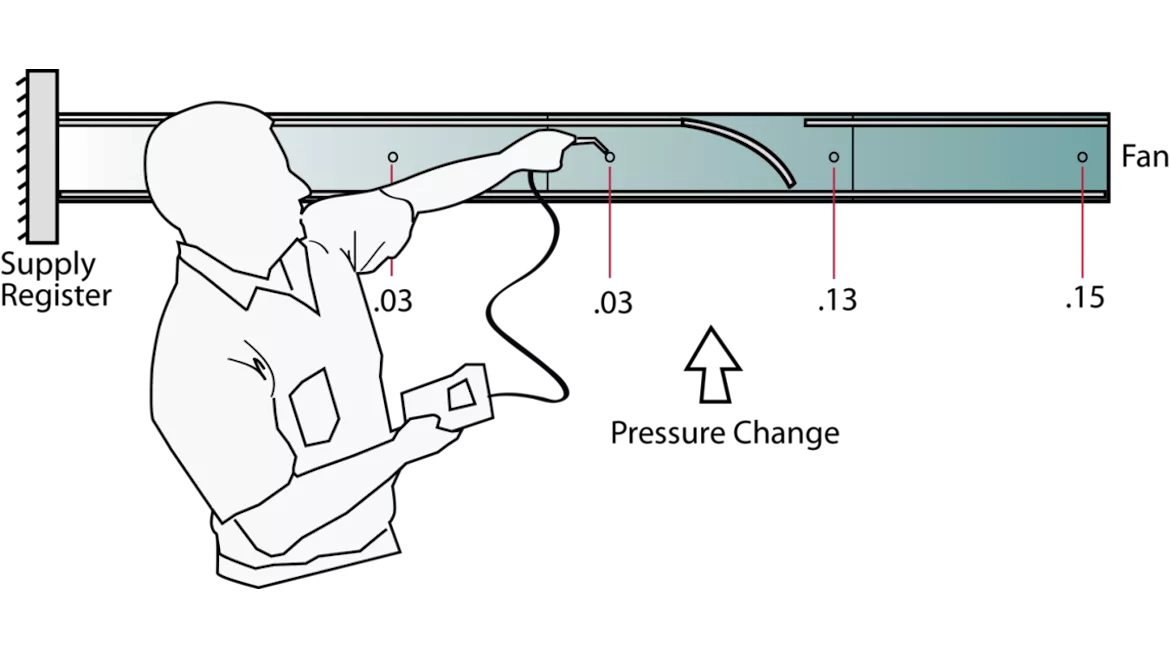
QUICK TIP: Measuring pressure every four feet in a duct system can help you find various hidden restrictions. (Courtesy of David Richardson)
Most of us have been there. You’re stumped trying to figure out why a room is uncomfortable and aren’t sure what to do next. You’ve measured the fundamental stuff like total external static pressure (TESP), temperature change (Δt), and refrigerant charge, but nothing obvious stands out. It’s clear you need to move past the air handling equipment, but which direction should you go?
With so many tests to choose from, it’s easy to get lost in the options. What should you do next? Unless you know what you’re looking for and why you’re looking for it, you could end up answering the wrong questions. If you find yourself stuck diagnosing a comfort problem, these four air diagnostic tests might get you out of a jam.
Duct Pressure Profiling
Filter and coil pressure testing results are often straightforward. They will let you know if a coil or filter is dirty or restricted. However, when you discover high TESP readings on either or both sides of the duct system, it may leave you confused. Is the entire duct system undersized, or is there just a poor fitting or restriction? This is where duct pressure profiling comes in handy to help you locate the cause of those high pressures.
To perform this test, you’ll use the same manometer and accessories you used to measure static pressure. You also need a drill or impact driver to install more test ports in the duct system (assuming the duct is accessible).
Start on the side of the duct system with the highest pressure. It’s the one most restrictive to airflow. If you’re testing the supply side of the duct system, start at the supply plenum and work down the supply trunk duct, towards the end. If you’re on the return side, start at the return drop or plenum, and work down the return trunk towards the return grille(s).
Install a test port every four feet downstream from your first test locations and then measure before proceeding. Look for suspect duct fittings like sharp transitions and turns. Drastic changes in duct pressure indicate excessive resistance to airflow.

GO WITH THE FLOW: Measured supply register airflow should be within ± 10% of design or estimated airflow. (Courtesy of David Richardson)
If you discover a large pressure change, identify what’s inside the duct and causing the problem, then repair it. This may be the only correction you need to make to fix a comfort problem.
Looking for quick answers on air conditioning, heating and refrigeration topics? Try Ask ACHR NEWS, our new smart AI search tool. Ask ACHR NEWS
However, sometimes you won’t find any duct pressure problems, but there’s still an unresolved comfort issue in a room.
Room Static Pressure
It’s possible you’ll need to look closer at the room you’re having issues with. One of the simplest tests is a room static pressure test. Just like you test static pressure in an HVAC system, you can also use it for a room. You might wonder why? Well, the room is part of the duct system. It’s what connects airflow from the supply registers back to the return grilles. And unless you account for this connection, you could overlook a common source of comfort problems.
To perform this test, you’ll need a high-precision manometer (micromanometer) like a DG-8 from The Energy Conservatory (TEC). While a standard manometer is fine for measuring HVAC system pressures, it doesn’t have a low enough range to measure room pressures.
During this test, look for how the room influences the HVAC system while it’s running. A properly balanced system will have equal airflow and pressures into and out of a room. The room pressure test helps you see if the airflow and pressure relationships are off.
Start by turning on the HVAC system to the mode of operation you’re having problems with. Close the problematic room’s door and attach a hose to the micromanometer. Attach a thin probe to the other end of the tubing (so it won’t kink) and slide it underneath the door. If you see a pressure change more than ±3 pascals (Pa) there is an airflow imbalance, or the interior door is acting like a damper — cutting off return airflow to a central return grille.
Inspect the duct system and its layout to see if the problem room has a supply register and return grille. If it has both, you’re dealing with an airflow imbalance. If the room only has a supply and no return, you’re likely dealing with a situation where the door becomes a damper. Comfort problems associated with this installation can be tricky because they are often situational and only appear when the door is closed. The system often works fine when the door is open.
Unfortunately, most door undercuts won’t provide enough free area for adequate airflow circulation back to a central return. So, if you’re dealing with a system using a central return, you will probably need a jumper duct to relieve room pressure. To estimate the duct size needed, you can crack the room door open until you see less than three pascals (3 Pa) on the micromanometer display. TEC’s Roomulator can help you identify options to relieve the pressure in the room.
The addition of a jumper duct may be all you need to solve this problem on a central return system. But what if the problem room has both a supply and return in it and the room pressure test is inconclusive?
Delivered Room Airflow
Unless you measure airflow, you’re assuming an important piece of HVAC system performance. Many problematic rooms suffer from low airflow. So, to eliminate it as a potential suspect, the third air diagnostic test involves measuring airflow into and out of the problem room.
You’ll need a high-quality airflow hood to measure supply register and return grille airflow in the room. There are airflow hoods designed for both commercial and residential applications. Make sure you choose one based on the type of work you do most and research options before investing.
One principle we teach in NCI’s Duct System Optimization course is how to estimate room airflow. Use this simple test in a single room to quickly see if it has enough airflow. To perform the test, measure supply airflow into the problem room with the airflow hood. Then compare your measurements to the room airflow estimate and see how close you are.
If supply and return airflow are within ±10% of estimated airflow, then the ducts are in good shape. However, if airflow on either the supply or return is less than ±10%, you’ll want to look for duct restrictions. Common duct restrictions include kinks, excess flex duct core, too many elbows, undersized ducting, and improper support.
Getting the proper amount of airflow in and out of a problematic room will correct many comfort issues you encounter. However, there are some tougher ones that require looking beyond airflow.
Duct System Temperature Loss
Temperature is another ingredient needed for comfort. When combined with airflow, you get sensible Btus, or heat that you feel. Unfortunately, duct system temperature loss prevents comfort in many rooms. Don’t assume a duct system located inside the conditioned space is safe from this problem.
An easy way to check duct system temperature loss is to measure air temperatures from the supply register and return grille in the problematic room and compare them to the temperature change across the HVAC equipment. Using four wireless temperature probes lets you see live equipment and system temperatures and reduces the time involved.
If a duct system has great insulation and minimal leakage, the equipment and room temperature change should be very close. There will be some differences, but duct system temperature loss to a room shouldn’t exceed more than 10% of the equipment’s temperature change.
Let’s say you measure a heat pump operating in heating mode on a 30°F winter day. You measure temperatures at the air handler and find your supply air temperature is 88.9°F and return air temperature is 70.7°F. This equals an 18.2° temperature rise (88.9 – 70.7 = 18.2) across the air handler.
Next, you measure temperatures in the supply register and return grille in the problematic room. You find that the supply register temperature reading is 80.6°F and the return grille temperature is 71.5°F. This equals a 9.1° temperature rise (80.6 – 71.5 = 9.1) across the room.
To determine the percentage of duct temperature loss to the room, divide the 9.1° duct system temperature rise by the 18.2° air handler temperature rise (9.1 ÷ 18.2 = .5). After you move the decimal point two places to the right, you have a duct system temperature loss to the problematic room of 50%.
The most applicable repairs for duct temperature loss are adding duct insulation and duct sealing. Choose wisely from the various insulation options available. Some insulation types offer high promises but fail in extreme conditions. Repeating the temperature test can also help verify insulation effectiveness once repairs are complete.
An Air Diagnostic Progression
Troubleshooting comfort problems can be tough. I hope these air diagnostic tests help you eliminate potential suspects and pinpoint overlooked causes. While I used examples of single situations in this article, you can apply them to much more than one installation scenario or mode of operation. You’ll notice the tests started with pressure, moved to airflow, and finished with temperature. These are all tests you can learn with a little practice on your own home or office systems.
We have a responsibility to make sure a comfort problem isn’t the result of an HVAC issue, and if it is, to test, diagnose, and repair it. However, sometimes the problem is outside the scope of an HVAC system, so you need to know where to look. This requires an air diagnostic progression and an understanding of building science principles. While this isn’t something many HVAC professionals will do daily, the knowledge is critical to understand how an HVAC system keeps your customers comfortable.
Your HVAC airflow diagnostics may need to shift to building airflow diagnostics. The room pressure test we covered in this article is the first step towards this progression. It causes you to look at the HVAC system from another perspective. Blower door testing is another natural progression.
Depending on the situation, you may need to charge an additional fee for these specialized tests. You’ll have to decide how much you give away or charge for based on the situation and customer relationship. If it’s a new installation or long-time customer, you might choose to offer the testing as a goodwill offering and relationship builder. However you choose to progress, remember to keep things simple and educate your customers in a way that’s easy to understand.
Looking for a reprint of this article?
From high-res PDFs to custom plaques, order your copy today!