FROSTlines
Refrigerant Recovery is a Revenue Opportunity
Contractors who diligently recover refrigerant will be better prepared for the future

NEED FOR R-410A: There is a large installed base of R-410A equipment, meaning contractors will continue to need legacy refrigerants like R-410A for many years to come.
The U.S. transition away from high-GWP HFC refrigerants is accelerating. In 2029, under the AIM Act, HFC production and consumption allowances will fall to 30% of the historic baseline, a 70% reduction. For HVAC contractors, this steeper shift in the market could influence business viability in the years to come.
Many air conditioning and heat pump systems installed over the past decade will still be running in 2029 and beyond. Customers who bought R-410A equipment only a few years ago will still expect affordable repairs and timely service of their equipment when refrigerant leaks arise, meaning contractors will continue to need legacy refrigerants like R-410A. While R-410A equipment will eventually be phased out, replacing a working system early with equipment that uses newer refrigerants such as R-454B or R-32 will not be practical or affordable for many homeowners and building owners.
R-410A deserves special attention because of its widespread use in residential and light commercial air conditioning and heat pump systems, accounting for more than 80% of residential and commercial sector equipment in 2022. The GWP (GWP100 year) of R-410A is approximately 2,000 times higher than that of CO2 and four times higher than refrigerants like R-454B (GWP100 year <500), and because the AIM Act phasedown is based on CO₂-equivalent terms, higher-GWP refrigerants like R-410A face more supply pressure as the allowances shrink.
This is where refrigerant recovery becomes more than a compliance obligation — it becomes a strategy that could support business viability for many contractors.
Refrigerant Recovery
Recovering refrigerant from retiring equipment can help contractors maintain refrigerant access and reliability even as virgin refrigerant production decreases, since recovery opens the pathway to reclamation. How? This is where reclamation comes in.
Reclaimed refrigerant is used refrigerant that has been recovered, cleaned, and processed by a certified reclaimer to achieve the purity requirements of AHRI Standard 700. In other words, when properly reclaimed, the refrigerant meets the same industry purity standard used for virgin refrigerant.
RMI's latest research in partnership with OTS Research & Development proved that virgin and reclaimed refrigerants have equivalent performance across several conditions. In a study on a 3-ton residential split heat pump and 5-ton packaged rooftop unit, there were no statistically significant differences in capacity and power consumption in both heating and cooling modes.
Looking for quick answers on air conditioning, heating and refrigeration topics? Try Ask ACHR NEWS, our new smart AI search tool. Ask ACHR NEWS
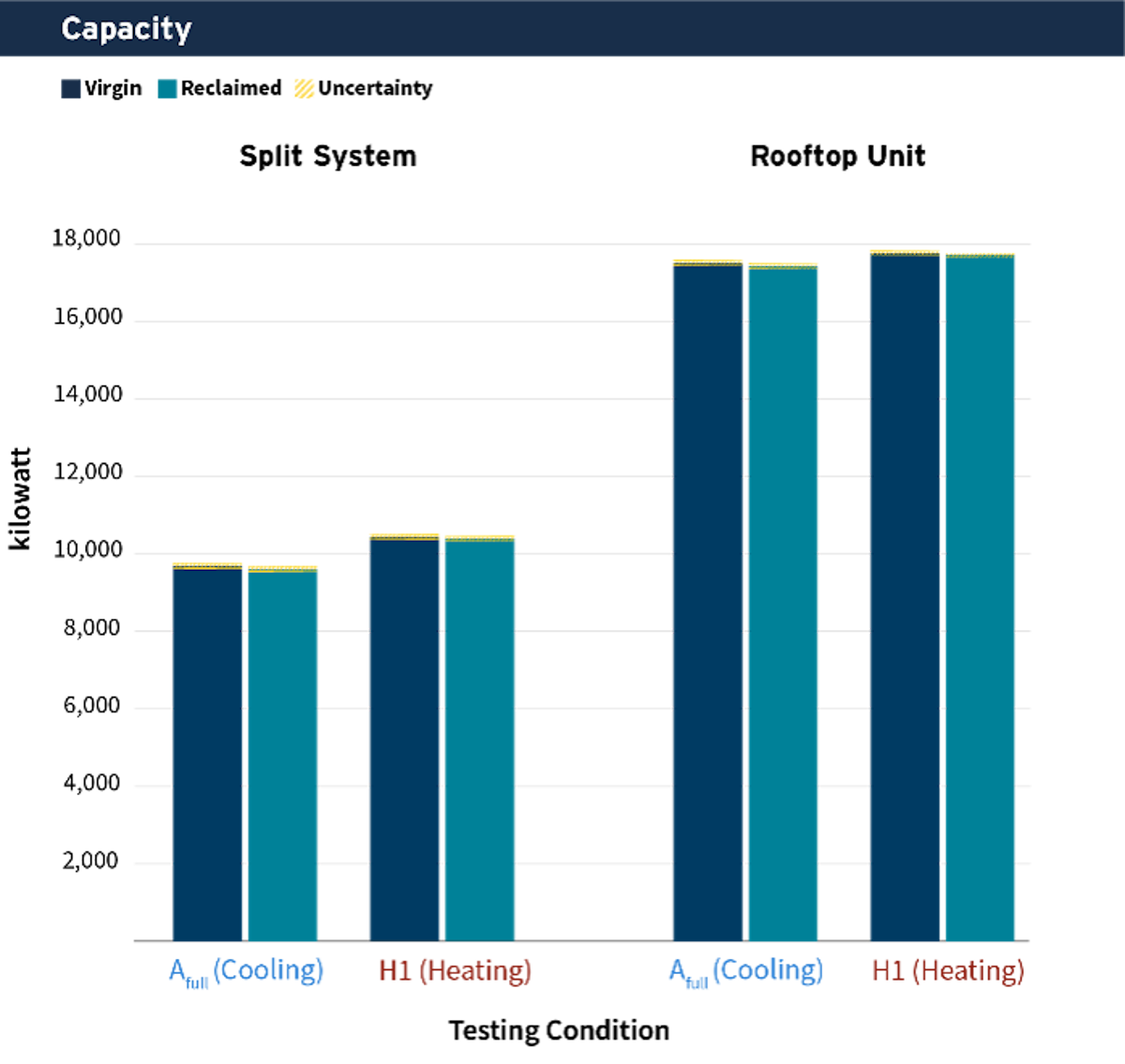
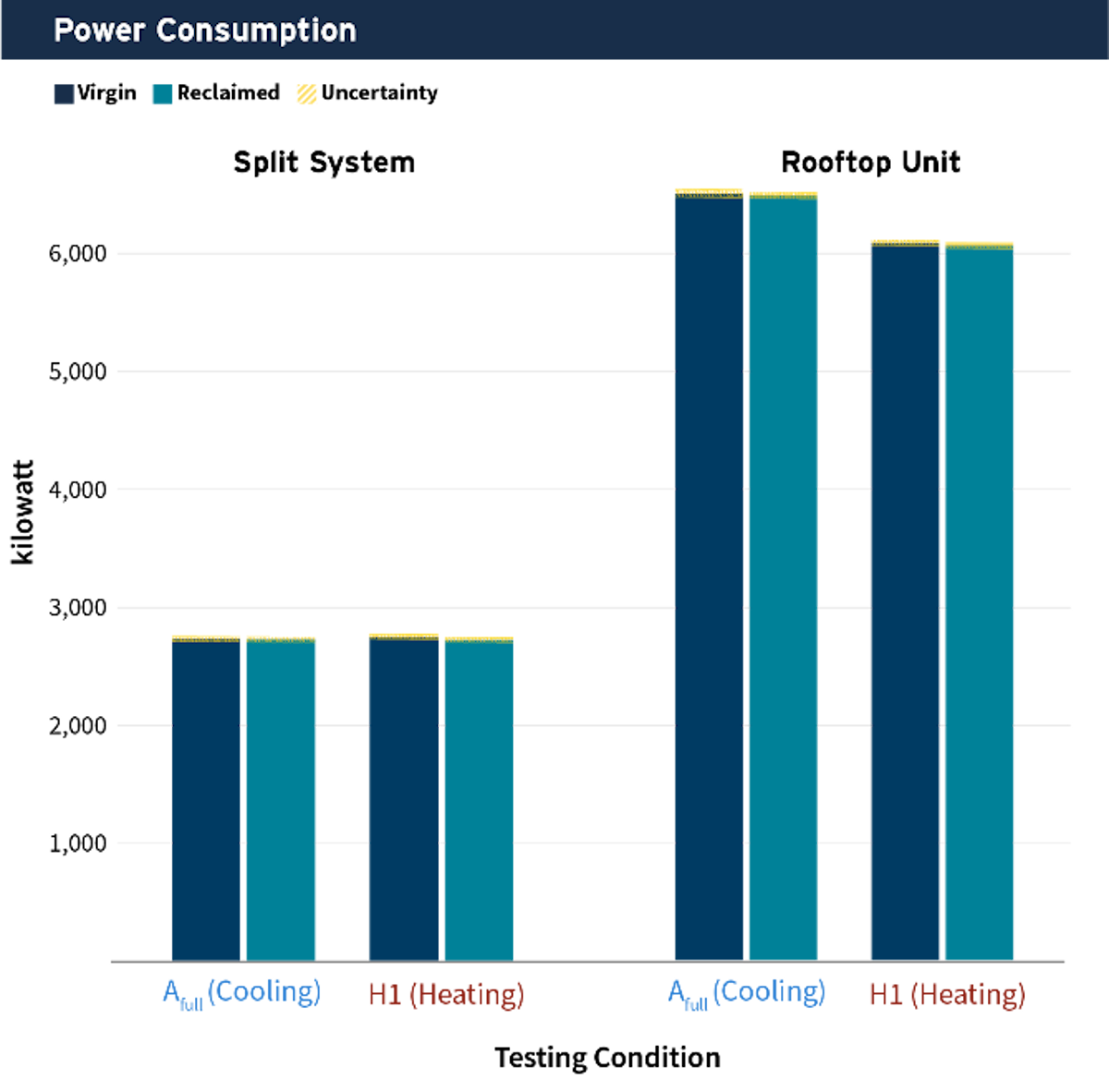
NO DIFFERENCE: In a study on a split system and a rooftop unit, there were no significant differences in capacity and power consumption in both heating and cooling modes. (Courtesy of RMI)
This matters because reclaimed refrigerant can be a tool that supports end users and contractors against supply risk, price risk, and trust risk. As supply decreases, price volatility can affect the affordability of refrigerants.
In Europe, during earlier F-gas quota reductions, refrigerant prices rose sharply before the market adjusted, with some commonly used refrigerants increasing several-fold. And while the U.S. market has not experienced a similar trend for R-22 or R-410A yet, the lesson is relevant — when virgin supply tightens faster than service demand falls, contractors and customers can feel the squeeze.
Recovering refrigerant from equipment is the foundation of managing those risks. Every pound that is vented or left behind in retiring equipment is a pound less that’s available to contractors in the future. Reclaimers cannot produce more reclaimed refrigerant unless more refrigerants are properly recovered, documented, and sold back to them. Furthermore, selling recovered refrigerant back to a reclamation program turns what was a loss into an additional revenue stream — and prevents that refrigerant from releasing into the atmosphere as pollution.
Big Opportunity
The opportunity is large, because the U.S. reclaimed market is still underdeveloped. Studies estimate that reclaimed refrigerant represented only about 3% to 10% of total annual HFC consumption as of 2022, while the installed base of equipment will continue to require service for years. That gap presents a huge opportunity for contractors.
But contractors don’t have to solve this alone. Here are some areas where the industry at large is supporting reclamation:
- OEMs are more frequently supporting reclamation programs.
- The DC Sustainable Energy Utility and Hudson Technologies launched a refrigerant recovery pilot that provides contractor training, recovery support, logistics, and financial incentives for qualifying recovered refrigerant.
- California is also moving in this direction through its REFRESH pilot, supported by California Air Resources Board (CARB) F-gas Reduction Incentive Program, which is designed to increase residential HVAC refrigerant recovery and support the reclamation market.
The contractors who invest in recovery practices now, i.e., recovering refrigerants, separating them into cylinders based on types, documenting recovered gas, working with reclaimers, and building shared awareness among their customers, will be better prepared for 2029 and beyond.
We need to transition to new, low, and ultra-low GWP refrigerant equipment, but it’s equally critical in that transition to properly manage the equipment already in the field. HVAC contractors are central to that outcome. Refrigerant recovery is where they can turn a future supply challenge into a revenue-generating and customer-retention strategy and ultimately support the whole industry to smoothly achieve the goals of the AIM Act.
Looking for a reprint of this article?
From high-res PDFs to custom plaques, order your copy today!