How to Diagnose Partially Restricted Filter Driers
A sight glass is helpful in determining the condition of the system

FIGURE 1: A cutaway of a liquid line filter drier. (Courtesy of Sporlan Division, Parker Hannifin Corp.)
Filter driers are designed to remove foreign materials from refrigeration or air conditioning systems. They are notorious for becoming restricted due to moisture, sludge, dirt, or oil that has entered the system from a poor service practice or extreme operating conditions. Of all these issues, it is excessive moisture that causes most filter driers to become restricted. Some sources of moisture in refrigeration and air conditioning systems include:
- Improper brazing or soldering techniques;
- Leaky systems;
- Improper evacuation techniques;
- Improper handling of hygroscopic system lubricants; and
- Improper handling of system piping at installation.
Some of the most common materials used in filter drier construction are activated alumina and molecular sieve desiccants. Activated alumina is used for removing organic acid molecules from refrigeration systems. Inorganic acids like hydrofluoric and hydrochloric acids are formed when certain refrigerants and water are broken down from very high operating temperatures in a refrigeration system. This is often referred to as system burnout. Activated alumina is often used in both liquid and suction line filter driers for acid cleanups after system burnouts.
Molecular sieve desiccants have honeycomb structures with cavities that are uniform in size. They can selectively absorb molecules based on their polarity (charge) or size. The proper filter drier selection allows water to be absorbed, while at the same time allowing larger molecules like refrigerant and oils to pass by freely. The surface of the desiccant is coated with a positive charge called a cat ion, which attracts polarized molecules such as water. Filter driers with molecular sieves keep freeze-ups, system corrosion, and acid formations at a minimum.
Diagnosing Restrictions
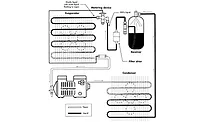
In the example scenario below, the refrigeration system has a partially restricted filter drier. The filter drier is located in the refrigeration system’s liquid line, which is located between the receiver and the metering device. Because the filter drier is located in the liquid line, a restricted filter drier can be referred to as a liquid line restriction. Figure 1 (top) illustrates a cutaway of a liquid line filter drier. It is important to note that any restriction or damage to the liquid line from the receiver outlet to the metering device inlet will have similar symptoms as a restricted filter drier. In this example, assume that the refrigeration system is a TXV/receiver system employing a filter drier and sight glass. The system has R-134a as the working refrigerant.
| Measured Values | |
| Compressor discharge temperature | 215°F |
| Condenser outlet temperature | 70°F |
| Evaporator outlet temperature | 30°F |
| Compressor in temperature | 60°F |
| Ambient temperature | 70°F |
| Box temperature | 30°F |
| Compressor volts | 230 |
| Compressor amps | Low |
| Low-side (evaporating) pressure | 1.8 psig (-10°F) |
| High-side (condensing) pressure | 95 psig (85°F) |
| Calculated Values | |
| Condenser split | 15°F |
| Condenser subcooling | 15°F |
| Evaporator superheat | 40°F |
| Compressor superheat | 70°F |
Notice the low head pressure and the low condenser split in the above system check. Many service technicians believe that when any part of the system’s high side is restricted or plugged, head pressures will elevate. This is simply not the case, especially on a TXV/receiver system. A restricted liquid line will starve the evaporator of refrigerant, causing low evaporator pressures.
With a starved evaporator, the compressor will also be starved of refrigerant, and there will be little heat for the condenser to reject. This small amount of heat to reject will cause a low condensing pressure and temperature. Most of the refrigerant will be stored in the receiver, simulating a pumped-down refrigeration system.
The symptoms for a partially plugged filter drier include:
- Higher-than-normal discharge temperature;
- High superheats;
- Low evaporator pressure;
- Low condensing pressure;
- Normal-to-a-bit-high condenser subcooling;
- Low condenser splits;
- Local cold spot or frost after the restriction;
- Low amp draw; and
- Short cycle the low pressure control (LPC).
Higher than normal discharge temperature: High discharge temperatures are caused from high compressor superheats and high compression ratios. A starved evaporator from the liquid line (filter drier) restriction will cause the high superheats. High compression ratios from the low evaporator pressure will cause high heats of compression as well as high discharge temperatures. This is assuming there is still some mass flow rate of refrigerant through the system. The severity of the restriction in the filter drier will determine how high the discharge temperature will be. If the system becomes completely restricted, the compressor will pump down the system and stay off or short-cycle sometimes on the low-pressure control.
High superheats: Both evaporator and compressor superheats will be high. This is caused from the TXV, evaporator, and compressor being starved of refrigerant from the liquid line restriction. Most of the refrigerant will be in the receiver, with some in the condenser.
Looking for quick answers on air conditioning, heating and refrigeration topics? Try Ask ACHR NEWS, our new smart AI search tool. Ask ACHR NEWS
Low evaporator pressure: The low evaporator pressure is caused from the TEV and compressor being starved of refrigerant. The compressor is trying to draw refrigerant from the evaporator through the suction line, but the liquid line restriction is preventing refrigerant from entering the evaporator. This will cause the compressor to put the evaporator in a low-pressure situation.
Low condensing pressure: Since both the evaporator and compressor are being starved of refrigerant, so will the condenser. Reduced refrigerant to the evaporator will cause a reduced heat load to be delivered to the condenser. The condenser in turn does not have to elevate its temperature and pressure to reject heat. Most of the refrigerant will be in the receiver.
Normal-to-a-bit-high condenser subcooling: Since the condenser has a low heat rejection load, it is not condensing much vapor to liquid. All of the liquid in the condenser will probably sit there for a while and subcool because of the low refrigerant flow caused from the restriction in the filter drier. The receiver will also have a reduced flow in and out of it, as most of the refrigerant will be in the receiver with some in the condenser. If the receiver is in a hot ambient, subcooling may be lost as refrigerant sits in the receiver. This is why some commercial systems have receiver bypasses for certain situations. Receiver bypasses are nothing more than a liquid line solenoid valve controlled by a thermostat, which will bypass liquid around the receiver to the liquid line.
Low condenser splits: Because the condenser is being somewhat starved, there is not much heat to reject from the evaporator being starved. This will cause low condenser splits. Remember, the split is the temperature difference between the condensing temperature and the ambient.
Local cold spot or frost after the restriction: Liquid refrigerant flashing to vapor might occur at the restricted drier if the restriction is severe enough. Simply running your hand along the liquid line and on the filter drier may find a local cold spot. A temperature measuring device on the liquid line about 12 inches before the entrance of the TXV should not be colder than the ambient that surrounds it. If it is, there is a sure restriction somewhere upstream.
There are a lot of scenarios where a filter drier may be partially plugged, and the technician cannot feel a temperature difference across it with their hands. The truth is that humans can only distinguish a temperature difference of more than 10°F across something. A filter drier in an R-134a system with a condensing temperature of 110°F would need about 20 psi pressure drop to exhibit a 10°F temperature difference. Many filter drier restrictions go unchecked by technicians because they are difficult to sense by touch and feel. That is why the use of a sight glass can be a big help in diagnosing this problem (more on this later).
Low amp draw: Because the compressor is being starved of refrigerant from the restriction in the liquid line, it will not have to work as hard in compressing what vapors do pass through it. The low density of the vapors from the low evaporator pressure will require less work from the compressor, requiring a low amp draw.
Short cycle the low-pressure control: The LPC will cycle the compressor off and on from the low evaporator (suction) pressures. Once off, refrigerant will slowly enter the evaporator and cycle the compressor back on. This on and off of the compressor will continue until the problem is fixed.
Sight Glasses
The use of a sight glass after the filter drier will assist the technician, and this same sight glass can help in system charging. A moisture-indicating sight glass will alert the technician if the system is contaminated with moisture by changing colors. With a restriction in the liquid line before the sight glass, bubbles are sure to occur in the sight glass. Many technicians believe that a bubbling sight glass means nothing but an undercharge of refrigerant, but this is simply not true. On startup with some refrigeration systems, if there is a large load on the system, bubbling and flashing could occur in the sight glass downstream of the receiver. This bubbling is caused from a pressure drop at the entrance of the outlet tube of the receiver.
Bubbling could also occur during rapid increases in loads. The TXV could be opened wide during an increase in load, and some flashing could occur even though the receiver has sufficient liquid. Also, sudden changes in head pressure control systems may dump hot gas into the receiver to build up head pressure, causing a sight glass to bubble even though there is sufficient liquid in the receiver to form a seal on the receiver's dip tube outlet. A sight glass on the receiver would prevent technicians from overcharging in this case but would cost the manufacturer a bit more money initially. A sight glass on the liquid line before the TXV would also help let the technician know if any liquid flashing is occurring before the TXV. This flashing could be from loss of subcooling or too much static and/or friction pressure drop in the liquid line before it reaches the TXV.
There is a big difference between a bubbling sight glass and a low flow rate sight glass. If bubbles are entrained in the liquid, this is sign of a pressure drop causing liquid flashing, or an undercharge of refrigerant causing vapor and liquid to exit the receiver because of no subcooling. Remember, the condenser subcooling will be low if an undercharge is causing the bubbling of the sight glass. Otherwise, the bubbling sight glass could mean a restricted liquid line, restricted filter drier, loss of receiver, or liquid line subcooling from a hot ambient or static and friction losses in the liquid line are too great.
On the other hand, a low refrigerant flow rate sight glass is an indication that the system is about ready to cycle off because the box temperature has pulled down to a low enough temperature. It is at these times that the system is at its lowest heat loads and the refrigerant flow rate through the system will be the lowest. The sight glass may be only ¼ to ½ full with no entrained bubbles. This situation is especially true with horizontal liquid lines. Do not add refrigerant in this situation because you will overcharge the system. The overcharge will be noticed at the higher heat loads. The low heat loads cause the system to be at its lowest suction pressure, thus the density of refrigerant vapors entering the compressor will be lowest. Because of the lowest evaporator pressures, the compression ratio will be high, causing low volumetric efficiencies, thus low refrigerant flow rates. There is usually plenty of subcooling in the condenser, but the sight glass will only be partially filled. So, do not confuse a low refrigerant flow rate sight glass with a bubbly sight glass that has bubbles entrained in the liquid.
A sight glass after the filter drier is a good method to tell if the drier is starting to plug because of the refrigerant flash from the added pressure drop in the restricted drier. Filter driers can be purchased with Schrader valves (pressure taps) on their inlets and outlets.
A pressure drop of more than 2 psi measured with the same gauge means that the drier has started to restrict. Also, as mentioned before, a sight glass right before the TXV will surely tell the technician if liquid flashing is occurring there. Just because the sight glass is bubbling doesn't necessarily mean an undercharge, so do not automatically add refrigerant. A lot of systems are found with the receiver completely filled with liquid, because the service technician kept charging refrigerant trying to clear up the sight glass. Also, many refrigerant blends may often slightly bubble a sight glass because they contain two, three, four, or even five different refrigerants in the same blend, all having different properties and characteristics. Always consult with the refrigerant blend manufacturer for more detailed information on refrigerant blend behavior.
Service technicians should always remember that systematic troubleshooting is the only sure way to find the actual cause of any system problem.
Looking for a reprint of this article?
From high-res PDFs to custom plaques, order your copy today!