ACHR News
search
Ask ACHR NEWS AI
cart
facebook twitter instagram linkedin youtube
  • Sign In
  • Subscribe
  • Sign Out
  • My Account
ACHR News
  • NEWS
    • Breaking News
    • New HVAC Products
    • Featured Products
    • Manufacturer Reports
    • HVAC Data
    • Legislation
    • ACHR NEWS Centennial
  • RESIDENTIAL
    • Air Conditioners
    • Furnaces
    • Residential Heat Pumps
    • Ductless
    • Residential IAQ
    • Testing, Monitoring, Tools
    • Components & Accessories
  • COMMERCIAL
    • Air Handlers
    • Rooftop Units
    • Chillers and Cooling Towers
    • Commercial Heat Pumps
    • Boilers and Hydronics
    • VRF/Ductless
    • Commercial IAQ
  • REFRIGERATION
    • Refrigerants
    • Refrigerant Regulations
    • Leak Management
  • CONTRACTOR PRO
    • Geothermal
    • Homeowner Study
    • VRF and VRV Ductless
    • Unitary Trends
  • EDUCATION
    • Training and Education
    • Business Management
    • Service and Maintenance
    • Continuing Education
    • Market Research >
      • HVAC Brand Awareness Report
      • VRV, VRF, VRVZ Report
      • Unitary Trends Report
      • Water Heat Professionals Report
    • Webinars
    • Sponsor Insights
    • eProducts Info
    • White Papers
  • EVENTS
    • HVAC Contractor Forum
    • Industry Events and Webinars
  • MEDIA
    • Videos
    • AHR Expo 2025 Videos
    • Podcasts >
      • ACHR News Podcast
      • HARDI Podcasts
      • AHR Expo Podcasts
      • ACCA Podcasts
    • Interactive Spotlights
    • Quizzes
    • eBooks
    • HVAC Talkback
  • HVAC GROUP
    • ACHR NEWS >
      • Current Issue
      • Digital Edition
      • Subscribe
    • Distribution Trends
    • SNIPS NEWS >
      • Join SNIPS NEWS
    • Engineered Systems News >
      • Join ES News
    • HVACR Directory
    • Contests
    • Newsletters
    • Contact
    • Advertise
    • My Account
Service and MaintenanceHVAC Residential MarketAir Conditioners

Troubleshooting Air Conditioning Systems, Part 3

How to diagnose air-side and refrigerant problems
By John Tomczyk
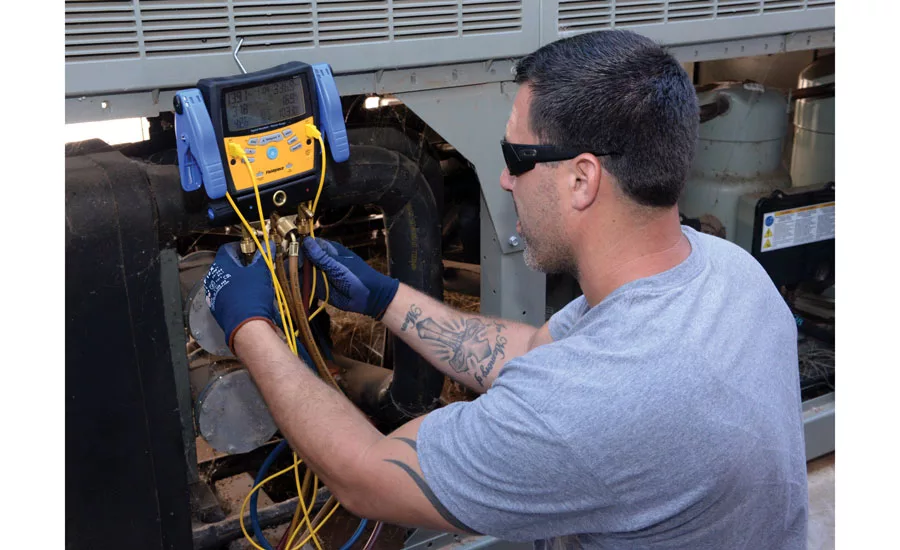
Troubleshooting Air Conditioning Systems.

CORRECT DIAGNOSIS: By understanding the causes behind air-side and refrigerant problems, technicians will be better equippied to quickly diagnose issues in an air conditioning system.

September 9, 2019

This is the third and final installment in the systematic air conditioning troubleshooting series. Part 1 dealt with low and high condenser entering air temperatures, an inefficient compressor, and noncondensables in the system. Part 2 dealt with liquid and suction line restrictions, overcharges and undercharges, and liquid subcooling in the condenser. Part 3 will cover how to diagnose air-side and refrigerant problems.


DIAGNOSING AIRFLOW PROBLEMS

In air conditioning system diagnostics, a service technician must realize that system problems fall mainly into two categories: air-side problems and refrigerant problems. In addition, air-side problems fall into two major categories: either too much or too little air blowing across the evaporator coil.

Assuming proper setup and commissioning of the air conditioning system and the fact that the system has been running fine in the past, too much air probably will not be a problem, since air handling systems do not suddenly increase their air volume flow (cfm) without some outside intervention. When the fan is not directly driven by the motor, the motor will have a sheave, or adjustable pulley, with a connecting belt between it and the fan to drive it. If the driven sheave on the blower motor became loose, the driven belt would ride lower on the driven sheave, thus decreasing the fans speed, not increasing it.

It is also possible to rule out the fan’s speed being too high, since most air conditioning units call for higher fan speeds in order to move the higher densities of colder air associated with air conditioning. This is why the majority of airflow problems will fall into the low airflow category rather than too much airflow.

However, remember that many times, air conditioning systems are not set up properly in the first place. There can be bad duct design, which can include either oversized or undersized ducts — or simply leaky ducts.

To determine if it is an airflow or a refrigerant problem, first record the air temperatures in and out of the evaporator coil and determine if it is higher or lower than it should be. Airflow that is too low will result in greater temperature differences across the coil, rather than too much airflow. This greater temperature difference is from the air being in contact with the coil longer, thus decreasing its temperature coming out of the coil. By comparing the measured temperature difference to the manufacturer’s required temperature differences, a technician can establish whether there is an airflow problem or a refrigerant flow problem.


MEASURE TEMPERATURE DIFFERENCE

What should the temperature difference across the evaporator coil be? To determine, a technician must obtain the wet bulb temperature (wbt) and dry bulb temperature (dbt) of the air entering the coil. A psychrometer is the only instrument needed for these measurements, and it has both wet and dry bulb thermometers in one package.

Looking for quick answers on air conditioning, heating and refrigeration topics? Try Ask ACHR NEWS, our new smart AI search tool. Ask ACHR NEWS →

Today, psychrometers are often digital; however, a thermistor or thermocouple with a wet piece of cotton wrapped around it can give the wbt accurately enough for air conditioning work.

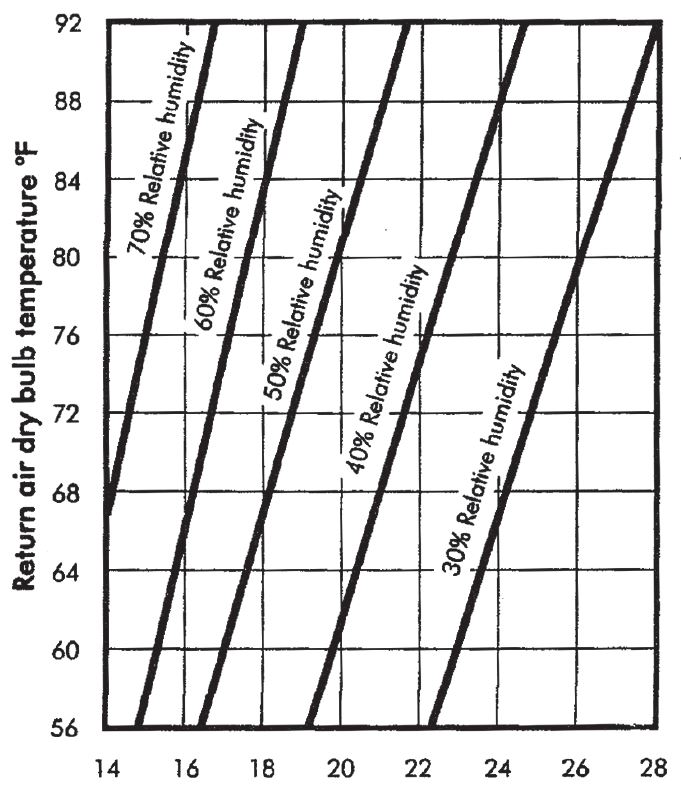
Once both the wbt and dbt of the entering air are measured, the relative humidity of the entering air can be obtained from a chart or table from the manufacturer (see Figure 1). In Figure 1, for a constant air entering or return air dbt, the temperature difference across the coil increases with decreasing relative humidity. The reason for this larger temperature difference with lower relative humidity is the decreased moisture (latent) load that the air conditioning coil has to condense. If the coil doesn’t have to condense as much moisture out of the air, it can perform more sensible cooling because the coil’s temperature will be lower.
ORBIS beverage pallets.

FIGURE 1: This chart shows the relative humidity of the entering air.

Sensible cooling is what is determined when measuring the temperature difference across a cooling coil with a dry bulb temperature. If the temperature difference is greater than the required temperature difference across the coil (see Figure 1), then it is an airflow problem. The problem would be low airflow, causing the air to stay in contact with the coil much too long, giving a greater temperature difference across the coil.

However, if the temperature difference across the coil is less than the required temperature difference, it would be a refrigerant flow problem instead of an airflow problem. This is because air conditioning systems hardly ever increase in airflow without some kind of human intervention.

Listed below are some causes that may cause a decreased airflow in an air conditioning system:

  • Restriction in the duct system;
  • Dirty evaporator coil;
  • Dirty or missing fan blades;
  • Direct drive blower with wrong speed tap on the motor;
  • Variable-frequency drive malfunctioning and running the fan motor too slow;
  • Dirty air filters;
  • Faulty duct design;
  • Fan pulleys loose;
  • Fan belts slipping; and/or
  • Blower motor running slow (burning out).

By understanding the causes behind air-side and refrigerant problems, technicians will be better able to quickly diagnose issues in an air conditioning system.

See more articles from this issue here!

KEYWORDS: air conditioning systems FROSTlines troubleshooting and HVACR

Share This Story

Looking for a reprint of this article?
From high-res PDFs to custom plaques, order your copy today!


John Tomczyk is HVACR professor emeritus, Ferris State University, Big Rapids, Michigan, and coauthor of Refrigeration & Air Conditioning Technology, published by Cengage Learning. Contact him at tomczykjohn@gmail.com.

Recommended Content

JOIN TODAY
To unlock your recommendations.

Already have an account? Sign In

  • HVAC-enrollment

    The Trades Are Back: HVACR Programs See Nearly 30% Enrollment Spike

    A new wave of future technicians is entering the pipeline.  
    News
    By: Matt Jachman
  • 2025 Top 40 Under 40

    2025 Top 40 Under 40 HVACR Professionals List

    The 11th annual Top 40 Under 40 list highlights those...
    HVAC Commercial Market
    By: Hannah Belloli-Oster
  • LG Ductless Mini-Split Systems

    The 9 Types of Heat Pumps

    As the U.S. moves toward electrification, heat pumps are...
    HVAC Commercial Market
    By: Joanna R. Turpin
Subscription Center
  • Create an Account
  • Start a Subscription
  • Manage My Account
  • Sign Up for Newsletters
  • Visit Customer Service
  • Update Preferences

More Videos

Sponsored Content

Sponsored Content is a special paid section where industry companies provide high quality, objective, non-commercial content around topics of interest to The News audience. All Sponsored Content is supplied by the advertising company and any opinions expressed in this article are those of the author and not necessarily reflect the views of The News or its parent company, BNP Media. Interested in participating in our Sponsored Content section? Contact your local rep!

close
  • Piggy Bank
    Sponsored byWatercress Financial

    Energy Prices, Inflation, and HVAC: What Today’s Homeowners Care About

  • Refrigerated Food
    Sponsored bySolstice Advanced Materials

    R-455A Refrigeration: A Cold Storage Solution for the Future

  • Airex Rooftop Units
    Sponsored byAirex Manufacturing Inc

    Consolidating Roof Penetrations: A Growing Trend in Multifamily HVAC Design

Popular Stories

HVAC-Price-Increase-graphic

HVAC Price Increase List: June 2026

Trump-Section-232.jpg

Trump Reduces Section 232 Tariffs on HVAC Equipment to 15%

R410A-Refrigerant-Cylinder.jpg

Refrigerant Recovery is a Revenue Opportunity

Heat-pump-cutaway.jpg

PFAS Rules and A2L Building Codes Continue to Evolve

Midea-training.jpg

HVAC Workforce Crisis Expands Beyond Technicians to Instructor Shortages

View The ACHR NEWS
Centennial Anniversary Timeline

The ACHR News Timeline Chart
Submit a Letter
Submit a letter to our editors.

Events

November 6, 2025

Next-Gen Data Center Cooling: HVAC Innovation and Real-World Solutions

On Demand As AI workloads and high-density computing push traditional cooling methods to their limits, the data center industry is accelerating the adoption of next-generation HVAC technologies.

June 17, 2026

Decarbonization Without Disruption

This webinar will explore practical HVAC decarbonization strategies that minimize disruption while maximizing long-term performance and ROI.

View All Submit An Event

Poll

Summer Staff

Are you fully staffed for the summer season?
View Results Poll Archive

Products

BNI Mechanical/Electrical Square Foot Costbook, 2026 Edition

BNI Mechanical/Electrical Square Foot Costbook, 2026 Edition

See More Products
Decarbonization Without Disruption - Free Webinar - 6/17/2026

Related Articles

  • Tips for Troubleshooting Air Conditioning Systems

    Tips for Troubleshooting Air Conditioning Systems, Part 2

    See More
  • How to Troubleshoot Air Conditioning Systems - The ACHR News

    How to Troubleshoot Air Conditioning Systems

    See More
  • The Professor: Diagnosing Air Conditioning Systems

    See More

Related Products

See More Products
  • ac.png

    Air Conditioning Service Guide R-410A and R-22 Systems 2nd Edition

  • EHEP002028.jpg

    Principles of Heating, Ventilation, and Air Conditioning in Buildings, 1st Edition

  • HVACR-Troubleshooting-Fundamentals-Cover-Image-One-Sheet.jpg

    HVACR Troubleshooting Fundamentals - Refrigeration & Air Flow Systems Training Package for Instructors & Service Managers

See More Products

Related Directories

  • Ai Air Conditioning Corp.

    AI Air Conditioning Corp. is a New York-based wholesaler and distributor of Midea heating, ventilation, and air conditioning (HVAC) systems, offering products and engineering support for commercial and residential projects.
  • Friedrich Air Conditioning

    Friedrich offers premium room air conditioning and heat/cool products that include packaged terminal air conditioners, universal heat pumps, single package vertical units, mini-split systems, window and through-the-wall units, portable air conditioners and dehumidifiers.
  • US Air Conditioning Distributors

    US Air Conditioning Distributors is your One-Stop-Shop for equipment, compressors, supplies and parts for all brands of HVAC equipment.
×

Sign Up. Stay Informed.

The #1 trusted source for the HVACR industry since 1926

SUBSCRIBE
  • RESOURCES
    • Advertise
    • Contact Us
    • Advisory Board
    • Classifieds
    • Submit a Letter
    • Directories
    • Store
  • ACCOUNT CENTER
    • Create an Account
    • Start a Subscription
    • Manage My Account
    • Sign Up for Newsletters
    • Visit Customer Service
    • Update Preferences
  • SERVICES
    • Marketing Services
    • Reprints
    • Market Research
    • List Rental
    • Survey/Respondent Access
  • STAY CONNECTED
    • LinkedIn
    • Facebook
    • Instagram
    • YouTube
    • X (Twitter)
  • PRIVACY
    • PRIVACY POLICY
    • TERMS & CONDITIONS
    • DO NOT SELL MY PERSONAL INFORMATION
    • PRIVACY REQUEST
    • ACCESSIBILITY

Copyright ©2026. All Rights Reserved BNP Media, Inc. and BNP Media II, LLC.

Design, CMS, Hosting & Web Development :: ePublishing