Tips for Troubleshooting Air Conditioning Systems, Part 2
Liquid/suction line restrictions, over- and undercharges, and liquid subcooling
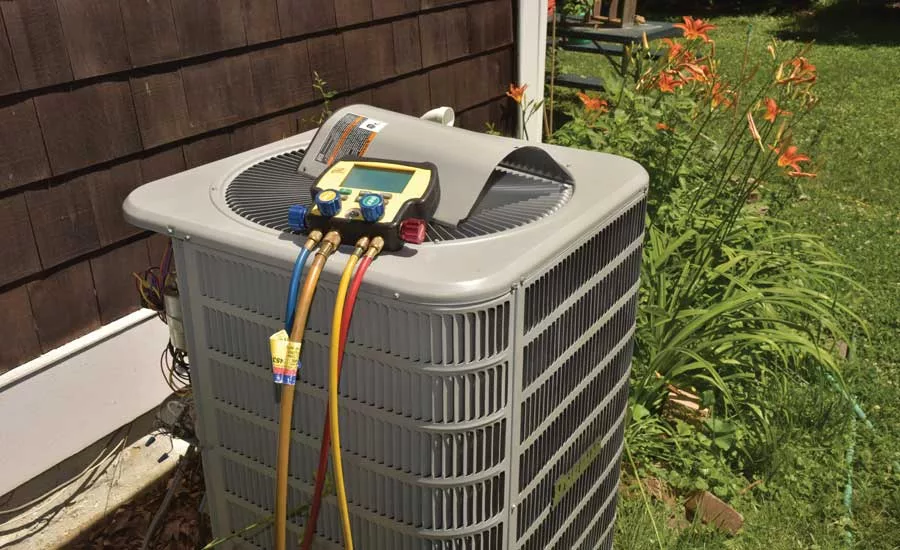
As noted in last month’s article, troubleshooting an air conditioning system often concerns refrigerant, airflow and mechanical problems, either individually or in combination. This installment in this series of articles will deal with an air conditioner’s liquid and suction line restrictions, overcharges and undercharges, and liquid subcooling in the condenser.
LIQUID LINE RESTRICTIONS
Liquid line restrictions can be caused by multiple problems, including:
- Restricted filter drier;
- Restricted thermostatic expansion valve (TXV) inlet screen/filter;
- Kinked or damaged liquid line;
- Kinked or bent U-bends on lower condenser coil;
- Restrictive solder joint in the liquid line; and/or
- Oil-logged capillary tube.
A restricted liquid line will starve the evaporator of refrigerant, thus causing low pressures in the evaporator. If the evaporator is starved of refrigerant, the compressor and condenser will also be starved of refrigerant, so the evaporator will not absorb much heat for the condenser to reject.
However, most of the refrigerant will be in the condenser and not necessarily cause high head pressures because of the reduced heat load on the evaporator. Because most of the refrigerant charge is in the condenser, liquid subcooling in the condenser will increase. This is a big difference from an undercharge of refrigerant, which will cause low condenser subcooling. If the system has a receiver, much of the refrigerant will be in the receiver, causing lower-than-normal head pressures.
Some other symptoms of a liquid line restriction are:
- High superheats from a starved evaporator;
- Low ampere draw at the compressor from the reduced refrigerant flow through it;
- Bubbles in the sight glass if the restriction is before the sight glass (sight glasses are optional on some systems);
- Low to normal head pressures from a low mass flow rate of refrigerant; and/or
- Local cool spot after a severe restriction from expansion of the refrigerant at the local pressure drop.
RESTRICTED SUCTION LINE
A restricted suction line will cause low suction pressures and also a starved compressor and condenser. The suction line is a much more sensitive refrigerant line than the liquid line, because much less dense refrigerant (vapor instead of liquid) flows through it.
A starved compressor will lead to low compressor amp draw because of its lightened load. The condensing pressure will also be low from the condenser’s light load. Since suction line restrictions starve compressors of refrigerant, the entire mass flow rate of refrigerant will decrease through the system, causing high superheats from inactive evaporators.
Restricted and/or dirty suction filters are the major cause of suction line restrictions. Liquid subcooling in the condenser will be normal to a bit high, since a lot of refrigerant will be in the condenser coil but not being circulated very fast. The condenser subcooling may be normal to a bit high if there is a receiver in the system. This subcooling in the condenser indicates that there is refrigerant in the system and that an undercharge of refrigerant can be ruled out.
OVERCHARGE
A system with an overcharge of refrigerant will have higher-than-normal condensing temperatures because of liquid backing up in the condenser and robbing it of useful condensing area. In reciprocating compressors, the elevated head pressure causes the volumetric efficiency of the compressor to decrease because of higher pressures of the re-expanding clearance volume vapors in the clearance pocket of the compressor. The amp draw of the compressor will increase from the higher head pressure, creating higher compression ratios, and the entire system will have reduced capacities.
Looking for quick answers on air conditioning, heating and refrigeration topics? Try Ask ACHR NEWS, our new smart AI search tool. Ask ACHR NEWS
If the system has a TXV metering device, the TXV will still try to maintain its superheat, and the evaporator pressure will be normal to slightly high, depending on the amount of overcharge. The higher evaporator pressure will be caused from the decreased mass flow rate from the higher compression ratio, and the evaporator will have a hard time keeping up with the higher heat load of the warmer entering air temperature. The TXV will have a tendency to overfeed on its opening strokes due to the high head pressures.
If the system has a capillary tube metering device, the same symptoms occur except for evaporator superheat. Remember, one reason a capillary tube system is critically charged is to prevent flooding of the compressor on low evaporator loads. The higher head pressures of an overcharged capillary tube system will have a tendency to overfeed the evaporator, thus decreasing the superheat. If the system is more than 10 percent overcharged, liquid can enter the suction line and get into the compressor’s valving and/or crankcase. This will result in compressor damage, and soon, failure.
UNDERCHARGE
Low suction and discharge pressures, low condenser subcooling, and high superheat in the evaporator are all indications of an undercharge of refrigerant. Undercharged systems have less mass flow rate or refrigerant throughout the entire system. Severely undercharged systems will run very low condenser subcooling because of no refrigerant to subcool.
If the subcooling drops to zero, the hot gas in the condenser will start to leave the condenser with some liquid; thus, bubbles will form in the sight glass (if the system has one). Compressor amp draw will be low because of the decreased refrigerant flow. Service technicians can be confused as to whether the problem is an undercharge of refrigerant or a liquid line restriction, because symptoms are very similar. Remember, a liquid line restriction will give the system a lot of subcooling in the condenser, whereas an undercharge will not.
REFRIGERANT SUBCOOLING
Condenser subcooling can be measured at the condenser outlet with a thermometer or thermocouple and a pressure gauge. Subcooling is defined as the difference between the measured liquid temperature and the saturation temperature at a given pressure. Simply subtract the condenser out temperature from the saturation temperature at the condenser outlet to get the amount of liquid subcooling in the condenser.
The saturation pressure has to be measured at the condenser outlet and converted to a temperature. Always take the pressure at the same point the temperature is taken, as this will alleviate any pressure drop error through the condenser. A forced air condenser should have from 6° to 10°F of liquid subcooling if charged properly. However, the amount of condenser subcooling depends on the static and friction line pressure losses in the liquid line, and will vary from system to system. The 6° to 10° of liquid subcooling is assuming no liquid amplification pump is pressurizing the liquid out of the condenser. Condenser subcooling can be an indicator of the refrigerant charge in the system. For receiverless systems, the less the refrigerant charge, the less the subcooling.
Another factor that will affect condenser subcooling is the air entering the condenser. As the condenser air entering temperature increases, the liquid subcooling will decrease. This is because higher condensing (head) pressures will force more of the subcooled liquid through the metering device to the evaporator. This will also affect evaporator superheat. The evaporator superheat will be less from the increased flow rate through its coil, assuming the system has a capillary tube or restrictive orifice as a metering device. TXV metering devices should hold a somewhat constant evaporator superheat under all system conditions, as long as the TXV valve’s rated conditions are not exceeded.
Want to read more? See more articles from this issue here!
Looking for a reprint of this article?
From high-res PDFs to custom plaques, order your copy today!