ACHR News
search
Ask ACHR NEWS AI
cart
facebook twitter instagram linkedin youtube
  • Sign In
  • Subscribe
  • Sign Out
  • My Account
ACHR News
  • NEWS
    • Breaking News
    • New HVAC Products
    • Featured Products
    • Manufacturer Reports
    • HVAC Data
    • Legislation
    • ACHR NEWS Centennial
  • RESIDENTIAL
    • Air Conditioners
    • Furnaces
    • Residential Heat Pumps
    • Ductless
    • Residential IAQ
    • Testing, Monitoring, Tools
    • Components & Accessories
  • COMMERCIAL
    • Air Handlers
    • Rooftop Units
    • Chillers and Cooling Towers
    • Commercial Heat Pumps
    • Boilers and Hydronics
    • VRF/Ductless
    • Commercial IAQ
  • REFRIGERATION
    • Refrigerants
    • Refrigerant Regulations
    • Leak Management
  • CONTRACTOR PRO
    • Geothermal
    • Homeowner Study
    • VRF and VRV Ductless
    • Unitary Trends
  • EDUCATION
    • Training and Education
    • Business Management
    • Service and Maintenance
    • Continuing Education
    • Market Research >
      • HVAC Brand Awareness Report
      • VRV, VRF, VRVZ Report
      • Unitary Trends Report
      • Water Heat Professionals Report
    • Webinars
    • Sponsor Insights
    • eProducts Info
    • White Papers
  • EVENTS
    • HVAC Contractor Forum
    • Industry Events and Webinars
  • MEDIA
    • Videos
    • AHR Expo 2025 Videos
    • Podcasts >
      • ACHR News Podcast
      • HARDI Podcasts
      • AHR Expo Podcasts
      • ACCA Podcasts
    • Interactive Spotlights
    • Quizzes
    • eBooks
    • HVAC Talkback
  • HVAC GROUP
    • ACHR NEWS >
      • Current Issue
      • Digital Edition
      • Subscribe
    • Distribution Trends
    • SNIPS NEWS >
      • Join SNIPS NEWS
    • Engineered Systems News >
      • Join ES News
    • HVACR Directory
    • Contests
    • Newsletters
    • Contact
    • Advertise
    • My Account
NewsRefrigerationGuest ColumnRefrigerants

FROSTlines

Mythbusting CO₂ Refrigeration Systems, Part 2

Misconceptions surround the natural refrigerant, which has been used safely for years
By Scott Martin
CO2 System
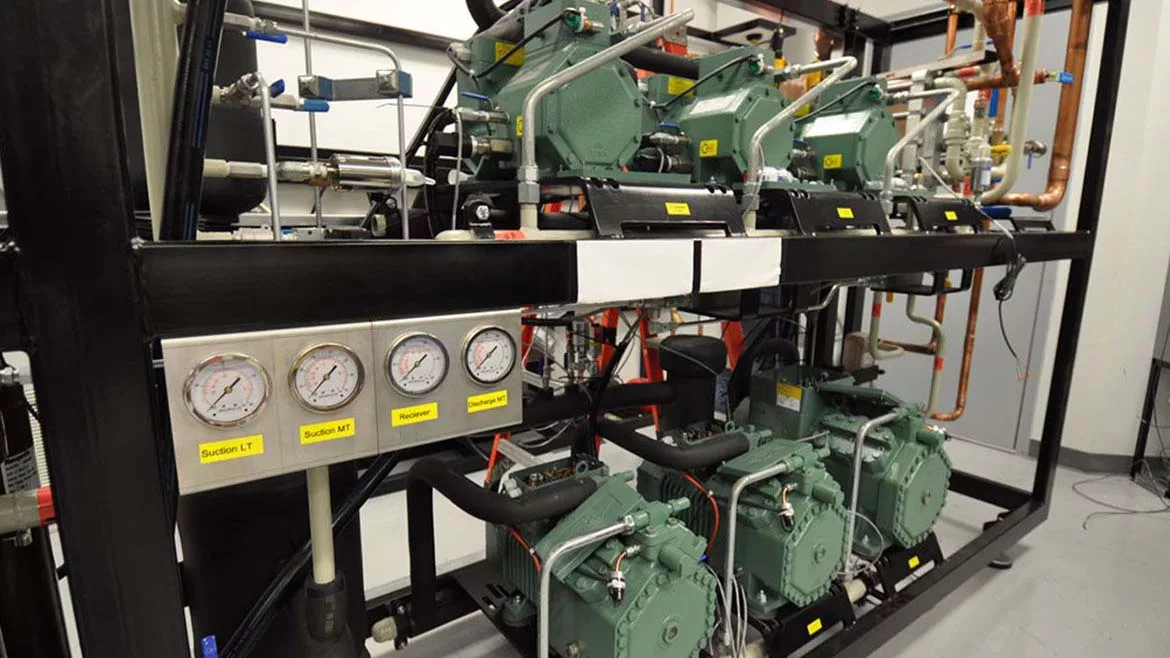
NO RISK: All sections of the CO2 system that require high pressure are located either in an equipment room or on the roof, posing no risk to shoppers or employees. (Courtesy of Hillphoenix)
June 26, 2024

As noted in Part 1, carbon dioxide (CO2) has served as a dependable and safe refrigerant since the Industrial Revolution. Even though modern food retailers are increasingly adopting CO2 (R-744) as their preferred refrigerant, skepticism remains as to how well this refrigerant works. This second installment of a two-part series will delve into additional misconceptions surrounding the use of CO2.


Myth: Pressure in a CO2 System Is Dangerously High

Pressure is required to operate a CO2 system, prompting concerns about the potentially high pressures — up to 1,600 psi — particularly on hot summer days. There is a fear that such pressures could pose a danger to anyone who comes into close contact with the coolers or freezers. The truth is that all sections of the CO2 system that require high pressure are located either in an equipment room or on the roof, posing no risk to shoppers or employees.

Another way to consider this fear is by looking at paintball and scuba diving. A paintball gun powered by a CO2 cylinder (positioned under the shooter’s arm) experiences 894 psi at an ambient temperature of 75ºF. No one is worried the paintball gun’s CO2 cylinder is too dangerous; in fact, some newer model paintball guns are powered by high-pressure air or nitrogen – between 3,000 and 4,500 psi.

For scuba divers, a compressed air tank resting behind their heads can have pressure ranging anywhere from 2,400 to 3,500 psi. Again, no one says these pressure levels are dangerously high.

Reality: The pressure in a CO2 system located inside a grocery store is actually lower than the pressure used to power paintball guns and scuba tanks, and we don’t think twice about playing paintball or scuba diving.


Myth: Leak Rates in CO2 Systems Are Greater Than 100%

This myth needs some clarification of terms. There is a difference between leak rates and emission rates. Leaks can occur in any system and can go unnoticed for days, months, or years, which may result in a large rate of fugitive gases being released into the atmosphere. Emission rates, on the other hand, concern three areas:

  1. Actual leaks in piping or fittings.
  2. Service and repair activities in which gases may need to be vented to the atmosphere.
  3. Power failures that force the relief valve to open, emitting gases into the atmosphere.

As a real-world example, a system for a food retailer holds approximately 400 pounds of CO2 total. When surveyed, a contractor said he adds approximately one 40-pound cylinder per year, which is a leak rate of 10% — nowhere near 100%.

To demonstrate emissions due to a power failure, Hillphoenix tested a CO2 system with a 650-psi (45 bar) relief valve on the system’s suction line. When the system was shut down, the 650-psi relief valve activated after 7.5 hours.

Looking for quick answers on air conditioning, heating and refrigeration topics? Try Ask ACHR NEWS, our new smart AI search tool. Ask ACHR NEWS →

An added benefit of CO2 is that it’s odorless, non-corrosive, non-toxic, and nonflammable, which means no reclamation is needed.

Reality: It is necessary to differentiate between leak rate and emission rate. When you do, it becomes apparent that a typical leak rate for a CO2 system is closer to 10%, and if emissions occur during service or repair, there is no need for reclaim.


Myth: Refrigerant-Grade CO2 Isn’t Widely Available in North America

In 2020 and 2021, outside factors contributed to this myth, including contaminated wells and a shortage of CO2 cylinders. There were also notorious supply chain issues. But CO2 supply worries are essentially a thing of the past.

For many years, refrigerant systems required 99.99% pure Grade 4 Coleman/instrument-grade CO2. This level of purity was needed to ensure that the CO2 did not contain excessive impurities or moisture. However, there has been a change in the grades of CO2 approved for use in refrigerant systems. A regulation change now allows 99.9% pure refrigerant-grade CO2 to be used, as it has comparable purity and moisture levels.

Also, in cases of emergency or a shortage of higher-grade CO2, lesser grades may be used as long as a filter drier is used during charging activities, and the user verifies that no air or non-condensable gases are present in the CO2 after charging.

Reality: Refrigerant-grade CO2 is widely available from many suppliers in North America, and both refrigerant- and Coleman-grade CO2 are now acceptable for refrigeration systems.


Myth: Adiabatic Gas Coolers Use Too Much Water and Are Required in Warm Climates

Operators have used adiabatic gas coolers for years to keep system pressures lower and save on energy costs. Adiabatic gas coolers must be used in regions where the ambient design temperature can reach or exceed 101ºF, according to ASHRAE. Of the 2,943 climate stations that ASHRAE operates in the U.S. and Canada, only 14% (roughly 410 sites) — most of which are in the western U.S. and Canada — experience 101ºF ambient temperatures.

There are also cherry-picked examples, like a store in a hot southwest climate that uses a lot of water. What may go unsaid, however, is that the facility is massive — three times the size of a typical store. And if an adiabatic gas cooler is operated in a normal-sized store and in a higher water-saving mode, significantly less water will be used.

Other methods to keep operating pressures low during hot summer days are utilized worldwide and are currently being field trialed in North America.

Reality: Those who argue adiabatic gas coolers must be used in warmer climates — and that they are water hogs — are being selective with the data and not telling the entire story.


Myth: CO2 Transcritical Systems with Dry-Gas Coolers Require Water Spray During High Ambient-Temperature Conditions

Some people are convinced that a sprinkler is needed on a system with a dry-gas cooler to keep the system pressure low when the ambient temperature gets close to 100ºF.

To refute this myth, data was gathered from many refrigeration installations with dry-gas coolers in the Upper Midwest. Even as the ambient temperature approached 101ºF, the dry-gas cooler continued to operate as expected, and there was no need for a sprinkler. Even at that elevated temperature, the high-pressure valve never came close to fully opening.

Reality: A properly sized and maintained dry-gas cooler does not require water spray as ambient temperatures rise toward 101ºF.


The bottom line is that CO2 is a safe and reliable refrigerant that many modern food retailers are finding to be an ideal choice for their refrigeration systems.

Read Part 1
KEYWORDS: alternative refrigerants CO2 refrigeration FROSTlines HFC refrigerants transcritical CO2

Share This Story

Looking for a reprint of this article?
From high-res PDFs to custom plaques, order your copy today!


Scott martin
Scott Martin is the senior director of industry relations and compliance at Hillphoenix, part of Dover Food Retail. He earned his mechanical engineering degree from Southern Polytechnic State University and has more than 40 years of experience in the refrigeration industry. He can be reached at smartin@doverfoodretail.com.

Recommended Content

JOIN TODAY
To unlock your recommendations.

Already have an account? Sign In

  • HVAC-enrollment

    The Trades Are Back: HVACR Programs See Nearly 30% Enrollment Spike

    A new wave of future technicians is entering the pipeline.  
    Training and Education
    By: Matt Jachman
  • 2025 Top 40 Under 40

    2025 Top 40 Under 40 HVACR Professionals List

    The 11th annual Top 40 Under 40 list highlights those...
    HVAC Light Commercial Market
    By: Hannah Belloli-Oster
  • LG Ductless Mini-Split Systems

    The 9 Types of Heat Pumps

    As the U.S. moves toward electrification, heat pumps are...
    News
    By: Joanna R. Turpin
Subscription Center
  • Create an Account
  • Start a Subscription
  • Manage My Account
  • Sign Up for Newsletters
  • Visit Customer Service
  • Update Preferences

More Videos

Sponsored Content

Sponsored Content is a special paid section where industry companies provide high quality, objective, non-commercial content around topics of interest to The News audience. All Sponsored Content is supplied by the advertising company and any opinions expressed in this article are those of the author and not necessarily reflect the views of The News or its parent company, BNP Media. Interested in participating in our Sponsored Content section? Contact your local rep!

close
  • An illustration shows a house with a geothermal heating system. Pipes are depicted running underground.
    Sponsored byClimateMaster

    Residential Tax Credits Are Ending, But Demand Continues

  • Piggy Bank
    Sponsored byWatercress Financial

    Energy Prices, Inflation, and HVAC: What Today’s Homeowners Care About

  • Refrigerated Food
    Sponsored bySolstice Advanced Materials

    R-455A Refrigeration: A Cold Storage Solution for the Future

Popular Stories

HVAC-Price-Increase-graphic

HVAC Price Increase List: July 2026

price-raising-practices.jpg

Rising Costs Force Contractors to Take a Harder Look at Pricing

DOE-sign.jpg

HVAC Groups Support DOE’s Rulemaking to Cut Energy Efficiency Mandates

Industry-Ethics_-Service-Calls.jpg

HVAC Contractor Agrees to $300K Settlement Over Alleged Deceptive Sales Practices

Daikin Applied CEO Yu Nishiwaki

Daikin Applied Announces New Top Leadership

View The ACHR NEWS
Centennial Anniversary Timeline

The ACHR News Timeline Chart
Submit a Letter
Submit a letter to our editors.

Events

November 6, 2025

Next-Gen Data Center Cooling: HVAC Innovation and Real-World Solutions

On Demand As AI workloads and high-density computing push traditional cooling methods to their limits, the data center industry is accelerating the adoption of next-generation HVAC technologies.

July 22, 2026

Designing VRF Systems Using A2L Refrigerant

In this session, we will cover how to design VRF systems for the U.S. market using new A2L refrigerants. These systems provide an advanced zoning solution by using inverter technology to deliver precise heating and cooling control across multiple zones and spaces.

View All Submit An Event

Poll

Summer Staff

Are you fully staffed for the summer season?
View Results Poll Archive

Products

BNI Mechanical/Electrical Square Foot Costbook, 2026 Edition

BNI Mechanical/Electrical Square Foot Costbook, 2026 Edition

See More Products
Designing Systems Using A2L Refrigerant - Free Webinar - 7/22/2026

Related Articles

  • CO2 Refrigeration System

    Mythbusting CO₂ Refrigeration Systems, Part 1

    See More
  • Tips for Troubleshooting Air Conditioning Systems

    Tips for Troubleshooting Air Conditioning Systems, Part 2

    See More
  • Joanna POV Frostlines

    Grocers Not Yet Sold On CO₂ Refrigeration Systems

    See More

Related Products

See More Products
  • Troubleshooting Tips for Servicing Refrigeration Systems

  • Understanding TXV Refrigeration Systems: Superheat and Subcooling DVD

  • Evaluating-and-Troubleshooting-Refrigeration-Systems-Video-Cover-210x300.jpg

    Evaluating Refrigeration Systems Troubleshooting & Identifying Problems CONTINUED

See More Products

Related Directories

  • M2 Mechanical

    At M2, we know what we do well and that is service of HVAC units at commercial sites throughout New England. We are ready to repair, replace, retrofit and recommend the best solution for your facility.
×

Sign Up. Stay Informed.

The #1 trusted source for the HVACR industry since 1926

SUBSCRIBE
  • RESOURCES
    • Advertise
    • Contact Us
    • Advisory Board
    • Classifieds
    • Submit a Letter
    • Directories
    • Store
  • ACCOUNT CENTER
    • Create an Account
    • Start a Subscription
    • Manage My Account
    • Sign Up for Newsletters
    • Visit Customer Service
    • Update Preferences
  • SERVICES
    • Marketing Services
    • Reprints
    • Market Research
    • List Rental
    • Survey/Respondent Access
  • STAY CONNECTED
    • LinkedIn
    • Facebook
    • Instagram
    • YouTube
    • X (Twitter)
  • PRIVACY
    • PRIVACY POLICY
    • TERMS & CONDITIONS
    • DO NOT SELL MY PERSONAL INFORMATION
    • PRIVACY REQUEST
    • ACCESSIBILITY

Copyright ©2026. All Rights Reserved BNP Media, Inc. and BNP Media II, LLC.

Design, CMS, Hosting & Web Development :: ePublishing