ACHR News
search
Ask ACHR NEWS AI
cart
facebook twitter instagram linkedin youtube
  • Sign In
  • Subscribe
  • Sign Out
  • My Account
ACHR News
  • NEWS
    • Breaking News
    • New HVAC Products
    • Featured Products
    • Manufacturer Reports
    • HVAC Data
    • Legislation
    • ACHR NEWS Centennial
  • RESIDENTIAL
    • Air Conditioners
    • Furnaces
    • Residential Heat Pumps
    • Ductless
    • Residential IAQ
    • Testing, Monitoring, Tools
    • Components & Accessories
  • COMMERCIAL
    • Air Handlers
    • Rooftop Units
    • Chillers and Cooling Towers
    • Commercial Heat Pumps
    • Boilers and Hydronics
    • VRF/Ductless
    • Commercial IAQ
  • REFRIGERATION
    • Refrigerants
    • Refrigerant Regulations
    • Leak Management
  • CONTRACTOR PRO
    • Geothermal
    • Homeowner Study
    • VRF and VRV Ductless
    • Unitary Trends
  • EDUCATION
    • Training and Education
    • Business Management
    • Service and Maintenance
    • Continuing Education
    • Market Research >
      • HVAC Brand Awareness Report
      • VRV, VRF, VRVZ Report
      • Unitary Trends Report
      • Water Heat Professionals Report
    • Webinars
    • Sponsor Insights
    • eProducts Info
    • White Papers
  • EVENTS
    • HVAC Contractor Forum
    • Industry Events and Webinars
  • MEDIA
    • Videos
    • AHR Expo 2025 Videos
    • Podcasts >
      • ACHR News Podcast
      • HARDI Podcasts
      • AHR Expo Podcasts
      • ACCA Podcasts
    • Interactive Spotlights
    • Quizzes
    • eBooks
    • HVAC Talkback
  • HVAC GROUP
    • ACHR NEWS >
      • Current Issue
      • Digital Edition
      • Subscribe
    • Distribution Trends
    • SNIPS NEWS >
      • Join SNIPS NEWS
    • Engineered Systems News >
      • Join ES News
    • HVACR Directory
    • Contests
    • Newsletters
    • Contact
    • Advertise
    • My Account
NewsRefrigerationGuest ColumnRefrigerants

FROSTlines

Mythbusting CO₂ Refrigeration Systems, Part 1

Misconceptions surround the natural refrigerant, which has been used safely for years

By Scott Martin
CO2 Refrigeration System
SIMILAR DESIGN: CO2 refrigeration systems are similar in design to traditional ones, but electronically controlled components enhance their reliability and longevity. (Courtesy of Hillphoenix)
April 18, 2024
✕
Image in modal.
“The CO₂ Equator myth is no longer relevant, thanks to advances in refrigeration system technology.”
- Scott Martin
Senior director of industry relations and compliance
Hillphoenix

Carbon dioxide (CO2) has been used as a safe and reliable refrigerant since the Industrial Revolution. Now, modern food retailers are adopting CO2 (R-744) as their preferred refrigerant — and for good reason. The list of advantages of using CO2 is comprehensive:

  • It is a natural refrigerant;
  • It is an odorless, non-corrosive, non-toxic, and nonflammable Class A1 refrigerant;
  • It has no ODP and with a GWP of 1, it is the basis by which all other refrigerants are measured;
  • Its high heat-reclaim capabilities improve stored-energy performance;
  • It offers significant energy and operational cost savings;
  • It has low service and maintenance costs since it can be vented to the atmosphere and does not have to be captured or reclaimed; and
  • It doesn’t run afoul of regulatory issues, so end users won’t be subject to fines or penalties. As such, it’s future-proof.

CO2 refrigerants started competing with “synthetic refrigerants” in the 1930s, with the creation of chlorofluorocarbons (CFCs). CFCs eventually gave way to hydrofluorocarbon (HFC) refrigerants, which were considered more stable and more reliable in the higher ambient temperatures below the so-called “CO2 Equator.”

READ MORE ABOUT

• Refrigerants

• CO2 Refrigeration

As a result, CO2 started to be seen as a secondary refrigerant. However, a series of technological innovations — coupled with the harmful effects HFCs have on the environment — helped restore CO2’s standing as a scalable sustainable refrigerant. Still, misconceptions continue to surround the use of CO2 in refrigeration systems, and some of those myths will be debunked here.


Myth: Transcritical CO2 Can’t Be Used Below the CO2 Equator

Because ambient temperatures increase the closer one gets to the Equator, the argument goes that transcritical CO2 systems shouldn’t be used below the CO2 Equator. Instead, many believe that a subcritical CO2 system should be used, which is one in which the refrigerant can be condensed.

Concerns around the CO2 Equator started to disappear about 10 years ago, due to a series of technological advances that included:

  • Adiabatic gas coolers, which combine the condensing of the refrigerant with the adiabatic cooling of the air;
  • High-pressure subcoolers, which use a small mechanical vapor-compression cycle coupled to the main cycle at the exit point of the condenser to provide subcooling;
  • Parallel compression systems, which compress excess (flash) gas at the highest pressure level possible to improve overall energy efficiency; and
  • Gas ejector systems, which recover the energy of the high-pressure side of the system to reduce the work required on the lower-pressure side of the system.

Reality: The CO2 Equator myth is no longer relevant, thanks to advances in refrigeration system technology.


Myth: CO2 Requires Significantly More Energy vs. Traditional Refrigerants

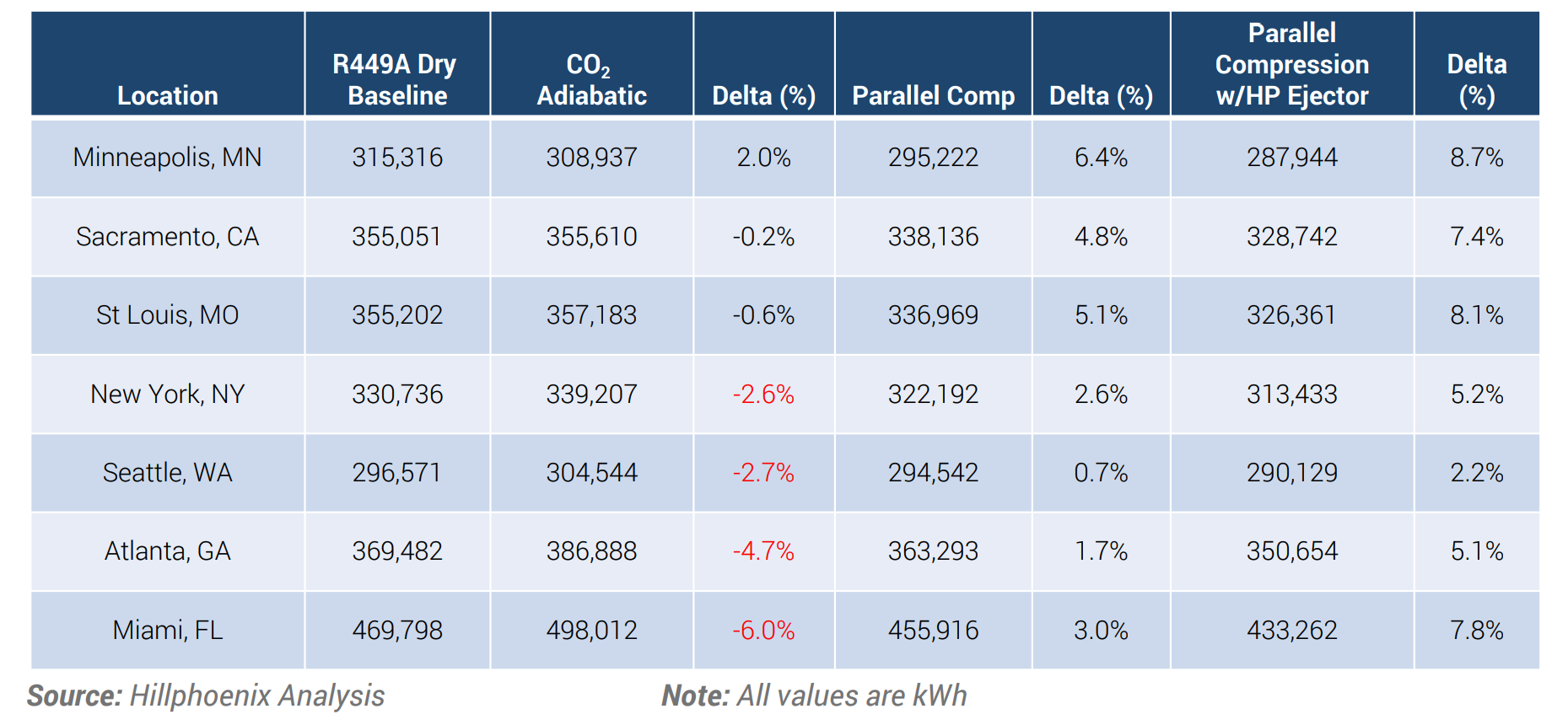
Perceptions often shape beliefs, yet a comparison between a system employing R-449A, a blend of HFOs and HFCs, and one utilizing CO2 refrigerant, sheds light on these distinctions. Side-by-side tests conducted across seven U.S. cities (Minneapolis, Sacramento, St. Louis, New York, Seattle, Atlanta, and Miami) showed that when improperly installed, a CO2 system can be 17% (in Seattle) to 22% (Miami) less efficient than an R-449A system.

However, when the CO2 system is properly designed and includes components, such as adiabatic gas coolers, parallel compressors, parallel compressors with high-pressure ejectors, and electronic expansion valves (EEVs) the CO2 system can be more efficient than the R-449A system. The problem is that many operators will mistakenly size their CO2 system according to HFC system parameters.

Reality: There are numerous energy-saving possibilities when CO2 refrigerant is used in a properly designed system, and the benefits can be compounded when additional components are employed.

Looking for quick answers on air conditioning, heating and refrigeration topics? Try Ask ACHR NEWS, our new smart AI search tool. Ask ACHR NEWS →
CO2 Versus R 449A Chart.

Click table to enlarge

IMPROPER INSTALL: Side-by-side tests conducted across seven U.S. cities showed that when improperly installed, a CO2 system can be less efficient than an R-449A system. (Courtesy of Hillphoenix)


Myth: Energy Consumption Increases Significantly When a CO2 System Goes Supercritical

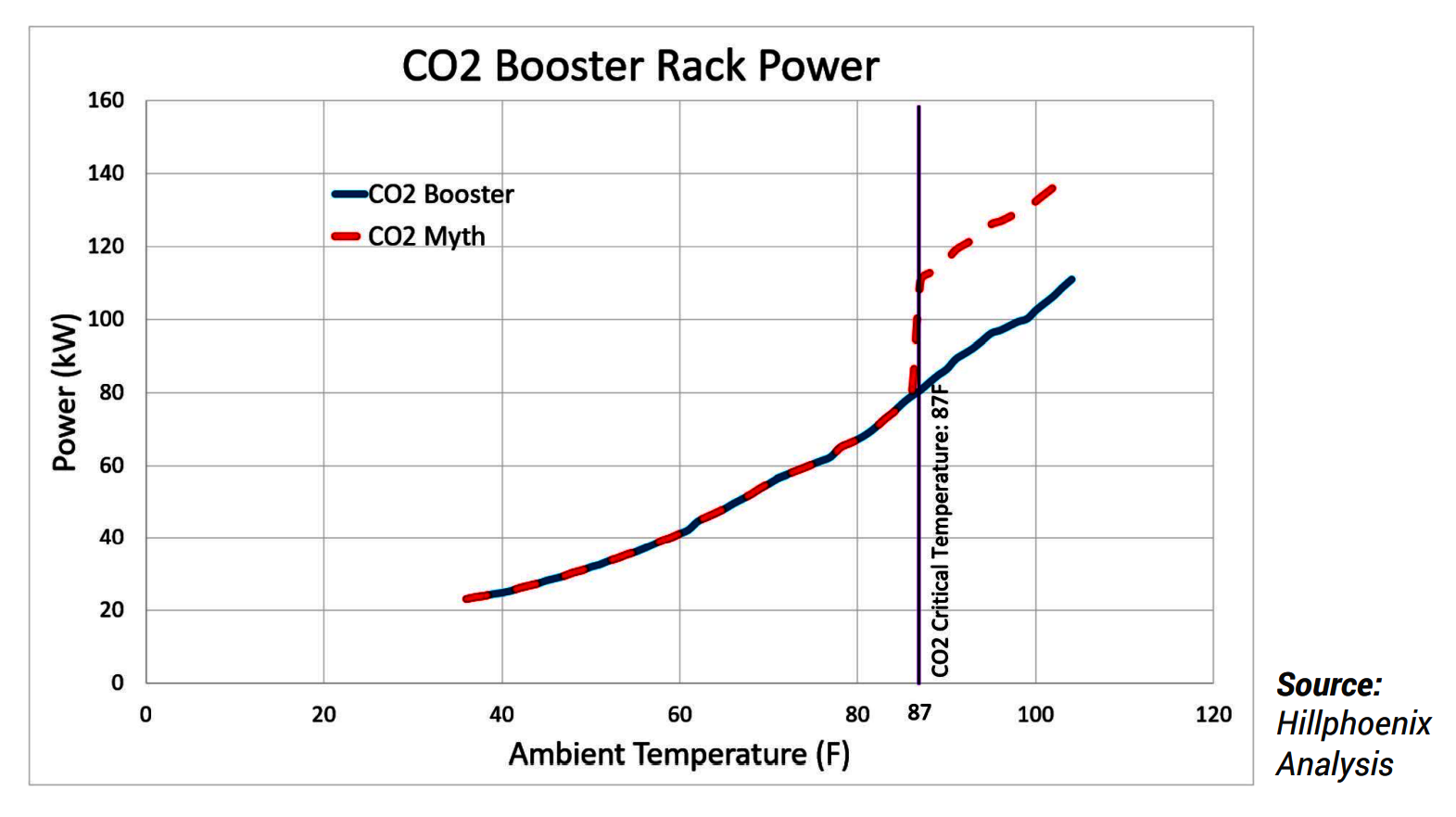
As the subcritical ambient temperature (less than 87ºF) around the refrigerant system moves toward the supercritical CO2 temperature of 87ºF, the belief is that there will be a significant and immediate spike in energy usage when the subcritical/supercritical line is crossed. This made food retailers nervous, especially in warmer climates. But when tested, the results show that so-called significant spike doesn’t happen.

Reality: While kilowatt (kW) usage does increase as the supercritical temperature threshold is passed, no drastic spike is experienced. Energy consumption increases along the same steady path as it does in subcritical temperatures — just like any other refrigerant.
CO2 Booster Rack Power Chart.

Click chart to enlarge

NO SPIKE: While kilowatt usage does increase as the supercritical temperature threshold is passed, no drastic spike is experienced. (Courtesy of Hillphoenix)


Myth: CO2 Refrigeration Systems Are Too Complex

Schematic drawings of a typical CO2 system can look complex, as they feature several valves (high-pressure, electronic expansion, and flash-gas bypass), transcritical and subcritical compressors, case and rack controllers, coolers, condensers, and heat reclaim systems. That can sound like a lot to keep track of; however, advances in technology have also busted this myth.

The key innovation here is the EEV, which is much easier to work with than mechanical valves. Also, CO2 refrigerant systems can now be controlled and optimized by computers, which means every system function is read through transducers, temperature sensors, and analog and digital inputs. Operation is reported/recorded via electronic software and hardware, so an effective computer-controlled system is all you need to ensure proper operation. That eliminates the need for a technician to constantly monitor and manually adjust the system’s valves and other components.

Reality: While the design and components of CO2 refrigerant systems are similar to those used for many years, electronically controlled components make them more reliable and give them longer service life. This results in a decidedly less complex and more robust system.


Part 2 of this article dispels even more myths about CO2 refrigeration systems.

Read Part 2
KEYWORDS: alternative refrigerants CO2 refrigeration FROSTlines HFC refrigerants transcritical CO2

Share This Story

Looking for a reprint of this article?
From high-res PDFs to custom plaques, order your copy today!


Scott martin
Scott Martin is the senior director of industry relations and compliance at Hillphoenix, part of Dover Food Retail. He earned his mechanical engineering degree from Southern Polytechnic State University and has more than 40 years of experience in the refrigeration industry. He can be reached at smartin@doverfoodretail.com.

Recommended Content

JOIN TODAY
To unlock your recommendations.

Already have an account? Sign In

  • HVAC-enrollment

    The Trades Are Back: HVACR Programs See Nearly 30% Enrollment Spike

    A new wave of future technicians is entering the pipeline.  
    Training and Education
    By: Matt Jachman
  • 2025 Top 40 Under 40

    2025 Top 40 Under 40 HVACR Professionals List

    The 11th annual Top 40 Under 40 list highlights those...
    HVAC Light Commercial Market
    By: Hannah Belloli-Oster
  • LG Ductless Mini-Split Systems

    The 9 Types of Heat Pumps

    As the U.S. moves toward electrification, heat pumps are...
    HVAC Commercial Market
    By: Joanna R. Turpin
Subscription Center
  • Create an Account
  • Start a Subscription
  • Manage My Account
  • Sign Up for Newsletters
  • Visit Customer Service
  • Update Preferences

More Videos

Sponsored Content

Sponsored Content is a special paid section where industry companies provide high quality, objective, non-commercial content around topics of interest to The News audience. All Sponsored Content is supplied by the advertising company and any opinions expressed in this article are those of the author and not necessarily reflect the views of The News or its parent company, BNP Media. Interested in participating in our Sponsored Content section? Contact your local rep!

close
  • Piggy Bank
    Sponsored byWatercress Financial

    Energy Prices, Inflation, and HVAC: What Today’s Homeowners Care About

  • Refrigerated Food
    Sponsored bySolstice Advanced Materials

    R-455A Refrigeration: A Cold Storage Solution for the Future

  • Airex Rooftop Units
    Sponsored byAirex Manufacturing Inc

    Consolidating Roof Penetrations: A Growing Trend in Multifamily HVAC Design

Popular Stories

HVAC-Price-Increase-graphic

HVAC Price Increase List: June 2026

Trump-Section-232.jpg

Trump Reduces Section 232 Tariffs on HVAC Equipment to 15%

Refrigerants-and-gauge.jpg

HVAC Industry Warns of Counterfeit Refrigerants Entering U.S. Supply Chain

U.S. Supreme Court building

95% Furnace Efficiency Rule to Get New Hearing

Midea-training.jpg

HVAC Workforce Crisis Expands Beyond Technicians to Instructor Shortages

View The ACHR NEWS
Centennial Anniversary Timeline

The ACHR News Timeline Chart
Submit a Letter
Submit a letter to our editors.

Events

November 6, 2025

Next-Gen Data Center Cooling: HVAC Innovation and Real-World Solutions

On Demand As AI workloads and high-density computing push traditional cooling methods to their limits, the data center industry is accelerating the adoption of next-generation HVAC technologies.

June 23, 2026

HVAC Duct Sealing Mastics: Why Selection Matters

In this webinar we will detail what HVAC material buyers and technicians need to know when selecting duct mastics, including matching mastic to substrate, alternatives to liquid mastic, and where UL 181 Listings fit into real world installations.

View All Submit An Event

Poll

Summer Staff

Are you fully staffed for the summer season?
View Results Poll Archive

Products

BNI Mechanical/Electrical Square Foot Costbook, 2026 Edition

BNI Mechanical/Electrical Square Foot Costbook, 2026 Edition

See More Products
HVAC Duct Sealing Mastics: Why Selection Matters - Free Webinar - 6/23/2026

Related Articles

  • CO2 System

    Mythbusting CO₂ Refrigeration Systems, Part 2

    See More
  • Joanna POV Frostlines

    Grocers Not Yet Sold On CO₂ Refrigeration Systems

    See More
  • Hillphoenix-ChargeSecure.jpg

    Power Outages Pose Risk for CO2 Refrigeration Systems

    See More

Related Products

See More Products
  • solidworkscourse1.gif

    SolidWorks for the Sheet Metal Guy - Course 1: Part Creation

  • Troubleshooting Tips for Servicing Refrigeration Systems

  • Understanding TXV Refrigeration Systems: Superheat and Subcooling DVD

See More Products

Related Directories

  • Hillphoenix

    UPDATE OR BUILD NEW? The answer is Hillphoenix. We've been offering low GWP, ODP solutions for years. Our expertise is grounded in time-tested experience.
  • Energy Recovery

    Energy Recovery's PX G1300 pressure exchanger for CO2 refrigeration systems lowers operating costs and energy consumption, increases efficiency, and reduces emissions.
  • NDL Industries Inc.

    A trusted HVAC-R, CO2 Refrigeration, and Hydronics component manufacturer offering CO2/ACR/PAC/Press Copper Fittings, NBV/CO2 Ball Valves, and Filter Driers--committed to top-quality products and exceptional customer service.
×

Sign Up. Stay Informed.

The #1 trusted source for the HVACR industry since 1926

SUBSCRIBE
  • RESOURCES
    • Advertise
    • Contact Us
    • Advisory Board
    • Classifieds
    • Submit a Letter
    • Directories
    • Store
  • ACCOUNT CENTER
    • Create an Account
    • Start a Subscription
    • Manage My Account
    • Sign Up for Newsletters
    • Visit Customer Service
    • Update Preferences
  • SERVICES
    • Marketing Services
    • Reprints
    • Market Research
    • List Rental
    • Survey/Respondent Access
  • STAY CONNECTED
    • LinkedIn
    • Facebook
    • Instagram
    • YouTube
    • X (Twitter)
  • PRIVACY
    • PRIVACY POLICY
    • TERMS & CONDITIONS
    • DO NOT SELL MY PERSONAL INFORMATION
    • PRIVACY REQUEST
    • ACCESSIBILITY

Copyright ©2026. All Rights Reserved BNP Media, Inc. and BNP Media II, LLC.

Design, CMS, Hosting & Web Development :: ePublishing