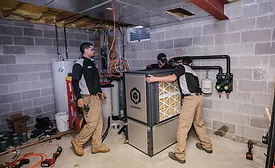
The baffling element of the Omnibus spending bill passed by Congress in December 2015 was the lawmakers’ decision to extend residential and commercial tax credits for solar photovoltaics and big wind through 2021, while allowing similar incentives for ground source heat pumps and other “orphaned” technologies to die on the vine.
That landmark in geothermal history was eventually followed by the Commonwealth Building in Portland, Oregon, which became the first commercial building in the U.S. to employ a geothermal system for heating and cooling.
Mechanical contractors in California should keep an eye on the state’s Occupational Safety and Health Administration (Cal/OSHA) as it continues work on a standard with a working title of Heat Illness Prevention in Indoor Places of Employment.
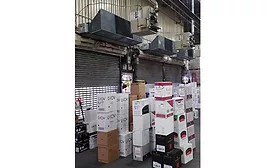
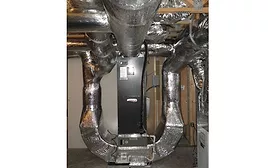
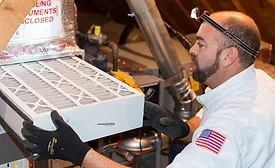
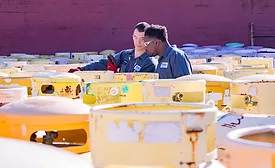
Following are four examples — a kosher wine shipping center, a chiller plant in a marine research lab, a community pool, and a 10th-floor medical office retrofit — that illustrate just how creative high-efficiency products can be when it comes to unique solutions for everyday issues.
With heating and cooling accounting for nearly half the energy use in a typical U.S. home, it’s not a surprise that the market for energy-efficient products continues to remain strong. According to a recent study by Zillow, energy efficiency ranked among the top priorities during a home search.
In 2015, Pechanga held an official groundbreaking to add 568 rooms and suites to its existing hotel facilities and to expand the resort’s dining, spa, outdoor recreation, and meeting facilities.
Sadly, it’s rare to hear about comfort and affordable housing together as one. Too often, there’s a compromise. At the losing end, it’s comfort that seems to always give way to price and ease of installation.
There seem to be fewer family-owned mechanical companies every year, especially in the South where fast a/c service is king, and competition is as fierce as anywhere in the country.
According to the U.S. Environmental Protection Agency (EPA), 10,804,918 pounds of ozone-depleting refrigerant was reported as reclaimed by EPA-certified reclaimers in 2016. That total includes 9,409,494 pounds of hydrochlorofluorocarbon (HCFC)-22 or R-22.
In the wake of its three-year-old high school’s nationally renowned sustainability design, Clark County Public Schools has improved upon its chilled beam energy-saving model with the recent HVAC retrofit of a 43-year-old school building.