Distributors Roundtable: 5 HVACR Pros Talk About How Their Companies are Facing the Year’s Challenges
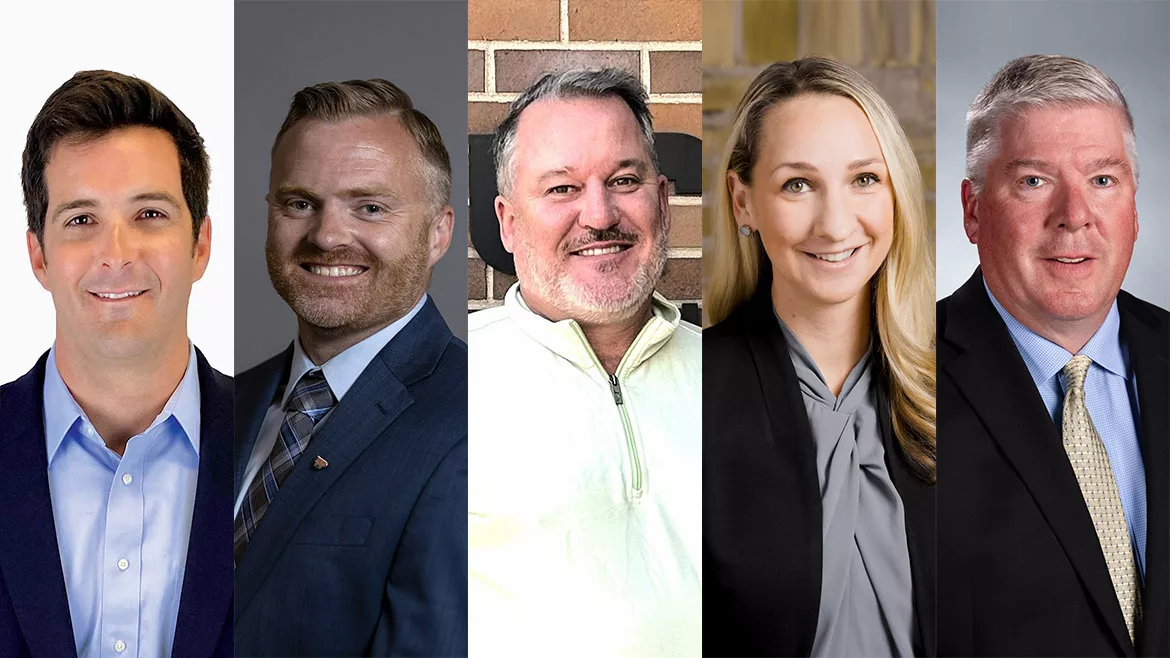
COUNTER CULTURE: Framing challenges as chances for growth and change, executives at several leading HVACR distributors say their companies are poised for success this year.
From left to right in photo:
Cory Anderson, president of M&A Supply Co. Inc.
Christopher Duncan Hendricks, president and CEO of Duncan Supply Co. Inc.
Patrick Newland, strategic marketing director at Denver, Colorado’s Hercules Industries Inc.
Katie Poehling Seymour, president and CEO of First Supply
Tom Schleisner, area leader, Winsupply Inc.
(Photos courtesy of the speakers)
With the A2L transition, a new presidential administration in Washington, D.C., an ever-changing regulatory landscape, and the consumer base still feeling pinched by inflation, the HVACR industry faces a challenging environment as it accelerates into the new year.
Yet the five HVACR distribution executives participating in this year’s Distributors Roundtable, an annual Distribution Trends feature, are largely optimistic about 2025, saying they expect growth, or at least stability, and a chance to take advantage of opportunities that changes in the industry present.
For this year’s Distributors Roundtable, DT sent questionnaires to five major distributors, all of which were included in the 2024 Top 30 Distributors list published by The ACHR NEWS last May. Participants were asked how they’re handling the move to A2L products, and about inflation, distributor consolidation, their outlooks for 2025, how the pandemic may have affected distributor-contractor relationships, and more.
Taking part in the Roundtable were Patrick Newland, strategic marketing director at Denver, Colorado’s Hercules Industries Inc.; Cory Anderson, president of M&A Supply Co. Inc. in Nashville, Tennessee; Christopher Duncan Hendricks, president and CEO of Duncan Supply Co. Inc., headquartered in Indianapolis, Indiana; Katie Poehling Seymour, president and CEO of First Supply, of Madison, Wisconsin; and Tom Schleisner, area leader, Winsupply Inc., based in Dayton, Ohio.
Here, lightly edited, is what they had to say.
DT: With the current economic climate, the shift of the balance of power in Washington, D.C., the refrigerant transition and all the other factors affecting HVACR, describe your outlook for your company, and HVACR distribution as a whole, for 2025.
Hendricks: We should see a nice lift in revenue for our company as well as the bottom line. With the increased costs of the new A2L equipment, that should bring increased revenue, and we expect the changes in Washington to be kind to us on the tax side.
Looking for quick answers on air conditioning, heating and refrigeration topics? Try Ask ACHR NEWS, our new smart AI search tool. Ask ACHR NEWS
Seymour: Transition and change create opportunity. We see an opportunity to build deeper relationships with contractors in education on the refrigerant transition and selling strategies in a soft economy. We also see an opportunity to create strategic planning opportunities with manufacturers to lean into their strengths in product changes aligned with a strong inventory position.
Newland: We predict this year is going to be very similar to last year, considering interest rates haven’t changed much, and while inflation remains unpredictable, experts predict it will begin to come down in 2025. The industry’s transition to A2L products and equipment will have the biggest impact, driven by pricing fluctuations, inventory availability, and trying to manage supply and demand.
Anderson: We remain optimistic about 2025 despite the challenges presented by the evolving economic and regulatory landscape. I’m expecting the industry to experience low single-digit growth. My biggest concern is the added costs that A2L brings to the end user. Will they be able to absorb it, or will it create a repair-over-replacement environment? We’ll see…
Schleisner: We are optimistic that 2025 will be better than 2024. The transition to A2L and the possibility of imposed tariffs will undoubtedly be a concern. The good news is that interest rates have been dropping, and inflation is stabilizing, which leads to more consumer optimism and increased purchases of durable goods such as furnaces and air conditioners. We see 2025 as an uptick year, leading to bigger years in 2026 and 2027.
DT: How is the consolidation among HVACR distribution businesses affecting the distribution sector and the industry?
Hendricks: The consolidation has certainly made an impact in distribution. We are seeing a ton of different distributors get purchased from private equity, manufacturers, and other distributors from different industries. The positive side for us: In our markets, we have seen less trust and faith in those distributors who sell, and that leads to an uptick for us, a private, family-owned distributor.
Seymour: For distributors, consolidation shifts the competitive landscape. Distributors need to react quickly to capitalize on opportunities. For the industry, it is critical that distributors and vendors are aligned to service the market.
Newland: Consolidation by private equity has forced us to have a two-pronged strategy in place, so we are prepared for both customer and competitor acquisitions. Manufacturers must adjust their pricing models, distribution agreements, and regional representation in order to navigate through fewer, but larger, distributors. Distributors must change product lines due to national agreements, and local support becomes less important.
In some regions, this could lead to higher prices for customers and/or fewer choices. From a customer standpoint, relationships can be strained (or) ended by these acquisitions.
On a positive note, consolidation allows distributors to diversify their product lines and capabilities for their customers when expanding into new markets.
Anderson: Consolidation within the HVACR industry has created a more competitive environment, where independent distributors like us must differentiate ourselves by providing unparalleled service and value.
Many of our competitors have sold to private equity, which has resulted in a loss of personal touch and dealer-centric service. This trend has allowed M&A Supply to stand out as a relationship-focused distributor.
Schleisner: Because of consolidation, the industry is seeing greater operational efficiencies and economies of scale, allowing larger distributors to offer their customers a wider range of products and services, such as product and business training, e-commerce, digital marketing, and vendor-managed inventory. This allows distributors to stay close to their customers and enhances the customer experience.
Speed-to-market with products and broader inventories, along with reducing the cost to serve (are other factors) in industry consolidation.
DT: Given recent inflation, the supply-chain problems of the not-too-distant past, and equipment changeovers connected to regulations, how much inventory should HVACR distributors keep on hand right now? What makes the most financial sense?
Hendricks: This is a loaded question to me. … A distributor’s needs are unique to their equipment lines and the current state of their manufacturer’s capabilities. Currently, we are inflated about 5% to 10% (above) our “norm” due to the A2L equipment changeover; we bought ahead to get through Q1 2025 with the HFC equipment, while also getting the new equipment on hand for those customers who want to change earlier.
With the box-store distributors having large quantities of inventory, it increases the little guy’s need to be able to compare to make sure we get all of the parts and pieces. Believe it or not, the parts and pieces add up to big numbers.
Seymour: The million-dollar question! It’s imperative that distributors listen to their customers to understand market demand and trends so that we can service our customers reliably. Industry associations and publications are key resources to identify emerging trends and regulatory impact.
Newland: While supply-chain issues in our industry driven by the pandemic appear to have been resolved for the most part, it’s going to be really important for distributors to maintain strong relationships with their suppliers. Taking a proactive, demand-planning approach with them allows us to stay in front of lead times on our fast-moving items in addition to being considered first for new or limited products.
The ultimate goal is to ensure product availability for customers while avoiding overstocking, which ties up capital and increases carrying costs. Implementation of our new ERP (enterprise resource planning) system and leveraging that data for real-time inventory insights will help us maintain the right balance between availability and cost efficiency even better.
Anderson: I don’t have that answer yet. Most all distributors (M&A Supply included) have been in a feast-or-famine inventory situation since 2020, where the pendulum swings back and forth. Since we’re in another transition year, I expect more bumps in the road for the industry.
I can tell you that inventory management continues to be a top priority for us, and we’re looking for better ways to operate. One major move we made last year was to open our first dedicated distribution center, which has given us much better control over inventory.
Schleisner: That depends on how accurate your forecasting is. As a distributor, are you having those conversations with your key customers about their inventory needs? Are you getting commitments from them for orders that will take them through the key peaks in their selling seasons? Have you significantly reviewed your inventory strategies with your customers when (determining) cutting-over dates from R-410A to R-454B?
Once those questions are answered, you can determine the amount of stock that makes sense based on the forecast.
Don’t overload your warehouses based on speculation. Communication between your customers and vendors will be crucial.
DT: How are you educating contractor customers on the refrigerant transition?
Hendricks: We have been holding regular training with our (field service representatives), both on-site and customer-specific at their shops. We are blessed with a lot of good, knowledgeable staff who make it look easy.
We have also leaned on manufacturers to help come in and hear the word from the proverbial horse’s mouth.
Seymour: Early and often! We’ve mobilized a team to travel across our branches for training events, as well as holding larger training events in partnership with key vendors are our larger branches. It started with dealer meetings and will no doubt continue well into 2025.
Newland: We began our awareness campaign on the A2L transition in early 2024. We have sent several mass-communication pieces via email and digital, in addition to providing monthly in-person, hands-on training sessions with our customers this past year.
We have really tried to get them prepared and educated on this major change happening in the industry. We’ve supplied several planning resources, timelines, FAQs, and even links (to) ASK A2L chat (an online resource). We will continue with our monthly outreach as much as possible.
Anderson: Educating our dealer partners on the refrigerant transition is a top priority. We’ve done this through workshops, webinars, and one-on-one consultations. These efforts focus on explaining the upcoming changes, their impact on product selection, and best practices for servicing equipment using new refrigerants.
We believe that by proactively equipping our customers with knowledge, we can help them adapt smoothly and position ourselves as a trusted partner in navigating regulatory changes.
Schleisner: Our contractors expect us to be the beacon of light to inform them about how this transition will affect them and their businesses. We are working with our vendor partners to provide the most up-to-date information to educate our customers on the transition. We constantly provide training and communications to our customers on the upcoming changes.
Handling, safety, and compliance with the new GWP rules are stressed in our training. We are also utilizing the Ask A2L AI (artificial intelligence) tool to keep our customers informed on any codes or regulations at a local level.
DT: How do you see increasing prices for HVACR products affecting the industry?
Hendricks:; I see it as a double-edged sword. On one hand, I see it helping business revenue streams. From the distributor to the contractor, everyone will be making more money. The downfall is that the cost for a homeowner or a business owner to replace these units is going to increase significantly and lead public opinions to sour.
Seymour: Consumers will likely trade into lower-end equipment, and repair and remodel will increase. The parts business for our industry will take on increasing importance. Distributors should have a strategy to address parts in our inventories with the right pricing.
Newland: Systems are going to be substantially more expensive; we’ll need to continue to educate our dealer base on all the financing, service agreements, rebates, and government tax incentives that are out there. Businesses will need to adapt by offering long-term opportunities such as energy-efficient solutions, diversifying services, and finding ways to offset increased costs.
Anderson: The cost of HVAC equipment has gone up 40%-plus since 2019. That is a huge number! So far, the end-user has accepted that, but there is a ceiling.
I worry that the average American is not in the same financial place that they were several years ago, which would lead to more repairs over system replacements. It’s more critical than ever for HVAC contractors to get proficient at consumer financing and to offer it on every job.
Schleisner: Equipment prices will stabilize at some point this year but will be at a significantly higher baseline. With that being said, we as distributors need to do a better job with our dealers based on the importance of financing due to the rapid increase in the price of HVAC systems. … Most consumers do not have disposable income to invest in a new HVAC system. That is why those contractors who know how to add the value of financing will make the most significant impact this year over the contractors who do not offer it.
DT: Do you find that, since the coronavirus pandemic, contractors are less loyal to distributors, more willing to shop around, perhaps because of the supply-chain and pricing issues that accompanied the pandemic? If so, how has that affected your business?
Hendricks: If anything, I think the pandemic showed contractors just how far a distributor would go for them. The pandemic was a time when we could be more real with our contractors; be more transparent. At the same time, we bought everything we possibly could get our hands on, and bought/leased more space in doing so. Our customers saw the lengths that we were going to protect them to make sure they never went without — and they never did. We gained a more loyal following and anchored the customers that were always good customers with undeniable loyalty. They know they may get things cheaper elsewhere, but they also know not many take care of them the way we have and continue to do. The pandemic was a terrible blessing for our company.
Seymour: To an extent, contractors can be less loyal but there was also a retention opportunity as customers shifted purchase habits based on product availability. Doors opened that weren’t previously open, where we took a strategic inventory position and could service the customer at the right time. E-commerce purchases are also impacting loyalty but can really create sticky customers with the right features and navigation on our site.
Newland: Thankfully, we have not run into that much. Ongoing open communication and transparency with our customers over the years has allowed us to keep our relationships strong during and after the pandemic. We have always put them first and have learned to trust one another through the tough times, resulting in powerful partnerships.
Anderson: The pandemic created a need for every contractor to shop around to some degree so that they could effectively run their business during supply chain issues. Every distributor gained some business and lost some business during this time. Now that things have normalized, many of those behaviors still exist. However, at M&A Supply, we have worked hard to retain our customers by being transparent, reliable, and supportive during challenging times.
Our focus on building genuine relationships and delivering consistent value has helped us maintain a loyal customer base. We understand that loyalty must be earned, which is why we prioritize communication, quick issue resolution, and proactive support.
Schleisner: I still believe relationships matter. Yes, during the pandemic, we saw many shifts in purchasing based on product availability. However, as the supply chain issues have pretty much returned to normal, we have not seen a drop-off in customers or an increase in new customers.
The biggest factors in retaining customers during the pandemic were our strategic partnerships with our key vendors and the strengths of our distribution centers. Price considerations were important but not the determining factor on who the contractors purchased from.
Looking for a reprint of this article?
From high-res PDFs to custom plaques, order your copy today!


