ACHR News
search
Ask ACHR NEWS AI
cart
facebook twitter instagram linkedin youtube
  • Sign In
  • Subscribe
  • Sign Out
  • My Account
ACHR News
  • NEWS
    • Breaking News
    • New HVAC Products
    • Featured Products
    • Manufacturer Reports
    • HVAC Data
    • Legislation
    • ACHR NEWS Centennial
  • RESIDENTIAL
    • Air Conditioners
    • Furnaces
    • Residential Heat Pumps
    • Ductless
    • Residential IAQ
    • Testing, Monitoring, Tools
    • Components & Accessories
  • COMMERCIAL
    • Air Handlers
    • Rooftop Units
    • Chillers and Cooling Towers
    • Commercial Heat Pumps
    • Boilers and Hydronics
    • VRF/Ductless
    • Commercial IAQ
  • REFRIGERATION
    • Refrigerants
    • Refrigerant Regulations
    • Leak Management
  • CONTRACTOR PRO
    • Geothermal
    • Homeowner Study
    • VRF and VRV Ductless
    • Unitary Trends
  • EDUCATION
    • Training and Education
    • Business Management
    • Service and Maintenance
    • Continuing Education
    • Market Research >
      • HVAC Brand Awareness Report
      • VRV, VRF, VRVZ Report
      • Unitary Trends Report
      • Water Heat Professionals Report
    • Webinars
    • Sponsor Insights
    • eProducts Info
    • White Papers
  • EVENTS
    • HVAC Contractor Forum
    • Industry Events and Webinars
  • MEDIA
    • Videos
    • AHR Expo 2025 Videos
    • Podcasts >
      • ACHR News Podcast
      • HARDI Podcasts
      • AHR Expo Podcasts
      • ACCA Podcasts
    • Interactive Spotlights
    • Quizzes
    • eBooks
    • HVAC Talkback
  • HVAC GROUP
    • ACHR NEWS >
      • Current Issue
      • Digital Edition
      • Subscribe
    • Distribution Trends
    • SNIPS NEWS >
      • Join SNIPS NEWS
    • Engineered Systems News >
      • Join ES News
    • HVACR Directory
    • Contests
    • Newsletters
    • Contact
    • Advertise
    • My Account
HVAC ContractingNewsService and MaintenanceVentilationDuct Products

Five Tips to Improve Your Flexible Duct Installations
By David Richardson
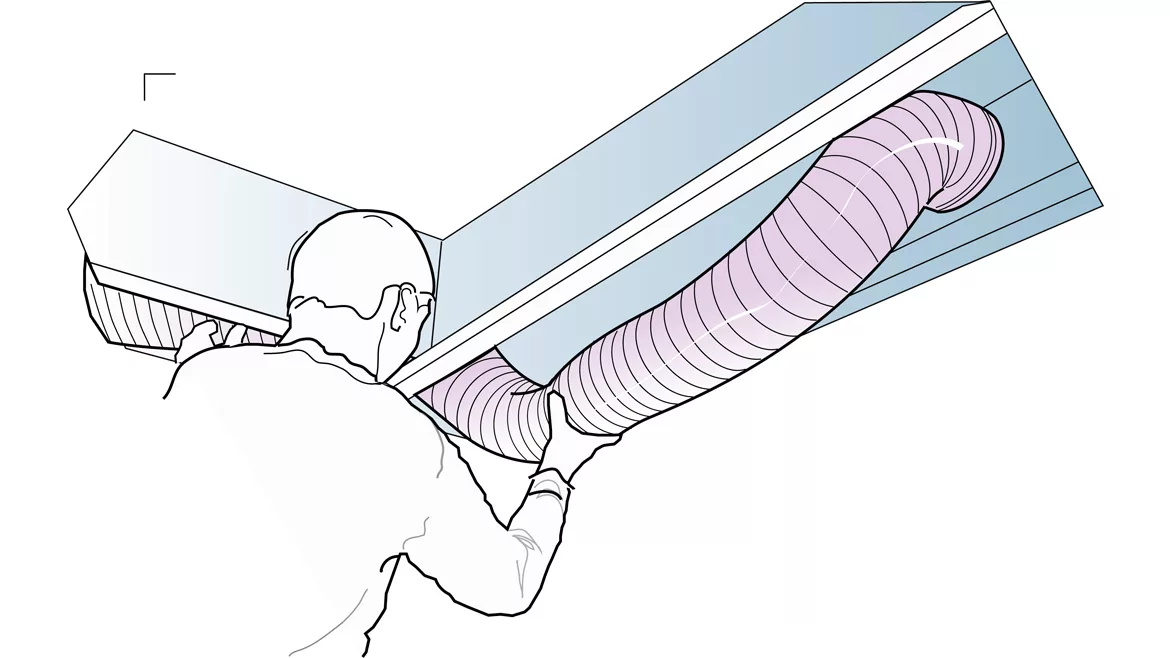
Flexible Duct Installation.

INSTALLATION: installation procedures equal poor airflow performance from flexible ducts. Exceptional installation procedures equal exceptional airflow performance from flexible ducts. You decide how well the product performs. (Courtesy of David Richardson)

January 15, 2022

Many in our industry believe the duct material used in an installation determines how well the HVAC system moves air. Because of this mentality, flexible duct often gets a bad name. The issue isn’t the material type. Instead, it’s how we install the product.

When you test poorly performing systems that use flexible ducts, there are recurring installation problems that lower airflow and reduce comfort and efficiency. However, with some attention to detail, you can easily correct and prevent the most common mistakes. Let’s look at five tips that can help you can provide better flex duct installations to assure your systems work as intended.


No. 1: Avoid Sharp Turns

To increase the performance of your installations, avoid sharp flex duct turns at all costs. Systems work best when you route ducts as straight as possible. Because of many obstacles found in homes today, this isn’t always an option.

When a duct must make a turn, do your best to keep it to a minimum. Long, sweeping turns work best and allow an easier path for air to travel. Sharp 90° turns kink the flex duct internally and reduce delivered airflow. Since the sharp turn restricts airflow, static pressure in the system increases.

Some common places these restrictions occur are improper duct connections to takeoffs and boots. At the connection point, there is often an abrupt turn that destroys airflow. Solve this by providing plenty of support for the duct where it changes direction or use a sheet metal elbow.

Structural framing is another common obstacle you’ll find in many attics. To get around this, you may need to reroute ducts or a find another location to avoid sharp turns.


No. 2: Add Duct Support

Another common cause of poor airflow and comfort complaints is sags from inadequate duct support. Many installers only suspend their ducts every 5 to 6 feet, which results in severe drooping. This condition will worsen over the life of the duct system and continue reducing airflow. Ideally, flex duct should not sag over 1 inch in a 4-foot length.

Looking for quick answers on air conditioning, heating and refrigeration topics? Try Ask ACHR NEWS, our new smart AI search tool. Ask ACHR NEWS →

Kinks and sags in the ducts require additional support. When you use narrow materials for hanging such as plumbing strap or wire, the duct becomes choked at that point. In severe situations, wire can cut into the duct, causing air leakage into unconditioned areas of the building.

When these defects exist, air gets choked off and slows down. To correct these problems, provide support at more frequent intervals such as every 3 feet instead of 5, 6, or 7 feet.

When you install more support, make wise choices in strapping materials to prevent unintentional restrictions. At a minimum, use 3-inch wide hanging straps or metal bands to cradle the duct. Duct Saddles are a premium product you could also use that works well for supporting flexible ducts.


No. 3: Remove Excess Core

Another common defect that results in low airflow occurs when the flexible duct inner core bunches up as it’s fastened to a boot or takeoff. This happens if you don’t pull the core tight and cut it to length. If you don’t do this, once you pull the insulation over the boot or collar, the bunching-up problem gets worse as the core compresses.

When renovating duct systems, we often remove up to 3 additional feet of core that a visual inspection would have missed. As a result, we’ve measured airflow increases of 30 to 40 cfm on a 6-inch duct.

So, remember to stretch ducts out as tight as possible. Once you connect the duct to the boot or takeoff, stretch it tight again from the opposite end to make sure you remove any excess core. Complete the connection by attaching to the other end and finishing the install.


No. 4: Avoid Remote Plenums

Remote plenums are rectangular boxes or triangles made from ductboard found in attic installations across the South. They connect one larger flexible duct into the plenum that feeds multiple smaller ducts that leave the plenum. The concept looks promising, but they have issues that you should be aware of.

These fittings have a large amount of pressure drop and lack direction for airflow as it attempts to leave the fitting. The air gets lost inside the plenum. This is mainly because of momentum loss in the fitting, as air from the duct feeding the fitting expands into a much larger space. Any air velocity drops there.

So, my suggestion is to avoid using these fittings. Instead, consider using extended plenum systems, lengthy transitions, or wyes. The cost to install these corrections will be slightly more than the remote plenum, but the improvement in airflow performance shows up immediately.


No. 5: Size Them Right

You can follow the previous steps to the letter and still have a duct system with poor performance if you size ducts according to old-school rules of thumb. When you size flexible ducts with methods intended for sheet metal duct, low airflow and high static pressure will result.

These duct materials have two different interiors. Sheet metal has a smooth surface, while flex has an uneven helix core. This difference often results in different airflow rates between the two products.

There’s only one person I know who can get flexible duct to perform like sheet metal duct and that’s Neil Comparetto of The Comfort Squad in Virginia. He uses some innovative installation techniques that allow his company to get similar performance from both duct materials.

Unless you can duplicate Neil’s install procedures, your systems will perform much better if you design your flexible ducts larger. Many like to use the .10 friction rate on a duct calculator and assume a 6-inch duct delivers 100 cfm. If this is your expectation, the results will disappoint you.

However, if you must use a metal duct calculator and default value, size your ducts at the .05 friction rate and follow the installation guidelines above. This gives you a greater chance of success and delivers systems that perform closer to intentions.


Trust and Verify

You can battle over duct design methods all day long, but until you take measurements and verify the installation delivers the required airflow, it’s strictly a guess. If you wondered how Neil knows he can get similar performance from flexible duct as metal, it’s because he measures.

Measured airflow values from a balancing hood are where the rubber meets the road with any flexible duct installation. Using the above-mentioned tips, you can show the increased airflow from these improvements to your installers. Help them see how their attention to detail makes a difference.

Share these tips with your installers and have the courage to install your duct systems the right way. Give your crews the flexibility to do the job right the first time. Your customers will appreciate it, and you will notice fewer callbacks.

KEYWORDS: Duct Dynasty duct systems flexible ductwork installing HVACR National Comfort Institute (NCI) troubleshooting and HVACR

Share This Story

Looking for a reprint of this article?
From high-res PDFs to custom plaques, order your copy today!


David richardson
David Richardson serves the HVAC industry as Vice President of Training for National Comfort Institute, Inc. (NCI). NCI specializes in training focused on improving, measuring, and verifying HVAC and Building Performance. If you’re an HVAC contractor or technician interested in learning more about building science applied to HVAC, contact David at ncilink.com/ContactMe.

Recommended Content

JOIN TODAY
To unlock your recommendations.

Already have an account? Sign In

  • HVAC-enrollment

    The Trades Are Back: HVACR Programs See Nearly 30% Enrollment Spike

    A new wave of future technicians is entering the pipeline.  
    News
    By: Matt Jachman
  • 2025 Top 40 Under 40

    2025 Top 40 Under 40 HVACR Professionals List

    The 11th annual Top 40 Under 40 list highlights those...
    HVAC Light Commercial Market
    By: Hannah Belloli-Oster
  • LG Ductless Mini-Split Systems

    The 9 Types of Heat Pumps

    As the U.S. moves toward electrification, heat pumps are...
    Ground Source Heat Pumps
    By: Joanna R. Turpin
Subscription Center
  • Create an Account
  • Start a Subscription
  • Manage My Account
  • Sign Up for Newsletters
  • Visit Customer Service
  • Update Preferences

More Videos

Sponsored Content

Sponsored Content is a special paid section where industry companies provide high quality, objective, non-commercial content around topics of interest to The News audience. All Sponsored Content is supplied by the advertising company and any opinions expressed in this article are those of the author and not necessarily reflect the views of The News or its parent company, BNP Media. Interested in participating in our Sponsored Content section? Contact your local rep!

close
  • Piggy Bank
    Sponsored byWatercress Financial

    Energy Prices, Inflation, and HVAC: What Today’s Homeowners Care About

  • Refrigerated Food
    Sponsored bySolstice Advanced Materials

    R-455A Refrigeration: A Cold Storage Solution for the Future

  • Airex Rooftop Units
    Sponsored byAirex Manufacturing Inc

    Consolidating Roof Penetrations: A Growing Trend in Multifamily HVAC Design

Popular Stories

Outdoor-condensing-units.jpg

EPA Removes R-410A Installation Deadline

Trump-Section-232.jpg

Trump Reduces Section 232 Tariffs on HVAC Equipment to 15%

cooling-habits.jpg

50 Percent of Americans Have Skipped HVAC Maintenance

ACHR NEWS Editor Chris Gray Presenting HVAC Minute 5-18-2026

HVAC Manufacturers Fight Pricing Lawsuits

tim-brooks.jpeg

2026’s Best Distributor Partners With Customers

View The ACHR NEWS
Centennial Anniversary Timeline

The ACHR News Timeline Chart
Submit a Letter
Submit a letter to our editors.

Events

November 6, 2025

Next-Gen Data Center Cooling: HVAC Innovation and Real-World Solutions

On Demand As AI workloads and high-density computing push traditional cooling methods to their limits, the data center industry is accelerating the adoption of next-generation HVAC technologies.

June 9, 2026

Before You Go All In on AI: Set Up Your Business to Actually Win

In this webinar, we'll walk you through exactly what to get in place before you add AI to your business. You'll leave with a clear picture of where you stand today and a practical action plan to set yourself up for real results.

View All Submit An Event

Poll

EPA Decision

Are you happy the EPA decided contractors can continue to install R-410A equipment?
View Results Poll Archive

Products

BNI Mechanical/Electrical Square Foot Costbook, 2026 Edition

BNI Mechanical/Electrical Square Foot Costbook, 2026 Edition

See More Products
A2L Refrigerants - Free Webinar - May 21, 2026

Related Articles

  • Duct Dynasty

    Six Tips to Improve Static Pressure Measurements

    See More
  • Five Tips to Take Your Business to the Next Level

    See More
  • Five Tips to Supercharge Your Website and Attract New Customers

    See More

Related Products

See More Products
  • 1966.gif

    HVAC Duct Construction Standards - Metal and Flexible

  • Troubleshooting Tips for Servicing Refrigeration Systems

  • Top 100 HVAC/R Tips

See More Products

Related Directories

  • Flexible Duct Machinery.com

    Mfg. and supplier of Flexible Duct MACHINERY for the manufacture of Polyester and Aluminum flexible ducting components, core and vapor barrier jacket.
×

Sign Up. Stay Informed.

The #1 trusted source for the HVACR industry since 1926

SUBSCRIBE
  • RESOURCES
    • Advertise
    • Contact Us
    • Advisory Board
    • Classifieds
    • Submit a Letter
    • Directories
    • Store
  • ACCOUNT CENTER
    • Create an Account
    • Start a Subscription
    • Manage My Account
    • Sign Up for Newsletters
    • Visit Customer Service
    • Update Preferences
  • SERVICES
    • Marketing Services
    • Reprints
    • Market Research
    • List Rental
    • Survey/Respondent Access
  • STAY CONNECTED
    • LinkedIn
    • Facebook
    • Instagram
    • YouTube
    • X (Twitter)
  • PRIVACY
    • PRIVACY POLICY
    • TERMS & CONDITIONS
    • DO NOT SELL MY PERSONAL INFORMATION
    • PRIVACY REQUEST
    • ACCESSIBILITY

Copyright ©2026. All Rights Reserved BNP Media, Inc. and BNP Media II, LLC.

Design, CMS, Hosting & Web Development :: ePublishing