Smart pump platform delivers data-driven savings, helps hotels meet district energy requirements, and proves the business case for building decarbonization
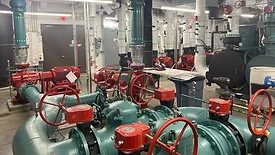
A Toronto-area Marriott used Armstrong Fluid Technology’s performance envelope platform to cut its energy use by 70% – and discovered even bigger potential savings for buildings not on district heating.
With LEED Gold certification, all-electric systems, and pioneering energy recovery solutions, San Francisco State University’s new science building sets a new standard for sustainability
Harris, in partnership with SFSU, delivered a state-of-the-art, energy-efficient science building. The building was designed to achieve an Energy Use Intensity (EUI) of 93 kBtu per square foot per year, already a 30% improvement over the baseline of 136 kBtu per square foot per year.
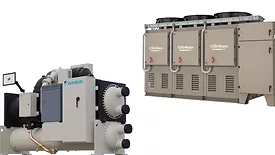
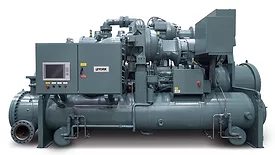
Refrigerant regulations apply to chillers as well as to residential HVAC products, and manufacturers have come up with versatile, efficient, and connected equipment.
We need to be making our buildings more energy efficient so that smaller amounts of renewable electricity are needed and less capacity needs to be built, whitepaper authors argue.
The chiller provides 250-450 tons (900- 1,600 kW) of cooling and 3600-5300 MBH (1,000-1,550 kW) of heating. This dual capability eliminates the need for separate heating equipment.
Air-cooled chillers are projected to hold a leading position in the Global Chillers market, and centrifugal chillers outshine other compressor technologies, Adroit Market Research analysts project.
The proposed new approach to chilled water HVAC systems promises to provide significant capital cost savings, energy cost savings, and a path to eliminate CO2 emissions.
Chillers are being used as heat pumps, outfitted with heat-recovery systems, used in building electrification projects, and installed in arrays to cool data centers.