A Capital Cost and Energy Saving Approach to Chilled Water HVAC with Zero Emissions Potential

There are significant capital and energy cost savings that can be achieved with an improved chilled water HVAC systems design. A new approach is presented that can provide a capital cost savings of 27% and an annual energy cost savings of 36% compared to the conventional system. Using conventional energy sources the energy savings results in a 34% reduction in CO2 emissions. This analysis assumes the use of an electric heat pump chiller for cooling and a natural gas boiler for heating. The system could be made all-electric by substituting electric heat pump heaters for the boiler. When this HVAC system is provided with 100% renewable electricity it will provide zero emissions and will still provide significant energy savings over an all-electric conventional system. These savings are made possible primarily by transitioning from fan coil unit (FCU) or air handling unit (AHU) piping packages that modulate water flow rate to a new piping package that controls water temperature. Controlling water temperature at the FCU can eliminate the need for air reheat allowing a single FCU coil to be used for both heating and cooling. Since each FCU utilizes a single coil for both heating and cooling only one piping package is needed per FCU.
The ability to modulate water temperature at the FCU allows the chiller to be operated at a lower temperature; our study assumed a 38॰F chilled water temperature compared to 45॰F for the conventional system. The lower water temperature is used to increase delta T at the FCU permitting a substantially smaller flow rate from the chiller, and consequently the use of smaller diameter pipes and smaller pumps throughout the chilled water distribution system.
The lower-temperature water available at each FCU permits the FCUs to provide substantially more latent cooling. This increased capacity is used to eliminate the need for a dedicated outdoor air system (DOAS). Outdoor air is brought in using an energy recovery ventilator (ERV) which is about 20% of the capital cost of a DOAS and requires much less fan energy to operate due to the fewer stages. While the ERV is only able to provide about two-thirds of the conditioning needed to bring outdoor air to room-neutral conditions, the remaining conditioning can be achieved at the FCUs with the additional cooling capacity provided by the availability of lower-temperature water.
To estimate the energy efficiency and performance of the proposed system, an energy simulation was performed by Syska Hennessy Group, Inc., using an IES VE model for a new 200-room hotel as a case study. Both a conventional chilled water HVAC system and the new approach were simulated for Chicago, Atlanta, and Miami with 36%, 34%, and 38% energy savings respectively. A capital cost estimate for the two systems was provided in each city by Gardiner & Theobald. In each case, the new approach provided a 27% reduction in capital costs.
Conventional Chilled Water HVAC System
Performance comparisons are made to the conventional chilled water HVAC system shown in Figure 1. This system is intended to be representative of that used for large commercial buildings and industrial plants. The conventional system consists of chillers that provide 45॰F chilled water, DOAS that provide 45॰F dewpoint air, and FCUs that are designed for a 10॰F delta T across the cooling coils.
In terms of energy efficiencies and capital costs, there are three major problems with this conventional system. The first problem is the low delta T of only 10॰F which results in the need for large pipes and in high pumping energy costs. The second problem is the high capital cost for the DOAS and its high fan energy costs created to overcome the pressure drops across the enthalpy wheel, desiccant wheel, cooling coil and reheat coil. The third problem is the energy penalties of having to reheat the air in the DOAS and FCU and the additional capital cost of having two coils and piping packages in the FCUs.

Click to enlarge
Figure 1: Conventional Chilled Water HVAC System. (Courtesy of FT Energy Controls, LLC)
Proposed Chilled Water HVAC System
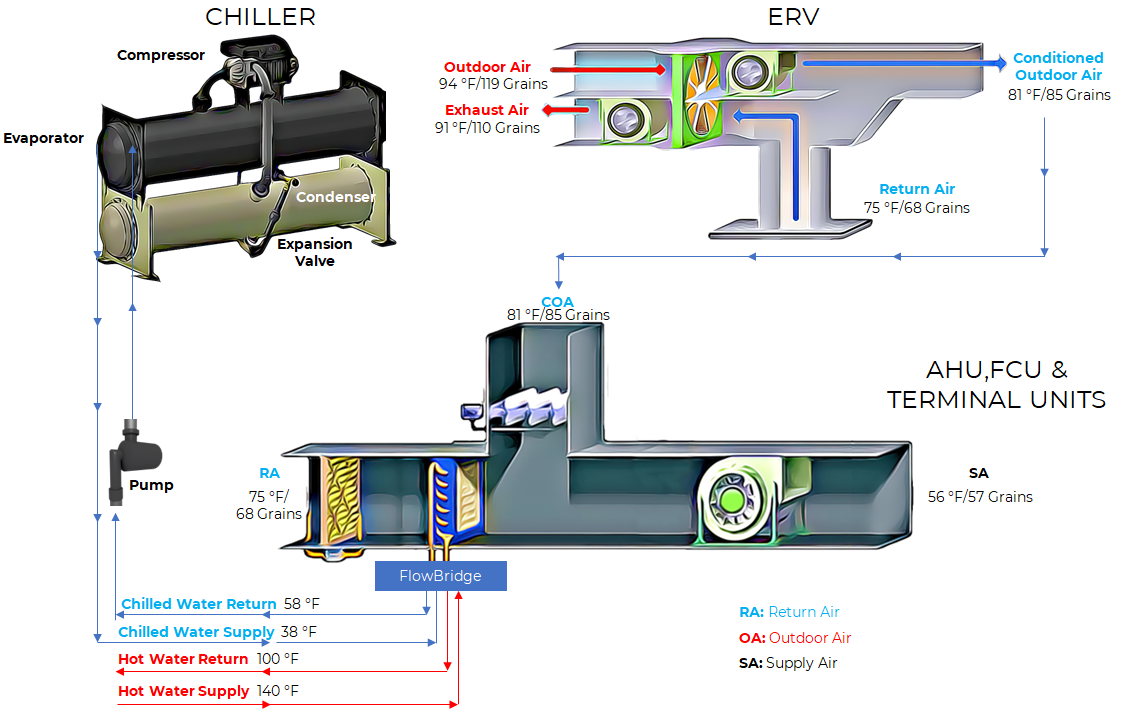
The proposed chilled water HVAC system shown in Figure 2 overcomes each of the identified problems with the conventional system. The new system substitutes an ERV for the DOAS, eliminates one coil from the FCUs, and replaces the two piping packages with a single temperature control piping package. The chiller provides 38॰F chilled water allowing the FCUs to condense more moisture from the air and reduce the moisture removal needs from the ERV. Delta T is increased to 20॰F which reduces the piping costs and the pumping energy costs. The ERVs utilize high-efficiency enthalpy wheels which can exchange both moisture and temperature between the conditioned air being exhausted from the building and the outdoor air being added to the building. A high efficiency, enthalpy wheel can make use of the 75॰F return air with 68 grains of moisture to reduce the outdoor air from 94॰F and 119 grains of moisture to 81॰F and 85 grains of moisture before being introduced into the FCU. This provides two-thirds of the temperature reduction and moisture removal needed to get to the room neutral conditions, 75॰F and 68 grains (50% RH). The temperature control piping package enables the use of a single coil for both cooling and heating and can be controlled so that the need for reheat is avoided.
Looking for quick answers on air conditioning, heating and refrigeration topics? Try Ask ACHR NEWS, our new smart AI search tool. Ask ACHR NEWS
Click to enlarge
Figure 2: Proposed Chilled Water HVAC System. (Courtesy of FT Energy Controls, LLC)
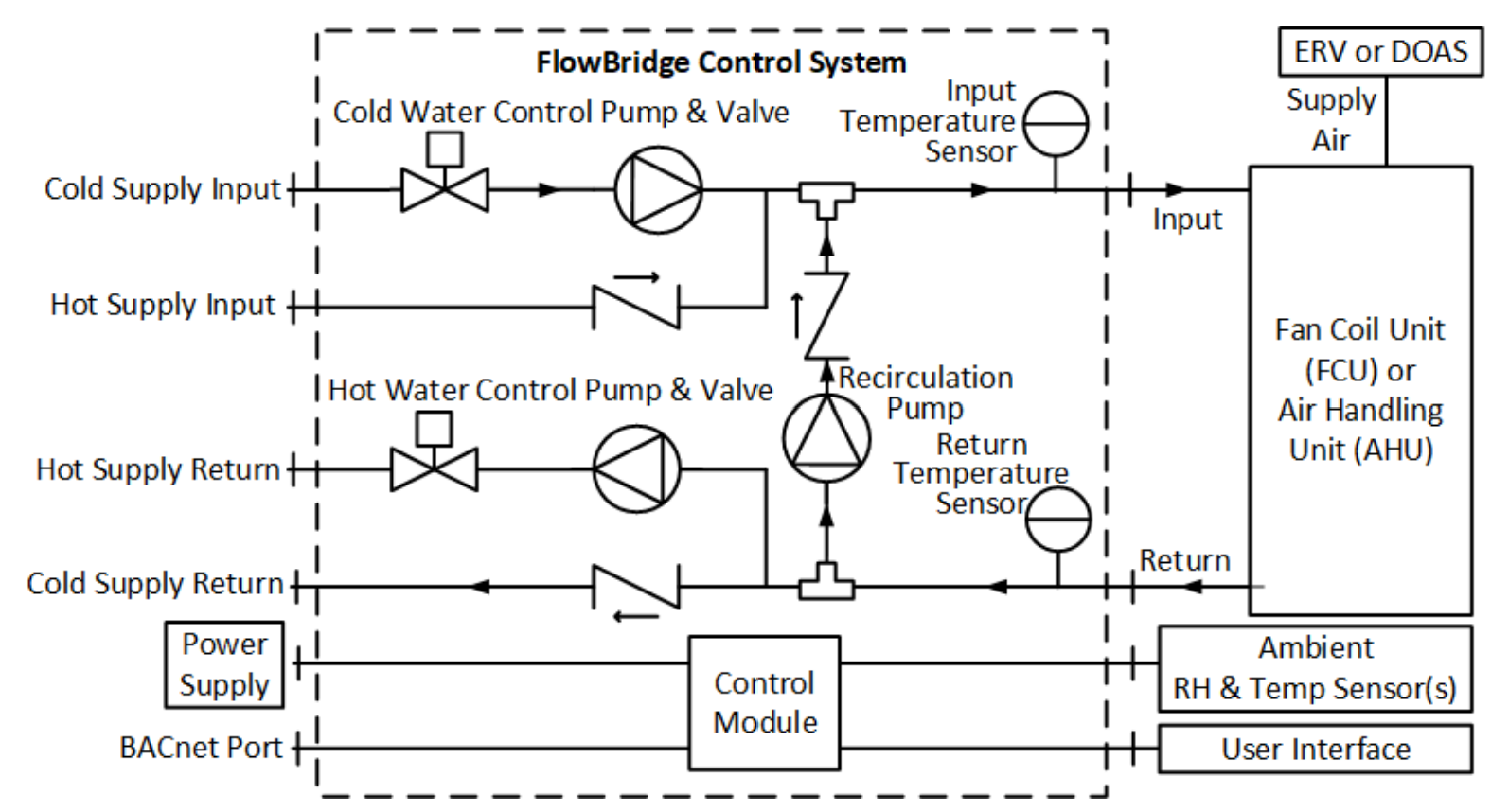
Figure 3 shows a schematic of the temperature and flow rate control piping package. This design connects to a four-pipe system at the left and to a single cooling coil at the right. A variable-speed recirculation pump is used to mix return water with supply water. A variable-speed supply pump is used to control the ratio of chilled water supply to recirculated return water in the cooling mode. A variable-speed return pump is used to control the ratio of hot water supply to recirculated water in heating mode. This configuration enables the control of both flow rates and temperatures to each coil. Each FCU and AHU can then respond to the changing loads of latent, sensible, and outdoor air required for each space.
Click to enlarge
Figure 3: Temperature and flow rate control piping package. (Courtesy of FT Energy Controls, LLC)
Energy Cost Savings
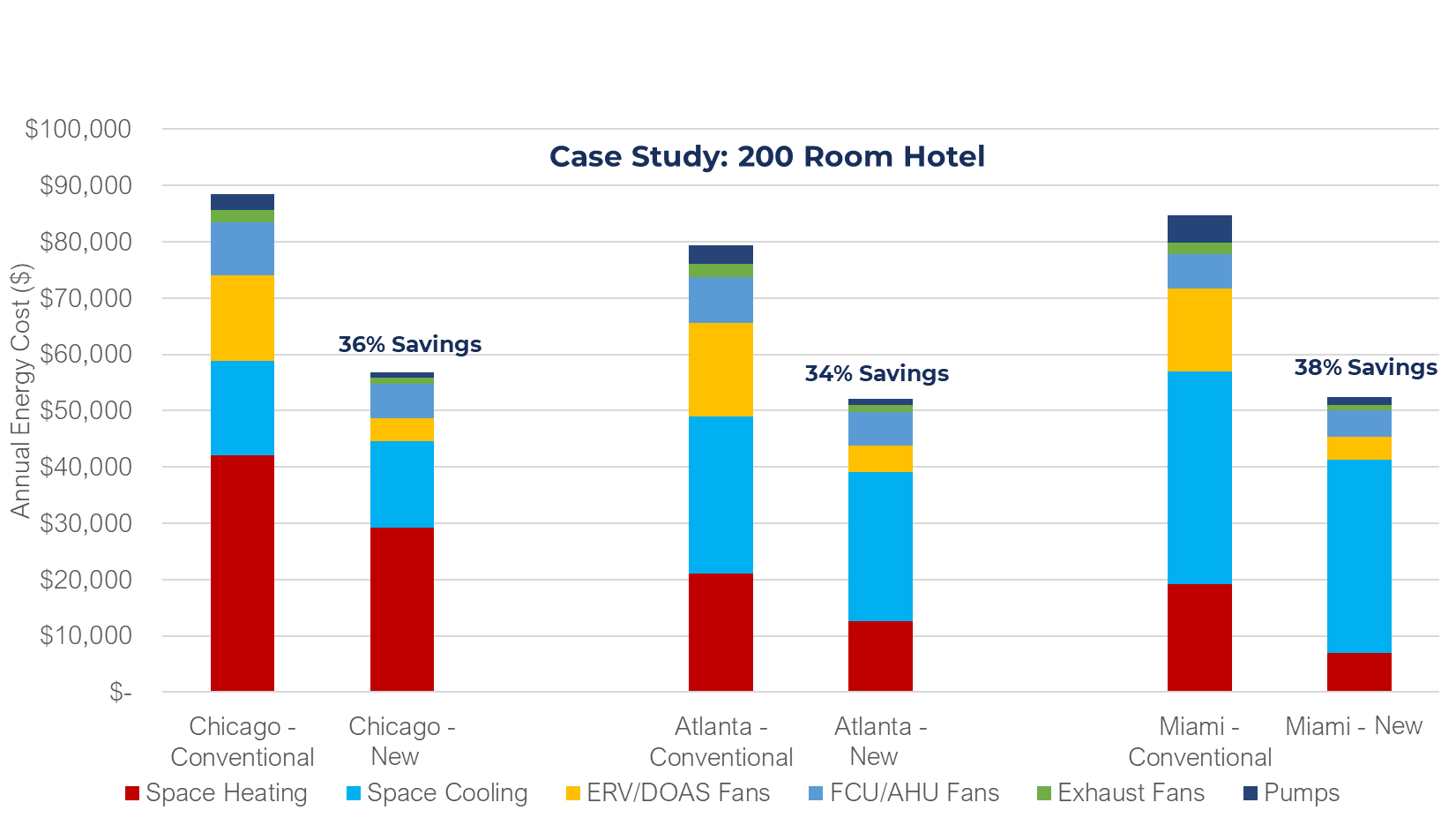
Figure 4 shows a comparison of the energy consumption for the two systems as modeled by Syska Hennessy. The largest contributor to energy savings is the elimination of reheat during cooling. The conventional system has dedicated heating coils in both the DOAS and the FCUs, all of which are eliminated by the new solution (without compromising indoor air conditions). Eliminating reheat also reduces the load on the chillers by about 22%. The second largest contributor to energy savings is reduced fan energy consumption. The conventional system must overcome pressure drops across an enthalpy wheel, desiccant wheel, and cooling and reheat coils in the DOAS which is much greater than the pressure drop across the enthalpy wheel in the ERV (72% savings). The single-coil FCUs also require less fan energy than the conventional two-coil FCUs (29% savings). Finally, pumping energy was reduced by about 61%.
Click to enlarge
Figure 4: Comparison of annual energy costs for conventional versus new system in Chicago (36% savings), Atlanta (34% savings), and Miami (38% savings). (Courtesy of FT Energy Controls, LLC)
Capital Cost Savings
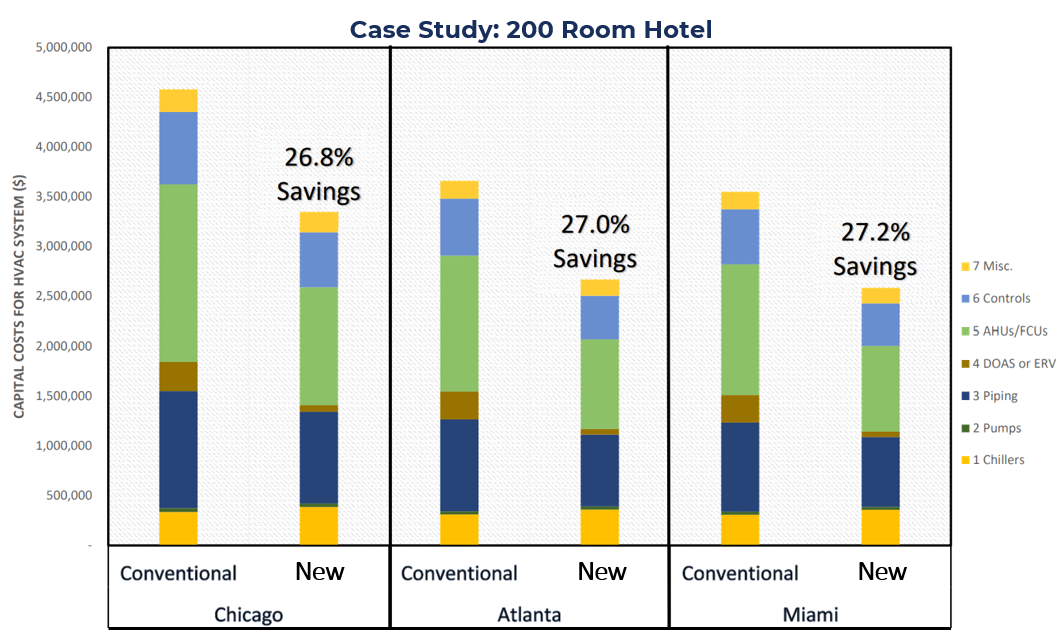
Figure 5 shows the capital cost savings calculated by Gardiner & Theobald for the new 200-room hotel example. The new system resulted in a capital cost savings of about 27%. While the chillers are slightly more expensive, the savings were more than offset by savings in pumps, piping, ERV, FCUs, and controls. The capital cost for the chillers that produce 38॰F chilled water for the new system is about 16% more than the cost for the chillers that produce 45॰F chilled water for the conventional system. The cost for the pumps for the new system is about 6% less than the cost for the conventional system because less chilled water is needed to be pumped with a 20॰F delta T. The cost of the ERV in the new system is about 80% less than the cost of the DOAS in the conventional system. The ERV is a simpler system that only requires an enthalpy wheel while the DOAS requires an enthalpy wheel, a desiccant wheel, cooling coils, and reheat coils. The cost of the piping for the new system is about 22% less than the cost of the piping system for the conventional system because the new system requires less volume of chilled water compared to the conventional system. The cost for the FCUs and AHUs for the new system is about 34% less than the cost for the conventional system because the new system uses the same coil for both cooling and heating while the conventional system requires a cooling coil and a separate heating/reheat coil.
Click to enlarge
Figure 5: Comparison of capital costs for conventional system versus new system in Chicago Atlanta and Miami. (Courtesy of FT Energy Controls, LLC)
Conclusion & Future Work
The proposed new approach to chilled water HVAC systems promises to provide significant capital cost savings, energy cost savings, and a path to eliminate CO2 emissions. The solution is made possible primarily by a new piping package and controller. FT Energy Controls, LLC which has patented and is commercializing the piping package/controller is actively seeking opportunities for pilot testing of the proposed piping package with the proposed new chilled water HVAC system. Additional studies are being performed to analyze other types and locations of buildings, and how best to retrofit existing systems to implement the proposed approach.
Looking for a reprint of this article?
From high-res PDFs to custom plaques, order your copy today!