Facility Little Things Add Up! Help Hotels Manage Their Reservationsmanagers want seamless integration for smarter, more efficient operation
August 20, 2018
Energy represents the single fastest-growing operating cost in the lodging industry, according to the Department of Energy (DOE). Decisions on guest room equipment amplify by dozens or hundreds in a single property. The mechanical systems work on such a scale that any amount of waste can add up to a significant financial loss or missed opportunity while, on the other hand, minor savings in one area can accumulate to an appreciable gain.
Whether designed for a hospitality, higher education, or multifamily housing application, it is important for HVAC technology to meet current energy and comfort standards.
Ventilation and indoor air quality have long been issues of concern for building owners and facility managers across the country. Recent news headlines involving the spread of air-borne diseases and the effects of sick-building syndrome, among other topics, are driving the attention given to these subjects to new levels of alarm. Nowhere is this more evident than within the hospitality industry.
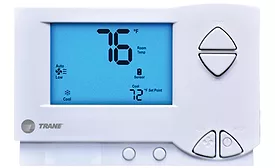
The ProSpace variable refrigerant flow (VRF) wireless control interface creates an open communication platform that allows Trane VRF systems to integrate with hotel room thermostats and building-level control systems. The control is equipped with motion and infrared sensors.
Generating electricity on-site will provide cost savings, reduce carbon emissions
November 5, 2015
Hyatt Hotels Corp. has announced a new relationship with Bloom Energy, a fuel cell manufacturer. Hyatt Regency Greenwich has been selected as the recipient of Hyatt’s first 500kW fuel cell, which will provide up to 75 percent of the hotel’s energy load, generating significant cost savings.
Wireless smart control helps hoteliers save energy while meeting energy code compliance for hospitality rooms
November 4, 2015
Leviton announced availability of its Omnistat™ 3 Hospitality Thermostat, a retrofit solution developed specifically for guest room energy management. The thermostat has a capacitive touch face, and when paired with wireless Leviton Lumina RF load controls and sensors, the company said it provides affordable guest room control.
When you’re traveling and check into a hotel, you expect the room will be clean, reasonably quiet, and — most of all — comfortable. Multiply those expectations by the millions of travelers staying in hotel rooms across the country each day, and you can see why the hospitality industry faces some unique challenges.
Nippon PMAC has launched 4-pipe system climate control technology for existing 2-pipe installations with no structural alteration required. The system, known as PAFMAC, provides hotel rooms with individual climate control so that hotels can provide a better guest experience while increasing their own profit margins.
The market is primarily being driven by extensive growth in the hospitality industry
July 28, 2015
The global food service equipment/commercial refrigeration market was valued at $31.54 billion in 2013, and is forecast to grow at a compound annual growth rate (CAGR) of 4.8 percent from 2014 to 2020, representing a value of $44.33 billion in 2020, according to a new market report published by Transparency Market Research.