ACHR News
search
Ask ACHR NEWS AI
cart
facebook twitter instagram linkedin youtube
  • Sign In
  • Subscribe
  • Sign Out
  • My Account
ACHR News
  • NEWS
    • Breaking News
    • New HVAC Products
    • Featured Products
    • Manufacturer Reports
    • HVAC Data
    • Legislation
    • ACHR NEWS Centennial
  • RESIDENTIAL
    • Air Conditioners
    • Furnaces
    • Residential Heat Pumps
    • Ductless
    • Residential IAQ
    • Testing, Monitoring, Tools
    • Components & Accessories
  • COMMERCIAL
    • Air Handlers
    • Rooftop Units
    • Chillers and Cooling Towers
    • Commercial Heat Pumps
    • Boilers and Hydronics
    • VRF/Ductless
    • Commercial IAQ
  • REFRIGERATION
    • Refrigerants
    • Refrigerant Regulations
    • Leak Management
  • CONTRACTOR PRO
    • Geothermal
    • Homeowner Study
    • VRF and VRV Ductless
    • Unitary Trends
  • EDUCATION
    • Training and Education
    • Business Management
    • Service and Maintenance
    • Continuing Education
    • Market Research >
      • HVAC Brand Awareness Report
      • VRV, VRF, VRVZ Report
      • Unitary Trends Report
      • Water Heat Professionals Report
    • Webinars
    • Sponsor Insights
    • eProducts Info
    • White Papers
  • EVENTS
    • HVAC Contractor Forum
    • Industry Events and Webinars
  • MEDIA
    • Videos
    • AHR Expo 2025 Videos
    • Podcasts >
      • ACHR News Podcast
      • HARDI Podcasts
      • AHR Expo Podcasts
      • ACCA Podcasts
    • Interactive Spotlights
    • Quizzes
    • eBooks
    • HVAC Talkback
  • HVAC GROUP
    • ACHR NEWS >
      • Current Issue
      • Digital Edition
      • Subscribe
    • Distribution Trends
    • SNIPS NEWS >
      • Join SNIPS NEWS
    • Engineered Systems News >
      • Join ES News
    • HVACR Directory
    • Contests
    • Newsletters
    • Contact
    • Advertise
    • My Account

Protective Coating Can Prolong Evaporator Life

By Joanna R. Turpin
November 14, 2001
Depending on the types of activities performed in a building and/or the geographical location, an evaporator can be exposed to some pretty harsh environments. Chemicals, salt, and various manufacturing processes can drastically reduce the life of an evaporator if it doesn’t have a protective coating.

Corrosive environments, whether they’re due to processes in a factory or salt water exposure on the East or West Coasts, are extremely tough on evaporators. Even though it costs more to have a coating applied to an evaporator, it can be beneficial in the long run because the evaporator will last longer.

Note: It’s important to make the decision to apply a coating before installation, because it’s next to impossible to accomplish after the evaporator is in place.
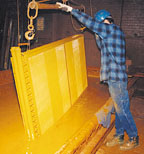


A coil is coated via the immersion method in Heresite P-413 heat-cured phenolic.

Different Types Available

Several types of coatings can be applied to an evaporator. Two of the most popular are modified phenolics and epoxy phenolics.

In order to be effective, coatings must be applied at a maximum thickness of 0.003 in. If they’re applied at a greater thickness, the heat transfer rate may be affected.

It’s also important to know that some amount of heat transfer loss occurs when a coating is applied to an evaporator; however, it is normally less than 5%, which remains constant over time. If that small number seems significant, consider that an uncoated, corroded coil will lose much more than 5% in a short time.

Very few coatings can be applied at 0.003 in. or less and still provide good chemical resistance. That’s why the densely cross-linked Heresite heat-cured phenolic is popular.

“Chemical resistance at a thin application is what differentiates a good coil coating from an inferior coating,” says Doug Schmidt, national sales manager, Heresite Protective Coatings Inc., Manitowoc, WI.

“What’s nice about Heresite is that it has a great deal of flexibility as a coating, so that if you bend the fins or whatever, you don’t crack the coating,” says Ken Kaye, sales and engineering manager, Phoenix Division, Super Radiator Coils, Phoenix, AZ.

Looking for quick answers on air conditioning, heating and refrigeration topics? Try Ask ACHR NEWS, our new smart AI search tool. Ask ACHR NEWS →

Kaye says his company also uses a company called Applied Surface Technologies in Louisville, KY, to apply a coating called “ElectroFin” to their evaporators. “Like Heresite, ElectroFin has its own patented process and has a lot of flexibility and resistance to a lot of acids, alkalis, salts, sulfites, and alcohols.”

Sometimes Kaye is called upon to use an epoxy coating for his company’s custom-made evaporators, but that’s primarily for aesthetic purposes (for example, if someone wants a different colored evaporator). But for corrosion resistance, Heresite and Electro-Fin are the industry standards.


How It’s Applied

It is very difficult to apply a coating in the field after the equipment has been installed. That’s because it is next to impossible to spray the coating and get full coverage on all areas of the fins and tubes in field conditions.

When a coil needs to be coated, the typical scenario is that the coil manufacturer packs up the coil and sends it to a particular coil-coating facility. There the coil is subjected to rigorous cleaning to get it ready for the coating.

Kaye notes that ElectroFin has a seven-step process it uses to coat evaporators. These steps include an alkaline wash, a city water rinse, and a deionized water rinse. Then the evaporator is dipped in the coating, the excess is sprayed off, and the coil is baked at 400?F. After cooling down, the coil is recrated and shipped to the customer.

“It is very important to cover all surfaces when applying coating to a finned tube coil,” says Schmidt. “The only sure way to do this is to completely submerge the coil in the coating several times. Any method that does not guarantee that all surfaces of the coil are completely covered is incorrect. Surface preparation and cleaning are also very important aspects of a suitable application.”

As you can imagine, it costs more to have the manufacturer ship the evaporator to a coating facility, have the coil coated, then have it shipped to the customer. The additional cost depends on the size of the evaporator, says Kaye. “The smaller it is, the more costly it is, because the setup to do a small coil is almost going to cost you the same as to set up to do a large coil. It can add 50% to the cost of a small coil. For a large coil you might be talking 10% to 25%.”

But that’s nothing compared to the cost of a new coil, says Schmidt. He says that an evaporator dipped in Heresite will prolong the life of a previously uncoated coil in a corrosive atmosphere at least three or four times.

Typically the coating lasts for the life of the coil; it seldom needs to be reapplied. “Normally the coil is operated until the coating and the coil fails, which normally takes many years,” says Schmidt. “Heresite does have an air-dry phenolic touch-up spray available. If it is used as part of normal maintenance, it will prolong the life of the coating and thus the coil.”

Contractors should be aware that effectively applying a coil coating is not an easy task and should be left to those companies with a lot of experience. No matter how chemically resistant the coating is, if the surface preparation is not right or you don’t get full surface coverage, it will likely result in a waste of time and money.

It is also important to have a program of regular maintenance and cleaning, as this will also prolong the life of the coil and its coating. But be aware that some cleaners can damage a coating. For example, high-alkaline cleaners will damage Heresite phenolics. Be sure to check with the coating manufacturer before using any cleaner on a coated coil.

The bottom line is that a chemical-resistant coating expertly applied to a finned-tube coil can add many years to the life of a coil in a corrosive environment.

Publication date: 11/19/2001

Share This Story

Looking for a reprint of this article?
From high-res PDFs to custom plaques, order your copy today!


Tn joanna 2017
Joanna Turpin is a Senior Editor at The ACHR NEWS. She can be contacted at 248-786-1707 or joannaturpin@achrnews.com. Joanna has been with BNP Media since 1991, first heading up the company’s technical book division before moving over to The ACHR NEWS, where she frequently writes about refrigerants and commercial refrigeration. She obtained her bachelor’s degree in English from the University of Washington and worked on her master’s degree in technical communication at Eastern Michigan University.

Recommended Content

JOIN TODAY
To unlock your recommendations.

Already have an account? Sign In

  • HVAC-enrollment

    The Trades Are Back: HVACR Programs See Nearly 30% Enrollment Spike

    A new wave of future technicians is entering the pipeline.  
    Training and Education
    By: Matt Jachman
  • 2025 Top 40 Under 40

    2025 Top 40 Under 40 HVACR Professionals List

    The 11th annual Top 40 Under 40 list highlights those...
    HVAC Light Commercial Market
    By: Hannah Belloli-Oster
  • LG Ductless Mini-Split Systems

    The 9 Types of Heat Pumps

    As the U.S. moves toward electrification, heat pumps are...
    HVAC Commercial Market
    By: Joanna R. Turpin
Subscription Center
  • Create an Account
  • Start a Subscription
  • Manage My Account
  • Sign Up for Newsletters
  • Visit Customer Service
  • Update Preferences

More Videos

Sponsored Content

Sponsored Content is a special paid section where industry companies provide high quality, objective, non-commercial content around topics of interest to The News audience. All Sponsored Content is supplied by the advertising company and any opinions expressed in this article are those of the author and not necessarily reflect the views of The News or its parent company, BNP Media. Interested in participating in our Sponsored Content section? Contact your local rep!

close
  • Piggy Bank
    Sponsored byWatercress Financial

    Energy Prices, Inflation, and HVAC: What Today’s Homeowners Care About

  • Refrigerated Food
    Sponsored bySolstice Advanced Materials

    R-455A Refrigeration: A Cold Storage Solution for the Future

  • Airex Rooftop Units
    Sponsored byAirex Manufacturing Inc

    Consolidating Roof Penetrations: A Growing Trend in Multifamily HVAC Design

Popular Stories

HVAC-Price-Increase-graphic

HVAC Price Increase List: June 2026

Trump-Section-232.jpg

Trump Reduces Section 232 Tariffs on HVAC Equipment to 15%

Refrigerants-and-gauge.jpg

HVAC Industry Warns of Counterfeit Refrigerants Entering U.S. Supply Chain

Heat-pump-cutaway.jpg

PFAS Rules and A2L Building Codes Continue to Evolve

Midea-training.jpg

HVAC Workforce Crisis Expands Beyond Technicians to Instructor Shortages

View The ACHR NEWS
Centennial Anniversary Timeline

The ACHR News Timeline Chart
Submit a Letter
Submit a letter to our editors.

Events

November 6, 2025

Next-Gen Data Center Cooling: HVAC Innovation and Real-World Solutions

On Demand As AI workloads and high-density computing push traditional cooling methods to their limits, the data center industry is accelerating the adoption of next-generation HVAC technologies.

June 17, 2026

Decarbonization Without Disruption

This webinar will explore practical HVAC decarbonization strategies that minimize disruption while maximizing long-term performance and ROI.

View All Submit An Event

Poll

Summer Staff

Are you fully staffed for the summer season?
View Results Poll Archive

Products

BNI Mechanical/Electrical Square Foot Costbook, 2026 Edition

BNI Mechanical/Electrical Square Foot Costbook, 2026 Edition

See More Products
Decarbonization Without Disruption - Free Webinar - 6/17/2026

Related Articles

  • Specialty Construction Brands Inc.: Fungicidal Protective Coating

    See More
  • Fujitsu Condensing Unit and Technician

    A Little TLC Can Extend the Life of Condensing Units

    See More
  • Coatings Can Help Condensers Live Longer

    See More

Related Products

See More Products
  • Understanding TXV Refrigeration Systems: Superheat and Subcooling DVD

See More Products

Related Directories

  • Heresite Protective Coatings LLC

    Building on over 90 years of experience in HVAC-R coatings, we continue to invest in R&D and testing services. We continue to develop the best protection for HVAC-R applications.
  • Modine Coatings

    Protect HVAC/R equipment from corrosion with factory-applied ElectroFin® E-coat, field-applied Insitu® Spray Coatings, or the GulfCoat® Contractor Series product line.
×

Sign Up. Stay Informed.

The #1 trusted source for the HVACR industry since 1926

SUBSCRIBE
  • RESOURCES
    • Advertise
    • Contact Us
    • Advisory Board
    • Classifieds
    • Submit a Letter
    • Directories
    • Store
  • ACCOUNT CENTER
    • Create an Account
    • Start a Subscription
    • Manage My Account
    • Sign Up for Newsletters
    • Visit Customer Service
    • Update Preferences
  • SERVICES
    • Marketing Services
    • Reprints
    • Market Research
    • List Rental
    • Survey/Respondent Access
  • STAY CONNECTED
    • LinkedIn
    • Facebook
    • Instagram
    • YouTube
    • X (Twitter)
  • PRIVACY
    • PRIVACY POLICY
    • TERMS & CONDITIONS
    • DO NOT SELL MY PERSONAL INFORMATION
    • PRIVACY REQUEST
    • ACCESSIBILITY

Copyright ©2026. All Rights Reserved BNP Media, Inc. and BNP Media II, LLC.

Design, CMS, Hosting & Web Development :: ePublishing