Portable A/C Units Enter the Smart HVAC Era
Wi-Fi, telematics, and smart controls are enhancing portable units

PORTABLE CONNECTIVITY: Portable a/c units are growing in popularity thanks to increased desires for IAQ and modern technology.
Much like residential customers expect smart technology in their HVAC systems, consumers are seeking the same advancements and connectivity in portable a/c units.
Portable units are increasingly moving beyond convenient stand-ins for on-demand cooling. With Wi-Fi capabilities, app controls, inverter technology, and even AI-driven features, portable a/cs are joining the broader HVAC ecosystem.
“We try to precisely match the specific model to the application as opposed to one-size-fits-all,” said Mike Reiner, vice president, KwiKool. “The old mentality that one size fits all doesn’t cut it. The closer you can match the criteria, the application criteria, the happier the customer is going to be.”
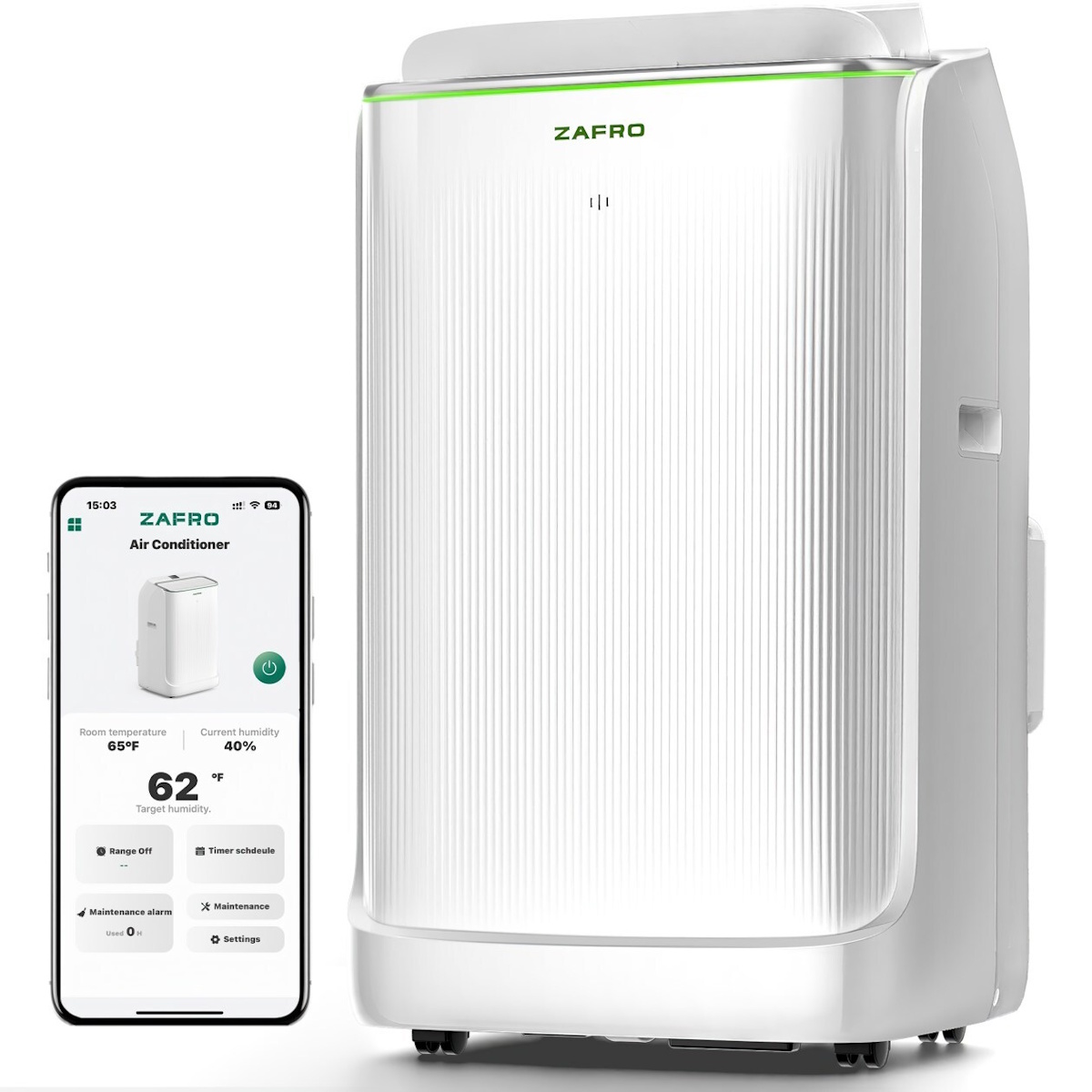
SMART AND PORTABLE: Portable a/c units, like the Zafro Portable AC, are increasingly including smart technology like W-Fi connectivity for ease of use. (Courtesy of Zafro)
According to Data Bridge Market Research, the global portable a/c market is expected to grow from $1.1 billion in 2022 to $1.42 billion by 2030. Demand for the equipment is expected to increase thanks to the use of Bluetooth and Wi-Fi connectivity.
Additionally, the 2025 American Home Comfort Study from Decision Analyst shows that portable HVAC equipment ownership has significantly increased since 2019. The growth is led by portable heat/air-conditioning/dehumidifiers, with 69% of the 2,500 survey respondents owning one or more of these units, followed by air purifiers (39%). This growth demonstrates a post-pandemic focus on HVAC solutions that support remote work and cleaner air.
“In the summer, when people are out of the a/cs, everybody calls dealers at the same time,” said Yi Hu, transformation leader, GE Appliances. “Sometimes we see large dealers buying truckloads from us just to give it to people to temporarily cool their space while they can send technicians out to do repairs.”
There is also an overall industry trend toward energy efficiency, which smart tech can help accomplish through optimized operations. According to the Department of Energy database of portable a/c products, the average combined energy efficiency ratio (CEER) is 7.86 BTU/Wh of the 2,748 models they’ve tracked, with the highest at 14.7.
Looking for quick answers on air conditioning, heating and refrigeration topics? Try Ask ACHR NEWS, our new smart AI search tool. Ask ACHR NEWS
“Portable a/cs are now effectively providing temporary cooling solutions for contractors, as a range of BTU sizes are now available to match the right unit to the desired room size,” said Doug Buckwell, senior director, sales – room AC and air care, LG Electronics. “This helps to match square footage to a correlated optimal comfort level.”
When combined, smart features and efficiency are making portable units more sophisticated and integrated into comfort strategies.
Emerging Technology
Buckwell said several trends and technologies have affected portable units over the past few years. Among them are inverter compressors that provide improved energy efficiency and quiet operation compared to single-speed compressors.
Similarly, he said heat pump models are on the rise when supplemental heating is desired.
“Much of this comes down to their four-in-one operation with cooling, heating, dehumidifying, and fan modes that offer a wide range of flexibility, all in a single device for total comfort and control,” he said.
Modern innovations like Wi-Fi are providing interconnectivity. Buckwell said Wi-Fi-enabled models work with mobile apps, allowing control from anywhere, and have become increasingly common. He said some units even feature voice control with Google Assistant, Amazon Alexa, and Apple Home.
Greg Sanch, vice president of sales and marketing at OceanAire, said his company has integrated USB technology that allows end-users to upload hardware upgrades. It also allows the team to customize operations.
“Say a customer says, ‘I want the fan to run all the time, no matter what.’ We can go in and program the parameters and send them a program. They can download it to a USB and plug it into the machine, download that program, and tell this machine to run all the time,” Sanch said.
This also allows them to download operational specs and troubleshoot any issues that arise, giving both users and manufacturers the ability to solve issues quickly.
Steve Odell, national sales manager, OceanAire, said whether these technologies go mainstream depends on economic realities.
“When cost comes down over time, they probably will eventually, in five or 10 years, have it on everything because I think that’s their preference,” he said. “They’re starting with the big stuff because that piece of equipment costs way, way more money than this [1-ton unit].”
Renier said KwiKool’s products are the result of customer feedback regarding specific features and how the equipment is used. He said if there is a viable solution and the market demand is there, they work toward making it a reality.
“What that boils down to is instead of thinking in terms of millions, tens of thousands of units, you’re thinking in terms of a few hundred for a specific application,” he said. “What you end up with is customers who are more likely to come back to you for those unique solutions, and you can put a premium on that.”
Tracking and Data Collection
Telemetry and telematics are slowly becoming the norm in the portable market as well. Telemetry provides remote collection and transmission of sensor data from a single or multiple units. Telematics provides holistic connectivity and data transfers, often wirelessly, in combination with GPS or site location data, allowing for predictive analytics.
Renier said telemetry mostly applies to 12-ton and above units, as it’s currently not viable for smaller equipment.
“You are probably seeing that with some of the bigger units that are being offered. They want to control them remotely and monitor them remotely,” he said.
Odell said telematics are being added to portable units to not only track them, but to operate them from any location.
“They can get as simple as where is the unit located to … where they can control everything remotely,” he said.
Neither telemetry nor telematics is a new trend, having been around for at least the past two years, but they’re growing. Larger, more expensive equipment like industrial-grade or fleet-focused units often has telematics installed since they’re bigger capital investments.
“Some people have a goal to put it on everything from one ton … and up. But most of them that are doing it are starting with the bigger stuff, 12-ton, 20, 30,” he said.
Sanch said one method manufacturers are implementing is to essentially have each unit possess a cell phone number. Once the unit is activated, a monthly fee begins.
“If you’ve got a fleet of 100 units, now you’re looking at $100 a month or $1,000 a month whether they’re on rent or not,” he said.
Another way customers track them is by using satellites, where every 30 seconds, the unit pings the satellite to show its location. This is more about preventing theft than anything else, Sanch said.
Outside of these tech trends, Renier said contractors can expect more of the same — more uncertainty, more variability in demand, and unexpected changes.
“You have to be prepared for unexpected demand,” he said. “You can’t wait for the boat to come in for components. You have to have the stuff on the shelf. Nobody is going to wait three months for an air conditioner. They can’t wait three weeks.”
Looking for a reprint of this article?
From high-res PDFs to custom plaques, order your copy today!