35% of Commercial Contractors Cite Labor Concerns as Top Risk in 2026
Contractors see AI as a solution to fighting workforce shortages, increased costs
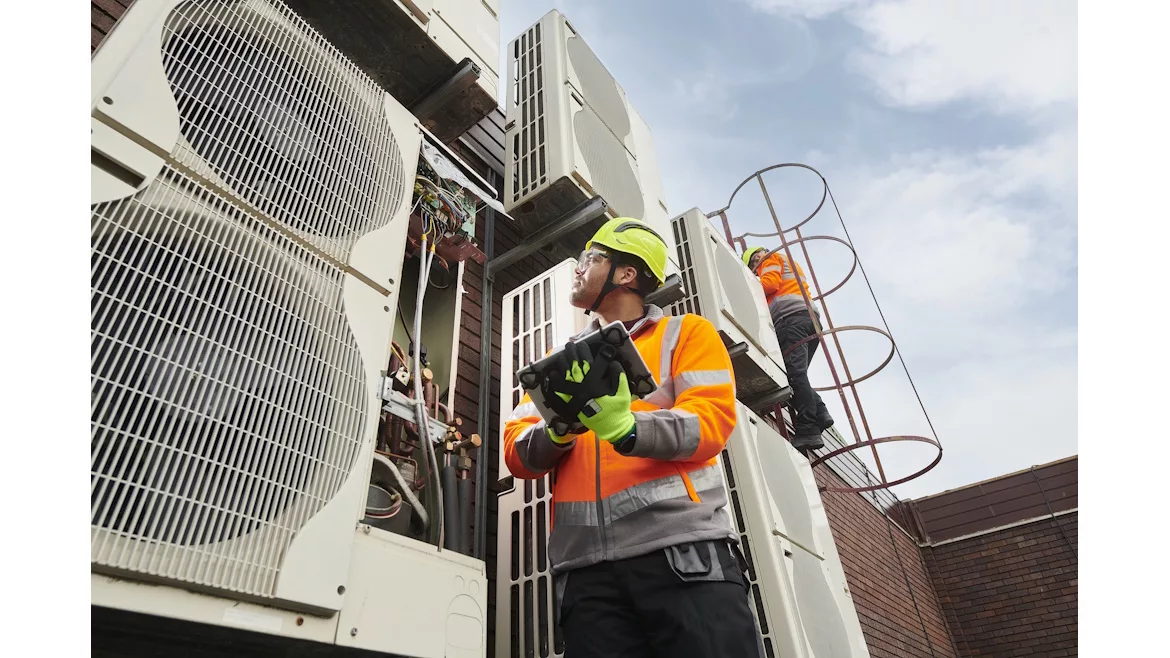
COMMERCIAL CONTRACTORS: A survey from ServiceTitan shows workforce concerns, including labor shortages and rising costs, are the top risks to profitability in 2026.
Commercial HVAC contractors and other specialty companies are concerned about labor shortages and costs in 2026, according to the latest survey from ServiceTitan.
ServiceTitan’s 2026 Commercial Specialty Contractor Industry Report surveyed more than 1,000 commercial construction leaders about their business goals, what risks they believe might hinder those goals, and what solutions they’re using to overcome those risks.
According to the results, the top risks to bottom lines in 2026 are rising labor or overhead costs and the skilled labor shortage. Around 35% of those surveyed listed these as their top concerns. Increasing material prices rounds out the top three concerns at 32%. The results align with other data showing that, by 2030, almost 25% of trade positions will be unfilled.
Regarding labor and overhead costs, respondents indicated that wages are up 16% from 2025. About 38% say they’re monitoring labor costs and assignments for efficiency opportunities to remain profitable.
The remaining risks contractors identified have 20% or fewer respondents concerned, including: growing market competition; limited access to working capital; longer material lead times; an economic downturn/recession; and falling behind in adopting digital workflows.
“Although there are risks associated with rising labor costs and inflation, both are projected and expected,” said Raffi Elchemma, a special industry advisor for ServiceTitan. “These, coupled with existing work and future demands, create an optimistic environment for business success.”
Nearly half of respondents (48%) said they’re optimistic about the market outlook, compared with 38% who have a neutral outlook. To that end, when looking to balance growth and profitability in 2026, 61% of contractors said their top goal is growing revenue via new projects.
Looking for quick answers on air conditioning, heating and refrigeration topics? Try Ask ACHR NEWS, our new smart AI search tool. Ask ACHR NEWS
These were followed by increasing project margins (45%), improving execution efficiency (41%), improving cash flow (37%), and building long-term relationships (33%).
“Even with continued market risks, commercial contractors are still optimistic about their business performance with goals for growth through steady market demands,” said Elchemma.
AI Impact
It’s impossible not to talk about artificial intelligence’s influence on the HVAC industry, let alone businesses around the world. In the commercial space, it’s been both a driver of business, due to data centers, as well as a resource. The report finds that AI adoption is accelerating, with 38% of contractors now reporting measurable business impact from AI, up from 17% in 2025.
Commercial contractors are applying AI mainly to cost estimation and budgeting (24%), followed by bid management (22%) and project planning and scheduling (21%). The report states that contractors still view AI as a support tool rather than a replacement for core systems.
“The next AI leaders in the commercial and construction markets will be defined by how seamlessly intelligence is embedded across the entire workflow,” said Alex Kablanian, senior vice president and general manager of commercial and construction markets at ServiceTitan. “Companies that unify their systems, sharpen execution, use real-time data to protect margins, and accelerate cash flow will transform operational complexity into a competitive advantage.”
Other ways commercial contractors are using AI include communication and collaboration, reporting, supply chain and procurement, document management, labor and resource management, and risk management and safety. Less than 20% of respondents reported using AI in these areas.
Matt Marsiglio, general manager at Flame Heating, Cooling, Plumbing and Electrical in Michigan, said his company — mostly residential but does commercial work — brought on an AI program that serves as a backup for answering phone calls when things get busy, ensuring the company doesn’t miss any opportunities.
“I was on the fence about AI when we first did it, but for me, it took us from on high-volume days, customers were leaving messages, and we weren’t getting back to those messages efficiently or quickly enough,” he said. “So one of the things AI helped with is that our phones never go unanswered.”
Potential Solutions
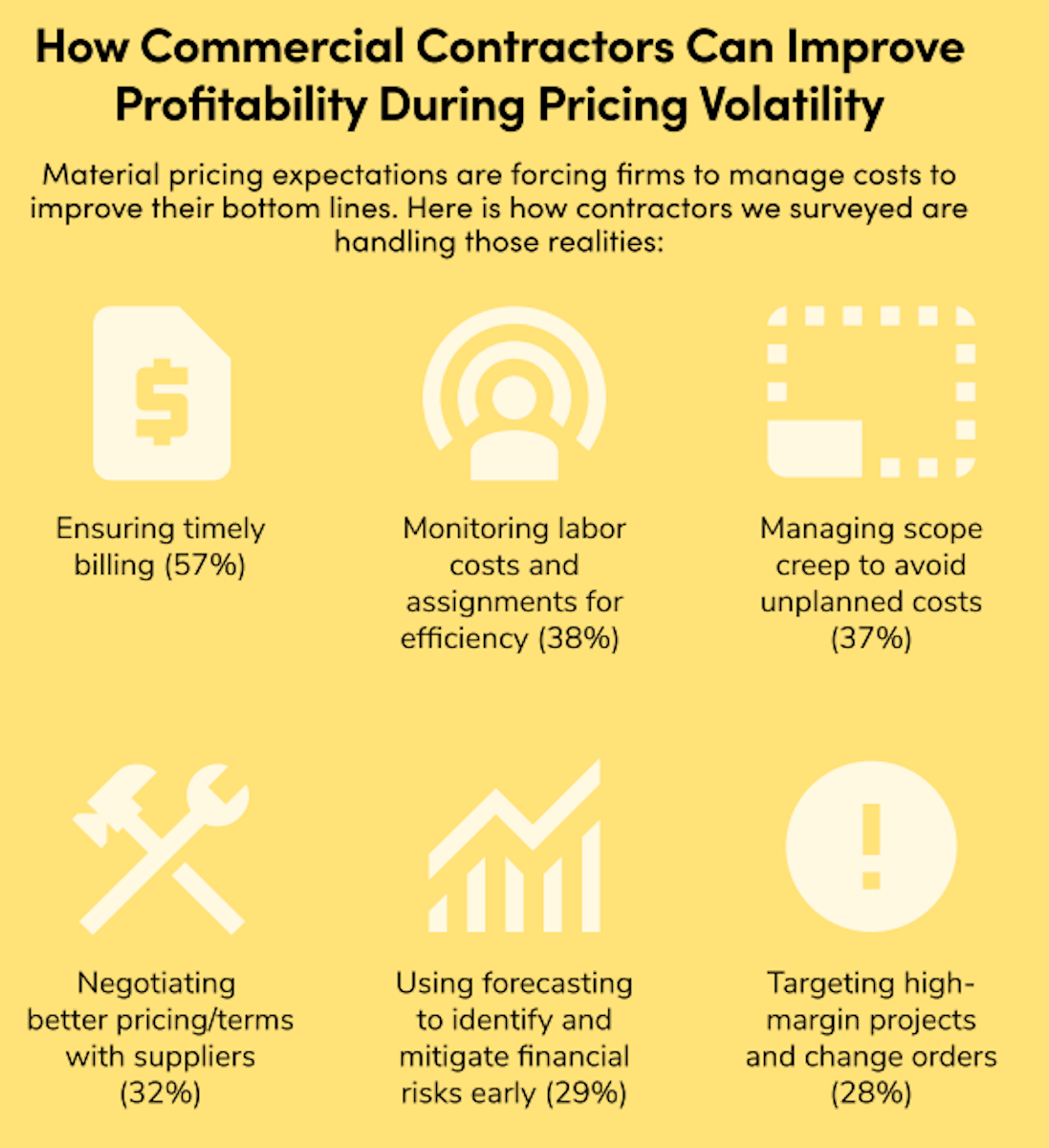
PROFITABILITY: ServiceTitan’s survey shows commercial contractors are leaning into timely billing and monitoring costs to improve profitability during times of price volatility. (Courtesy of ServiceTitan)
Commercial contractors are seeking to overcome price volatility and labor shortages, whether through managing costs and cash flow or seeking ways to bolster their resources.
About two-thirds (67%) of firms pursue lines of credit to fund materials and protect liquidity. This indicates a shift from a reactive cash flow stance to a proactive strategy.
Just over half of respondents negotiate extended terms with their suppliers to bridge the gap between spending and getting paid. Another 32% are negotiating with suppliers for better pricing or terms.
“We do have some primary vendors where we don’t look at each part’s price, we look at the whole inventory price — what supplier can give us the best price on that whole inventory, and then our commitment is we’ll pay you regularly, and we’ll just be a good customer to you, and you’ll be a good supplier to us,” Marsiglio said.
By far the most popular solution to improve profitability is ensuring timely billing, which 57% of respondents are implementing. Other tactics include managing “scope creep” to avoid unplanned costs (37%), using forecasting to mitigate financial risks (29%), and targeting high-margin projects and change orders (28%).
Document management is becoming a priority as well. While 42% of firms say they have a digital system for document management, 59% recognize its importance, saying change orders can increase a project’s value by 5% to 20%. Around 55% are targeting documentation to increase payment velocity, while 52% are targeting approval workflows to eliminate payment delays.
Only 13% of contractors identified lagging in digital workflows as a top business risk, but it’s an area ripe with opportunity. When it comes to tech stack solutions, 34% of respondents rely on two to three systems, while 25% use four to six. Only 20% have a single platform.
The top five systems most used are:
- Accounting/finance, 76%
- Project management, 62%
- Estimating/takeoff, 51%
- Time tracking, 49%
- Bid management, 46%
As system providers offer more services and interconnection, consolidation can become a way to streamline operations and improve business. Aside from proprietary sales software, Marsiglio said using ServiceTitan as its single platform has streamlined his business.
“Whether it’s HVAC residential, commercial, plumbing, electrical, it’s got everybody in the company, no matter what department they’re on, talking the same language,” said Marsiglio. “You can set it up trade-specific or department specific, so they only see what you want them to see ... a commercial technician doesn’t want to have to sort through a bunch of residential pricing to get to where he wants to be.”
Looking for a reprint of this article?
From high-res PDFs to custom plaques, order your copy today!