AI-Driven Buildings Are Coming: What HVAC Contractors Need to Know
Autonomous buildings might cut down emergency calls, but not contractors’ jobs
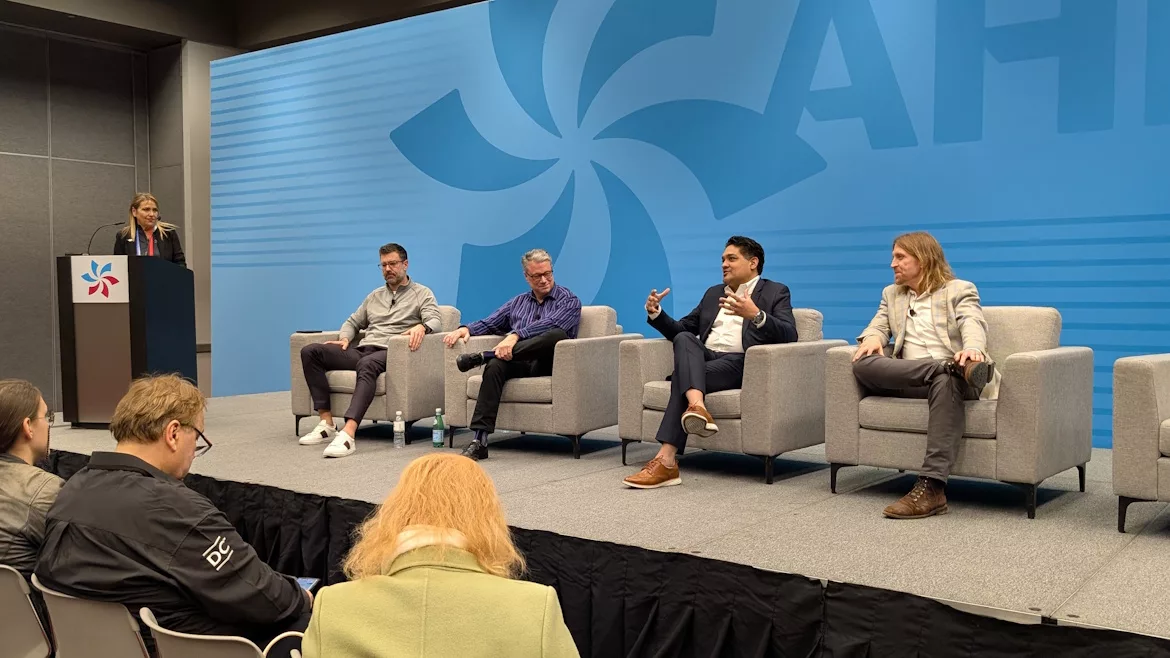
SMART BUILDINGS: From left, Charles Pelletier, vice president of product management at Distech Controls; Darryl DeAngelis, ASHB board and ASHRAE member; Saheel Chandrani, co-founder and CEO of PingCX; and Stephen Holicky, chief product officer at Tridium Inc., discuss autonomous buildings at the 2026 AHR Expo.
If buildings become so advanced that they detect heating and cooling issues ahead of time and deploy robots to fix those issues, what happens to HVAC contractors?
“I would love it if we can get all these typical maintenance issues addressed by something that you can call autonomous: filter changes, for example, [planned maintenance],” said Stephen Holicky, chief product officer at Tridium Inc. “I would love to see a world whereby filter changes can be actually done by something like [a robot] … having some automated way to be able to dispatch something to be able to conduct those tasks would be extraordinary.”
Holicky made the comment at the 2026 AHR Expo, where he and a panel of technology leaders discussed how technology like artificial intelligence is driving commercial buildings toward autonomous operation. The panel also consisted of Darryl DeAngelis, ASHB board and ASHRAE member; Saheel Chandrani, co-founder and CEO of PingCX; and Charles Pelletier, vice president of product management at Distech Controls.
Whether due to seeking savings on building upkeep, reacting to ongoing labor shortages, or technology advancements, facility owners and managers are seeking automation in the commercial space.
While it sounds like autonomous buildings might make HVAC contractors obsolete, they instead pose an interesting opportunity for the industry. If contractors are adaptable, they can find new opportunities for revenue — so long as they don’t mind a building placing service calls.
Buildings Thinking for Themselves
The panel defined what they envision as buildings that operate autonomously. Holicky put it simply: a building that doesn’t involve a human in the operations. A technician or engineer would no longer be called to fix an issue.
“You’ve got people in these spaces. More often than not, if there’s an issue with the temperature, there’d be a comfort call, an individual would be dispatched to the mechanical room to do something about it,” he said. “Buildings that think for themselves would otherwise remove every bit of that human from that process.”
Looking for quick answers on air conditioning, heating and refrigeration topics? Try Ask ACHR NEWS, our new smart AI search tool. Ask ACHR NEWS
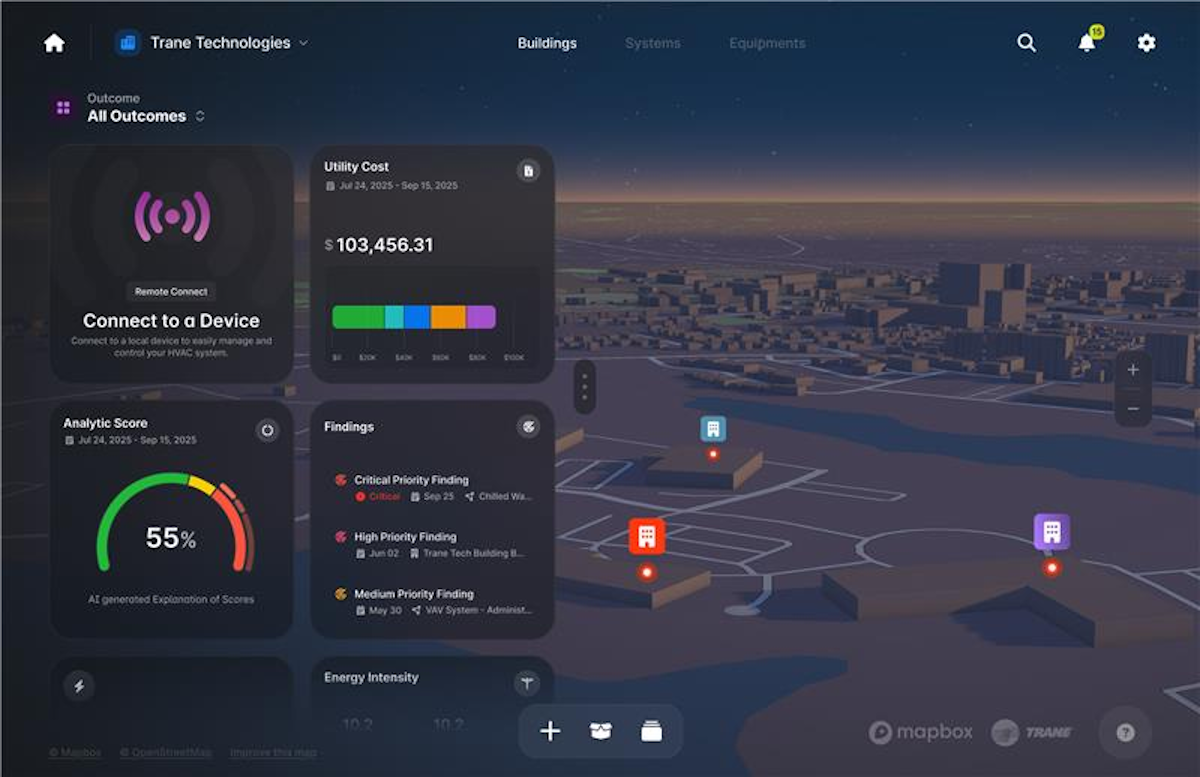
REMOTELY SMARTER: With Trane Cloud, equipment can be monitored remotely to identify issues before they become emergencies. (Courtesy of Trane Technologies)
DeAngelis defined it as buildings that can reason, predict, and make changes, to which Chandrani added includes using input data to self-perform. Pelletier said the idea isn’t to have autonomy for its own sake, but to accomplish goals like energy efficiency and to predict faults ahead of time to improve comfort in the building.
Concepts like direct digital control and building automation systems have been around for decades, notes Ken Misiewicz, president and CEO of Michigan-based Pleune Service, a commercial and industrial HVAC contractor. What is different nowadays, he said, is that more systems have open protocols versus proprietary, and more manufacturers are including components to coincide with building management software.
“Manufacturers are including a lot of base programming or capability in their equipment, some of which is almost plug and play … you don’t have to put in a bunch of extra programming cards. You don’t have to put in a bunch of local area networks because, for the larger part, it’s already canned in the program,” he said. “Some of it is even capable of wireless, like right out of the box.”
Are We There Yet?
While all of this is futuristic and forward-thinking, we’re not there yet. There’s the issue of interoperability — the ability for different systems, devices, or applications to work together seamlessly. HVAC contractors are familiar with this issue when their software platforms, like a CRM, can’t communicate with each other.
“We’re siloed from other systems,” DeAngelis said. “The HVAC system is not with the lighting system, it’s definitely not with the maintenance system, so there’s a lot of cross that has to go between these silos for that to happen, and it’s a lot of effort.”
DeAngelis said that, at a minimum, there needs to be a feedback loop for user input, so the people operating the building have an idea of what’s going on inside it.
“We want autonomy, we want the building to think for itself, solve the problems, and everything else, but the building is operating for the human inside, right? So the human has to have some impact, input into the model and the engine that’s thinking there.”
Pelletier compared it to the medical space, where people would rather have a doctor make decisions with AI assistance rather than have AI do it wholesale.
“I think there is a human in the middle and acting as an assistant to help humans make better decisions in some instances,” he said.
Pelletier said, however, that if a building can’t diagnose and fix issues, it can’t really be considered autonomous. Some roadblocks need to be overcome, such as a building’s ability to coordinate everything from maintenance schedules to ordering parts and dispatching a person — or a bot — to resolve it.
“Without the robot, we’re more talking about assisted building, where we have the diagnostic, but there’s still someone that needs to go change the sensor or fix the issue,” he said.
All of this doesn’t mean automation isn’t coming. With ongoing labor shortages not providing the skilled workers needed, building owners will seek cost-effective solutions.
“The average age of a building engineer in New York City is 54 years old. Forty percent of the tradesmen in the field today will retire by 2031. We all know this. We are not filling those pipelines nearly fast enough,” Chandrani said. “So like it or not, ready or not, there is going to come a tipping point where we are going to be compelled to take advantage of every innovation that's available to us, because we just don't have the people … we can't continue doing it the way that we've done it.”
Additionally, AI is speeding up the automation process. AI takes user inputs and drives output to, for example, change the temperature of a space to meet thermal needs, or can predict when maintenance is needed before failure.
“We are so much further along, in my opinion, today than we were, say about five, seven, 10 years ago, when we didn't have that high-fidelity. So essentially, to me, having access to that data today, it really allows us to do a lot of creative things,” Chandrani said.
Misiewicz said AI can also learn not only from its internal environment, but when allowed, can pull data from elsewhere to optimize efficiency, such as analyzing weather reports.
“It’s consolidating that information and not just giving it to you in a report, but on this dashboard where you can actually see not only how is my stuff performing, but it’s a button in the top right that says, ‘Here’s our recommendations,’ so I think there’s a lot to be gained in that way,” he said.
Still a Need for Humans
Despite a desire for autonomous buildings, the panel did express a need for human involvement. Contractors who shift their service models and perspectives are in a unique position to benefit.
Practically speaking, Misiewicz said he doesn’t see the maintenance side of HVAC going away, even with fully automated buildings. In fact, he sees automation as a boon for contractors because a building that can detect issues ahead of time can reduce the frequency of emergency calls.
“If I’m doing maintenance on a building and I have a guy there for three days or a week, and he has to keep pulling off for emergency service calls, we’re not efficient either,” Misiewicz said. “But if a unit at one of your other customers says, ‘Hey, over here, I’m having a problem, and that can be scheduled for next Monday, it’s not a crisis,’ then both customers are being taken care of, and you’re maximizing efficiency for everybody.”
His own company made the philosophical shift to open protocol systems, meaning they can take any manufacturer’s hardware and layer software on top of it. However, he said larger projects will still likely see proprietary systems, so companies will need to make the decision that best fits their model
“It kind of fit us in a retrofit, renovation and service aspect, and did not at all work in a construction aspect,” he said. “For us, we’re a service company who happens to do construction, so for us, it’s okay for us to do that. But for a pure construction company, that would’ve been devastating.”
The market currently skews toward renovations. As Holicky points out, there are more existing buildings than new ones — older buildings with outdated infrastructure that would hamper full adoption of automation. Not only that, but not every building in the U.S. even has air conditioning.
The panel also recognized the need for the institutional knowledge contractors possess. At the 2026 AHR Expo, which had more than 53,000 HVACR professionals in attendance, Holicky acknowledged there is a vast amount of information that contractors and others can provide. He said yes, a building might operate on its own, but AI needs to be checked and challenged.
“There is so much experience … within these four walls right now that you don't necessarily have today within a language model,” he said. “We need openness to accept new technology and a willingness to work with it and to challenge it meaningfully … that's how you succeed in the market.”
Looking for a reprint of this article?
From high-res PDFs to custom plaques, order your copy today!