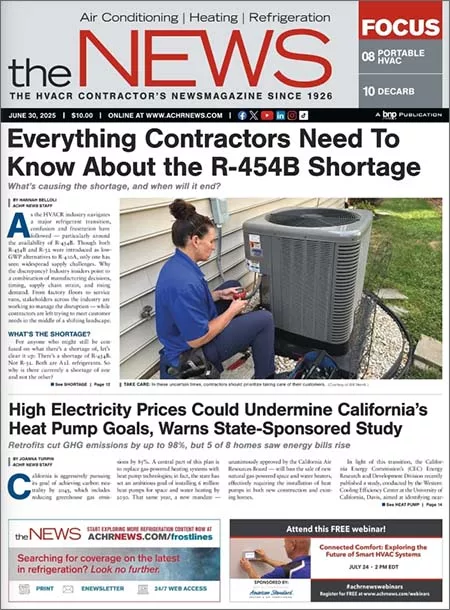
Heat Pumps Surge Ahead: What HVAC Contractors Need to Know Now
AHRI shipment data shows heat pumps outselling furnaces by 30%, closing in fast on air conditioners

NEW GROUND: Due to recent technological advancements, heat pumps can now be installed in cold climates where they never would have worked a decade ago. (Courtesy of Midea)
Heat pumps may not be the golden child of the federal government like they were under President Biden, but that hasn’t put a dent in their popularity with everyone else.
In fact, heat pumps outsold gas and oil furnaces by 30% in 2024, and in four of the last five years. That’s according to the latest AHRI shipment data, which logs how much equipment leaves the factory warehouses each month.
“The trend is real,” said David Rames, senior product manager at Midea America Corp. “In 2020, air conditioners outsold heat pumps by 73%. Now jump forward to year-end 2024 — a/cs outsold heat pumps by 35%, so heat pumps have basically dug into that by half. We're making some real movement.”
The latest AHRI shipment data — April 2025 — closes the gap even more, with a/cs leading heat pumps by a mere 17%.
“In the course of less than 5 years, we went from 73% to 17%, so I think the heat pump business is catching the a/c business quick,” Rames said. “2022 was when heat pumps surpassed gas furnaces in AHRI shipments, and we're not looking back. So the trend is good — the trend is positive.”
Where It Works — And Why
That’s made clear in a study conducted by energy data startup 257. According to 257’s analysis of EIA and AHRI data, roughly 25 million U.S. homes currently use heat pumps.
“Heat pump adoption continues to accelerate,” the study stated. “They are 3-4x more efficient than traditional fuel-based heating, and they cut costs, ease winter peak loads, and reduce carbon emissions.” The wrinkle, though, is that “upfront costs and ongoing savings can vary widely by HVAC setup, household economics, climate, energy prices, and incentives. … Heat pumps don’t pencil out yet for everyone.”

SALES: Central a/c and heat pump shipments year-over-year since 2005 show the latter continuing to make inroads. (Courtesy of AHRI)
257 can tell you who it’ll work for. The company uses large data sets and AI to build a digital energy
twin for every one of the 130 million homes in the country, giving insight into how homes are heated and cooled today, and whether any given home might be a good fit for a heat pump, solar, home battery, etc. The startup shared a report with ACHR NEWS, called “Heat Pump Adoption: A Regional Story”; they plan to debut the platform later this summer, making data available to contractors and manufacturers.
“The first thing that I’d highlight is that it’s certainly regionally specific,” said Scott Rosenberg, co-founder and CEO at 257. “A home that went and got a heat pump in Georgia is very distinct from a home that’s getting one in Maine.”
A contractor in North Carolina, for example, would want to focus on pockets of homes that have first-generation heat pumps — the kind that don’t perform particularly well in the cold, aren’t very good at air conditioning, and are approaching end of life. In Maryland, the study found, 1 in 5 homes has a heat pump, driven by newer housing stock and multifamily growth. These homes are 19 years newer on average and belong to a blend of mainstream and “prosumer” buyers. (Here, “prosumer” means an early adopter of electrification or an enthusiast — not necessarily doing it for purely economic reasons.)
“250K homes heated with resistance electric or delivered fuels, plus another 200K older heat pump homes, would benefit from a modern heat pump retrofit,” the study stated.
Maine is “a nice little hotbed of heat pump adoption” because it’s rural, meaning lack of gas infrastructure and high cost to bring in fuel by truck. Meanwhile, selling heat pumps in California means having to make the tough economic case, dollar-for-dollar, as already-exorbitant electric costs keep on increasing. Currently, fewer than 5% of California homes use heat pumps.
“And so in California, I think, the focus needs to really be on homes that have already started to electrify … and even though it’s a really big market, it will remain more of a niche for a while because of the cost of electric and the prevalence of gas,” said Rosenberg. It’s still a huge opportunity: “1.1 million homes with costly electric heating are prime candidates for heat pumps, plus another 1.5 million prosumer homes already on the path to electrification,” the study noted.
What’s Fueling The Growth?
Rames chalks up the heat pump momentum to two main drivers: incentives — be it local, state, or federal — that offset the upfront cost, and technological advancements that allow heat pumps to work in cold climates.
“Climates that they were never able to be installed in, just a few years ago,” Rames said.
But one of those drivers is about to be dialed back in a big way. In President Trump’s “One Big Beautiful Bill Act,” passed by Congress on July 3, incentives including the 25C credit for residential energy efficiency improvements, which covers HVAC, will dry up December 31, 2025.
Without federal incentives, will the momentum continue?
Rames isn’t too worried.
“I think, in a different way, it will continue,” he said. “It will keep going. This snowball is rolling, and it's getting bigger. … And I'll say this: The 25C Inflation Reduction Act [credit] wasn't to the point where it blanket-covered the whole country. We talked about it a lot, but it still wasn't implemented in a lot of states.”
State-level heat pump programs were making strides even before IRA tax credits became available. California and Maine have both made headlines with their heat pump programs — California for its ambitious Heat Pump Blueprint, which aims to install 6 million heat pumps by 2035, and Maine for its wildly successful state-level legwork that has homeowners installing cold-climate heat pumps in frigid climates without batting an eye. Going forward, Rames said, local utilities will likely be under more pressure to help offset that initial cost and incentivize consumers to make energy-conscious HVAC purchases.
“And let's not forget that dual fuel is a major option for a lot of people,” Rames added. “They're saying, ‘I'm not going to give up a gas furnace, but give me that heat pump,’ and I know a lot of manufacturers are on the dual-fuel bandwagon, too.”
Tony Young, senior product manager, residential air conditioning at Rheem, agreed: “Manufacturers are continuing to prioritize heat pump development heading into the rest of 2025,” he said. “That said, air conditioners remain a strong option, particularly in consistently hot climates where heating isn’t a major concern. A/c systems are widely installed and can be the right solution for many homeowners, depending on regional needs and household priorities.”
How Contractors Can Win
Step 1 for contractors who want to surf the heat pump wave is education — for technicians, salespeople, and customers alike.
“Know what the equipment is capable of doing,” Rames said. That way, if a contractor in a northern climate walks into Mr. and Mrs. Jones’ house and mentions the word “heat pump,” only to be met with “No, no, my dad had a heat pump, and he hated it,” the conversation doesn’t automatically screech to a halt.
Midea has done a lot of consumer research on this topic, including sitting down with consumers who replaced their HVAC system within the past 18 months and asking them what the biggest factor was in why they made the purchase, what brand they chose, and what efficiency.
“And their answer was, ‘I did what my HVAC contractor told me to do,’” he said. “You have to be educated — to go through the statistical data of what your brand of heat pump can actually heat down to and let them know, put them at ease.”
Many manufacturers offer online and in-person training resources through distributor networks, which can help build that deep subject matter expertise.
“Contractors can best position themselves for this market shift by focusing on heat pump training, especially as technology continues to evolve,” said Young. “Staying up-to-date on installation and servicing best practices, particularly for variable-speed and connected systems, will be key.”
That also includes being able to speak confidently about any available rebate programs, Young said. Not all contractors are comfortable doing double-duty as financial advisor, but having that information can be “a strong differentiator” during the sales process.
If education is step 1, step 2 is being prepared to close the sale with a crucial follow-up: financing.
“Because there are consumers — and we've learned this through consumer research — who will say yes to the first contractor that comes to their house to offer financing,” Rames said. They may have the money, or they may not; they may want to keep their money in the bank earning interest, or they may be too embarrassed to say they don’t have enough money to pay for new HVAC — either way, “99% of consumers do not plan for this. It’s a reactionary decision. So offer financing. If you do, you will see your closure rate increase drastically.”
Looking for a reprint of this article?
From high-res PDFs to custom plaques, order your copy today!