The Pros and Cons of Electric Work Vans for HVAC Contractors
How to determine if a fleet of EVs is right for you

GOING ELECTRIC: More than 90% of the fleet for Super Cool Air Conditioning & Heating in North Carolina consists of electric vehicles.
With fuel prices rising and electrification becoming more widespread in both the HVAC and auto industries, electric vehicles could be the way of the future. However, they do come with tradeoffs HVAC contractors must consider.
Mitchell Demitruk, owner of Super Cool Air Conditioning & Heating in North Carolina, has more than 90% of his fleet as EVs, opting for three Chevrolet Bolts and 11 Ford E-Transits. Only one service vehicle, a Ford Transit Connect, runs on gas. He was inspired to switch to EVs for his company after purchasing one for personal use in early 2021.
“I was like, ‘Wow, this is way better than what we were doing in the past,’” Demitruk said. “Mainly not paying for fuel, the maintenance being nonexistent, not going to the gas station. I mean, it’s just the convenience of it.”
Nick Lamb, co-owner of Butler Heating and Air Conditioning in Dayton, Ohio, had similar notions in 2021, but after looking into EVs at the time, decided against it. He said he is still interested, but factors like costs and limited vehicle ranges kept him from investing
“There weren’t as many options at that time, so the opportunity has grown a bit … but we talked to an electrician that went that way, and they were not having a lot of success, specifically with service and maintenance,” he said. “Not a lot of people in our area were able to service them.”
The Pros
Budget-friendly fuel costs. Going electric means eliminating gas from operating expenses. Demitruk estimates spending around $7,500 on total electric bills a year, compared to about $3,400 a year on gas for his sole fossil fuel vehicle. Part of that $7,500 includes reimbursing workers for their electric bills when they charge the EVs at home.
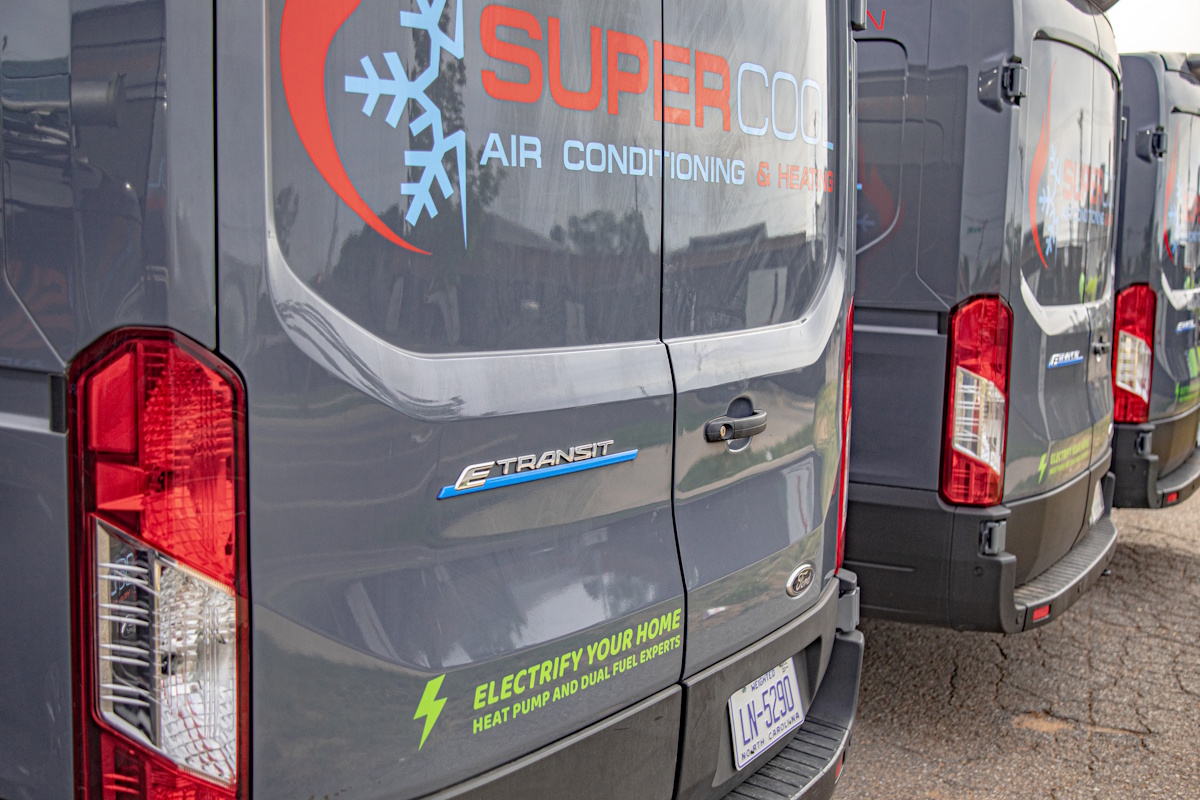
PROS AND CONS: EVs require less maintenance and are better for the environment, but do have limited range and reduced performance in the cold. (Courtesy of Mitchell Demitruk)
Some manufacturers and third-party companies provide telematics software that can further optimize ranges, or even track charger use to make record-keeping easier. Trevor Blum, senior manager of commercial EV strategy at Ford, said the return on investment can be significant, especially in states with higher gas prices.
Looking for quick answers on air conditioning, heating and refrigeration topics? Try Ask ACHR NEWS, our new smart AI search tool. Ask ACHR NEWS
“Currently, the market conditions are pushing oil prices up, which in effect results in a lot more fleet costs,” Blum said. “So total cost of ownership is one of [the benefits], as well as uptime since you don’t have oil changes with EVs.”
Reduced maintenance. EVs don’t need oil changes or tune-ups — there are fewer parts, and regenerative braking reduces wear on brake pads. Compare this to fossil fuel vehicles, which require engine oil and air filter changes, spark plug replacements, fuel filter replacements, and maintaining engine components like serpentine belts.
“It’s laughable how little we spend on maintenance,” Demitruk said. “Our entire fleet budget for last year, including buying the vehicles, was lower than a buddy of mine’s wear-and-tear maintenance.”
Better climate control. EV compressors can run at 100% when stopped, meaning contractors can comfortably sit in their vans while making calls or handling other business, regardless of the weather. They can also be started indoors to warm up or cool down the vehicle without worrying about exhaust fumes.
Onboard power. Certain automakers include power outlets in their vehicles to provide on-demand electricity. This can be useful on new construction jobs when electricity might not be available, or a convenient way to recharge battery-powered tools.
Tax incentives. Tax credits are available to support purchasing an EV as part of a fleet, as well as for the supporting infrastructure. According to the Department of Energy, commercial fleets that buy a qualified clean vehicle may qualify for a maximum credit of $7,500 per commercial vehicle weighing under 14,000 pounds and $40,000 for all other vehicles.
Consumers can receive up to $7,500 for qualified new vehicles and up to $4,000 for pre-owned vehicles.
A tax credit valued at 6% of the cost of property subject to depreciation, capped at $100,000 for each item, is available when purchasing charging equipment for a business or fleet.
“Cost was one, weight was another [factor],” Lamb said when recounting why he didn’t switch. “If we were to move forward, we would narrow it to service vehicles.”
Sustainability. Contractors drive with a clean conscience knowing their EVs help reduce their carbon footprint and produce zero tailpipe emissions. This can be helpful for larger companies that are looking to meet sustainability goals.
Noise pollution is reduced as well, with EVs operating quieter than combustion vehicles.
The Cons
Limited range. Like a gas vehicle, EVs can only go so far before they need a recharge. The latest models for the Ford E-Transit, Dodge Ram ProMaster EV, and Rivian Commercial Van currently have estimated ranges of 159 miles, 164 miles, and 161 miles, respectively. Ranges for older models tend to be smaller.
This means contractors are limited to how far they can travel. That isn’t an issue if their market is small, but larger companies, or those servicing customers in rural areas, will run into issues.
“We did a study on how many miles per day our service vehicles drove, and it was quite a bit,” Lamb said.
Impacted by weight. Like gas-powered vehicles, additional weight or being less aerodynamic can impact the range of upfitted EVs. For the 2024 Ford E-Transit, the range is reduced to 91% with 100% payload.
Similarly, the roof height can affect range. Ford shows that a medium roof reduces the range for a 2024 E-Transit from 159 miles to 148, while a high roof lowers it to 143 miles.
“A lot of the things that affect your range in an [internal combustion engine] vehicle — are you carrying anything? Are you towing anything? Are you operating in cold weather conditions? Are you driving uphill — a lot of those factors are the same for an EV as well,” said Blum.
Extreme weather range reduction. EV performance drops with extreme hot or cold temperatures. For contractors in regions where winter temperatures can drop to single digits, their effective service area is reduced. That can hurt business in the cold season, especially when receiving those “no heat” emergency calls.
“There are places where I would never tell somebody to have an [electric work van], like if they’re in the Boston area, it’s a nightmare because half your season is cold and the cold weather eats up the battery,” Demitruk said.
Infrastructure investment. Owners will want to invest in chargers to ensure their fleet is ready. This could mean installing multiple chargers at the office or at the homes of technicians who take the vehicles with them.
This becomes complicated if workers live outside of an EV’s range to the office or live in structures like apartments that don’t lend themselves to installing a charger. There’s also the consideration of lost time spent charging EVs since it takes longer than a gas fill-up (see sidebar).
“We had conversations of ‘What do we do? Do we install chargers at our employees’ homes, do we just install them here at work?’” Lamb said. “The last thing we want is to create additional downtime here, unbillable hours here at the shop.”
Tire Replacement. EVs may not need the same amount of maintenance as gas vehicles, but they do wear out tires faster. Any savings from reduced maintenance might be negated by more tire replacements.
“They do eat up tires,” Demitruk said. “But part of that is because the guys are lead-footed and [the EVs] are a little heavier.”
Poor resale value. EVs see as much as a 50% decrease in as little as three years. Compare this to gas vehicles, which depreciate by 50% in five years. It’s great when looking to buy used EVs, but when it’s time to retire a vehicle or upgrade to a newer model, contractors could face a loss on their investment.
The Verdict?
There is no simple answer as to whether contractors should use EVs over traditional work vans. It depends on multiple factors, such as their region, the breadth of their markets, whether they can afford the investment, and their preferences. Blum said it’s ultimately about determining if they are the right fit for your company.
“I'd say start small and keep a very data‑oriented approach. ... The steps are starting with really identifying what are the vehicles that are fit to actually switch?” Blum said. “So are these vehicles that are driving a lot in very hilly terrain — maybe not the best fit for an electric vehicle. But fleets that have very consistent routes that are operating in urban environments start to make sense.”
He said thinking through charging is crucial, as it is a shift away from the gas-powered vehicles workers have driven for decades and may require investments. The last is to determine if your employees are willing to make the switch.
“Are these people that are used to change, are willing to give honest feedback … but can really help push the business forward? And those change agents can be good advocates for EVs in the company, or can be really honest about what works and doesn't work,” Blum said.
The Basic of EV Charging
If you’re considering an electric vehicle, here’s what to know about charging them.
In general, charging takes longer than a gas fill-up, so the main difference will be the time your vehicle spends charging. According to the Department of Transportation, the following are the levels of charging and how fast they charge a battery-powered EV from empty to 80%:
- Level 1, using standard household 120-volt outlets: 40 to 50 hours
- Level 2, using 240V or 208V: four to 10 hours
- Level 3, known as DC fast charging: 20 minutes to an hour
The better the charger, the more expensive it will be to install, and it may require electric service upgrades to your home or business.
Public infrastructure for EVs is growing. As of fall 2024, there were 192,000 publicly available charging ports nationwide. One year later, there were more than 228,000. There are 77,758 EV charging stations as of February 2026.
Looking for a reprint of this article?
From high-res PDFs to custom plaques, order your copy today!