FROSTlines
Refrigerant Choices and Challenges in Commercial Refrigeration
Today’s low-GWP solutions move the industry forward, but each comes with trade-offs
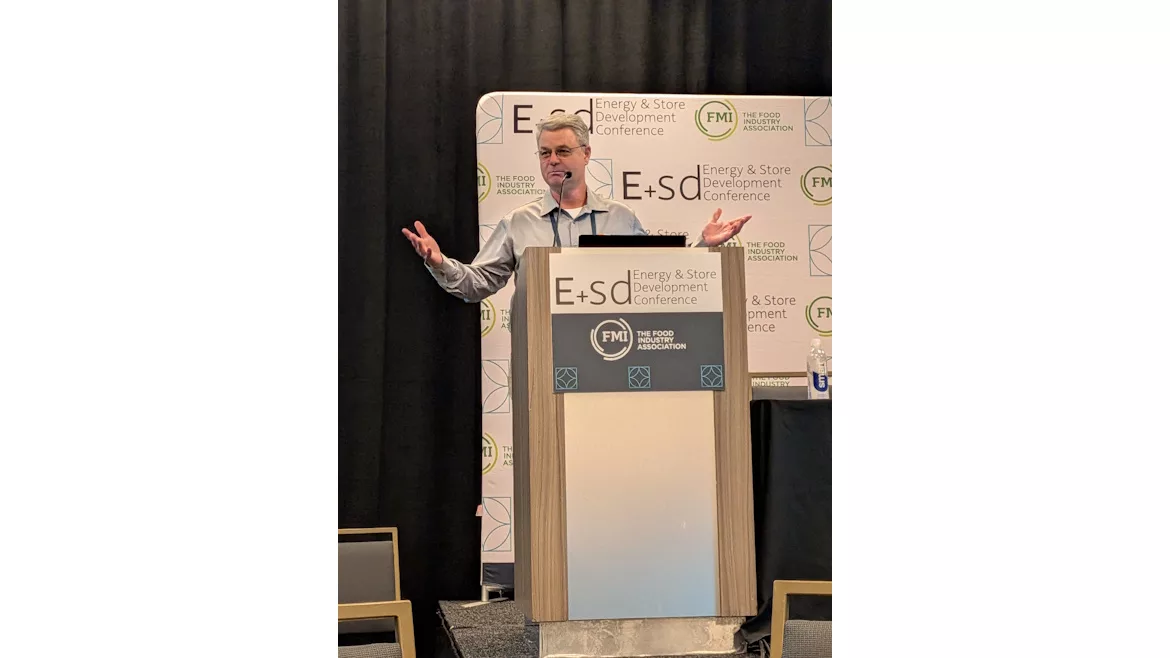
VIABLE PATHS: At the FMI E+SD conference, Tom Wolgamot said CO₂, A2Ls, and propane offer viable paths, but that each has unique challenges for end users.
The commercial refrigeration landscape is evolving rapidly, driven by regulatory pressures such as the AIM Act, which are accelerating the demand for low-GWP refrigerant solutions. Speaking at the recent FMI Energy & Store Development Conference in San Diego, California, Tom Wolgamot, principal at DC Engineering, shared insights based on his work with a wide range of end users who are actively evaluating and implementing these new technologies.
He noted that while low-GWP refrigerants such as CO₂, A2Ls, and propane all present viable paths forward, “they each have their own challenges.”
Code-Friendly CO₂
Starting with CO₂ (R-744), Wolgamot said that the good news is that codes and standards are largely settled.
“For CO₂, codes are not an issue. We have standard leak detection, ventilation, machinery rooms, easy-peasy stuff,” said Wolgamot. That regulatory clarity has made CO₂ refrigeration systems increasingly popular, especially in supermarkets.
CO₂ systems do present some challenges, though. For example, leaks are fairly common, he said, and they are often caused by vibration or pressure relief valve pop-offs. And while manufacturers have made progress — such as fixtures rated for standstill pressures up to 90 bar — capacity ratings can still be a limitation in some applications.
“We're being told that capacity uses are the same, and then in some instances, we find out the capacities are not the same,” he said. “So watch for that.”
Another barrier is cost-effectiveness, particularly in smaller-capacity applications. The industry has largely come to terms with the cost of CO₂ rack systems, as well as distributed architectures, said Wolgamot. But as CO₂ systems are scaled down into lower-capacity applications, the economics become more challenging.
Looking for quick answers on air conditioning, heating and refrigeration topics? Try Ask ACHR NEWS, our new smart AI search tool. Ask ACHR NEWS
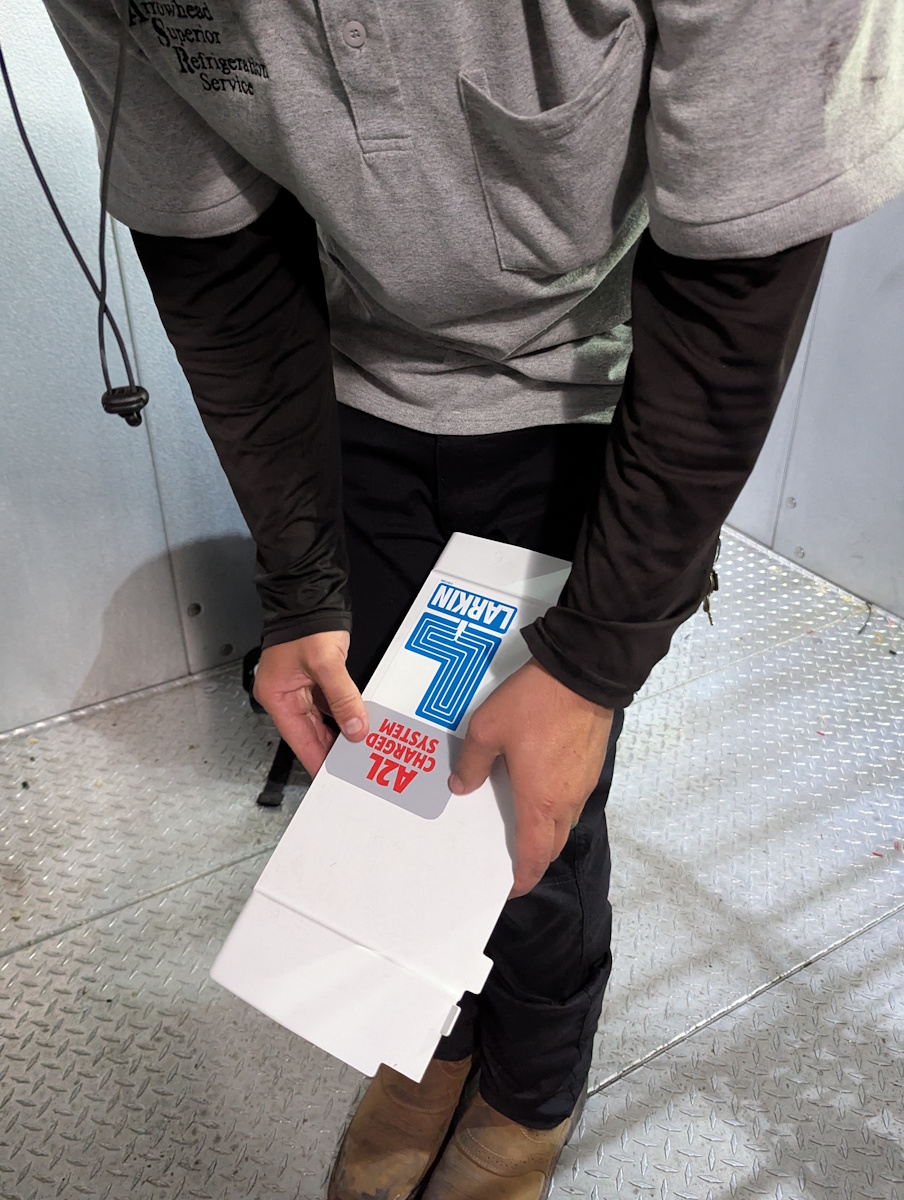
FAMILIAR DESIGN: A2Ls offer lower GWP and compatibility with familiar system designs — however, they are mildly flammable. (Staff photo)
“We've still got the same high-side components that we have to pay for, manage, and maintain, but now we have a smaller Btu capacity to spread that over,” he said. “So trying to make a CO2 condensing unit cost-effective, as compared to an A2L unit or something similar, I think, is going to be a long-term challenge.”
Controls can be another challenge with CO2 systems. As Wolgamot noted, CO₂ systems generally perform very well once they're up and running — they’re stable and reliable. When problems do occur, nine times out of ten, they’re related to the controls.
“People don't understand the controls,” he said. “There are layers of controls, controls that don't communicate with each other. Trying to get more transparency into just what the sequences are, getting controls to communicate better, I think, would go a long way.”
Propane: Safety First
Propane continues to gain traction — particularly in self-contained case applications — thanks to revised charge limits.
“The self-contained fixtures can go up to 300 and 500 grams now, which is great,” said Wolgamot. Even more promising, building codes allow up to 1,100 pounds of propane for field-built systems if using an outdoor application or machinery room, he said.
Despite that potential, market momentum has been slow.
“We’re not seeing much of a demand for propane on the consultant side,” noted Wolgamot. “Without much of a market demand, we're just not seeing a lot of components and availability out there.”
Propane’s biggest obstacle remains safety. While the A3 refrigerant is efficient and well-suited for self-contained systems, wider deployment depends on industry readiness to manage flammability concerns. As Wolgamot put it, “The big thing with propane is just the overall safety concern. It’s hard to say whether it moves beyond the self-contained case application.”
A2Ls Are Technically Ready
A2L refrigerants — such as R-454A, R-454C, and R-455A — present a middle ground between HFCs and natural refrigerants. They offer lower GWP and compatibility with familiar system designs; however, they are mildly flammable. That said, significant progress has been made in drafting codes and standards, and “we have pretty much what we need in order to deploy an A2L system,” said Wolgamot.
The problem is that, unlike CO₂, A2Ls suffer from a lack of precedent. The industry has not yet established a true “standard of care,” so engineers and contractors must rely on best practices and professional judgment rather than clear industry guidelines when designing these systems.
“There are not enough systems out there to say this is how you safely deploy an A2L system, because no matter how detailed the codes are in writing, there's interpretation required,” said Wolgamot.
He added that this uncertainty drives caution, which means engineers and contractors may need to take a more conservative approach until a proven track record is established. The code landscape is also more complex than in the past.
“There are specific requirements for installation in the UL standards now. So you need to take the mechanical code, the ASHRAE standard, and then apply the UL standard on top of it. And each one has their own complexities.”
For example, UL Standard 60335-2-89 restricts the installation of A2L indoor equipment based on minimum room size, which varies depending on the refrigerant used. Wiring diagrams will also play a critical role in A2L systems, particularly when it comes to integrating leak detection and the required safety responses. In addition, A2Ls introduce safety protocols for evacuation and charging, which differ from those used with traditional refrigerants.
“Trying to get the technicians comfortable with that is a big challenge,” noted Wolgamot.
He added that leak detection can be a particularly confusing issue for A2L systems.
“For clarification, there are actually two leak detection systems that are required now. There is the traditional occupancy exposure limit leak detector in the 300 to 500 ppm range in cooler boxes, and those are field-adjustable and configurable. And now we've got the lower flammability limit (LFL) leak detectors that will come on the coils or on the appliances, and those will be in the 15,000 to 20,000 ppm range. So, two different leak detection systems. One's field configurable, and one is non-adjustable in the field. And the location of those is super key.”
So Many Choices
With CO₂, A2Ls, and propane all presenting workable — but imperfect — options, the industry is left facing what Wolgamot calls an “abundance of options.” The challenge is not finding alternatives, but knowing which one to choose.
“We’ve done a huge job, I think, in advancing where we’re at,” he said. “We almost have too many choices now.” Training, risk management, system design, and long-term regulatory stability will ultimately determine which refrigerants win a larger market share.
Until then, Wolgamot advised end users to be cautious.
“Make sure you’re working with suitable partners,” he said. “If you get into a situation where you’re working with somebody that is just wanting to do the bare minimum, cut corners, and just get it in, I'd be a little cautious on that.”
SIDEBAR: Can A2Ls Be Used for Retrofit Applications?
In the Q&A session following Wolgamot’s presentation, an audience member asked whether A2L refrigerants could be used to retrofit existing A1 HFC systems in supermarkets — not in new installations, but as replacements in legacy stores. The moderator, Rajan Rajendran from Five Rivers Research & Consulting LLC, explained that while work is underway to make this possible, it is not currently allowed. “The short answer is not yet,” he said, noting that standards committees are developing safety and mitigation provisions that could eventually permit A2L retrofits, but EPA would still need to approve any changes. As of today, he said, “EPA only allows A2Ls in new systems.” Tim Anderson, director of principal engineering at Hussmann Corp., added that an addendum to ASHRAE Standard 15 is expected soon, which will outline requirements for converting an A1 system to A2L. “Understand that if this does come to pass and you can do these retrofits, it won't be a simple thing,” he said. “Essentially, the equipment into which the A2L is being retrofitted will have to meet all of the requirements of UL 60335-2-89 and ASHRAE Standard 15 for what a new A2L system would have. So that may mean also retrofitting in leak detection sensors and making sure that the releasable charges are acceptable. It will also likely have to be evaluated by a nationally recognized testing laboratory, like UL or ETL.” In short, A2L retrofits are not currently permitted, but standards and regulatory pathways are under development. Even once approved, retrofitting will likely be complex, costly, and heavily design-dependent, which will likely mean more of a full-system conversion rather than a simple refrigerant swap.
Looking for a reprint of this article?
From high-res PDFs to custom plaques, order your copy today!