FROSTlines
A2Ls Offer Alternative Solution in Commercial Refrigeration
These low-GWP refrigerants offer energy savings and ease of installation and service
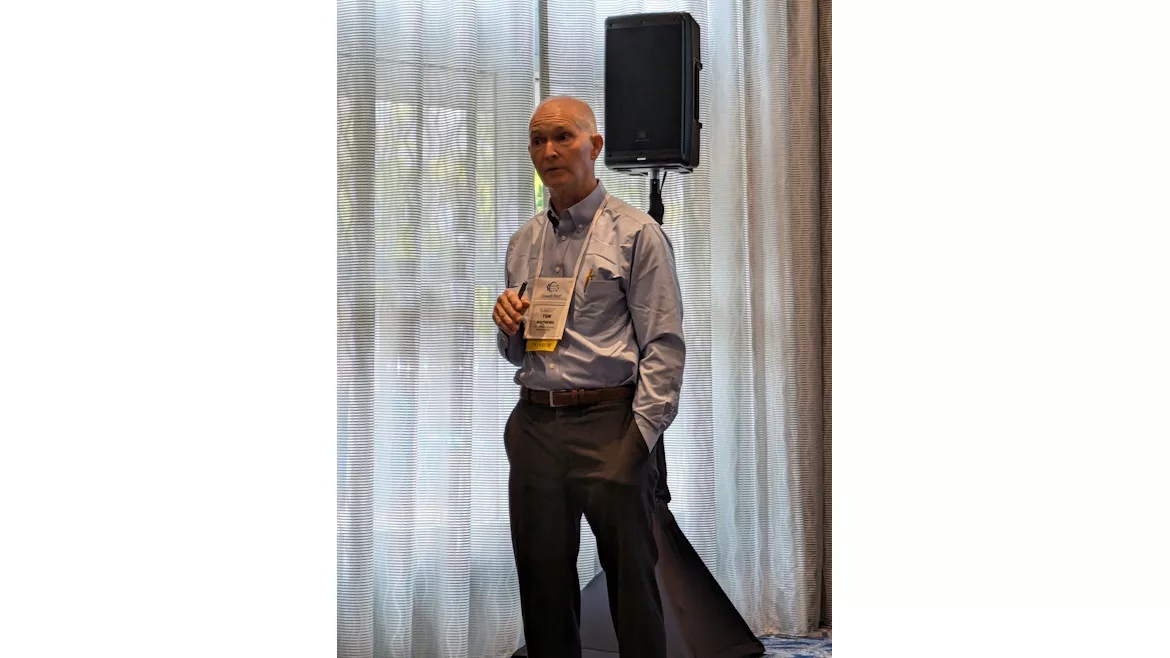
A2L BENEFITS: CBES’s Tom Mathews spoke at the FMI conference about the benefits of A2L refrigerants. (Staff photo)
As mandated by the AIM Act, the U.S. is phasing down the use of high-GWP HFCs in air conditioning and commercial refrigeration equipment. In commercial refrigeration, this requires new systems to use refrigerants that meet the GWP limits of 150 or 300, depending on the size of the equipment. In response, the low-GWP alternative CO2 (R-744) has been gaining popularity in supermarket refrigeration systems, but some grocers have expressed concern over the complexity and expense of this equipment.
That is why mildly flammable (A2L) refrigerants should also be considered, according to Tom Mathews, vice president of sustainability at City Building Engineering Services (CBES) in Burlington, Massachusetts, and Kyle Klahre, PE, CEM, project engineer at Cuhaci Peterson in Jacksonville, Florida. The two men recently spoke about the benefits of A2Ls at the Food Marketing Institute’s (FMI’s) 2024 Energy & Store Development Conference in Baltimore, Maryland.
Why A2Ls?
Grocers have many reasons to consider A2Ls as part of their refrigerant transition strategy, said Klahre. These include their compliance with GWP regulation limits, as well as their reliability and ease of servicing, maintenance, and installation.
“Overall, they are utterly simple, conventional, and similar to what we are using today,” he said. “If we look at energy efficiency and cost effectiveness, A2Ls offer a unique strategy for this type of system. If we compare them to other A1-classified refrigerants, they're actually performing either equal to or better from an annual energy usage standpoint. And this doesn't matter what climate we are in, whether it's in Miami, Denver, or Chicago. They are often ranking either at the top or in the middle with other A1 refrigerants.”
Klahre added that A2L refrigerants such as R-454C, R-455A, and R-1234ze also perform comparably to A1 refrigerants in terms of COP and glide, making them similar to what contractors and technicians are used to working with today. In addition, the system design is similar to traditional DX systems and includes compressors, condensers, TXVs, and coils, thus avoiding the complexities of high-pressure CO2 systems. A2Ls are also well-suited for remodels, he said, particularly in distributed systems or setups using secondary or cascade systems, where they can easily be integrated on the high side.
The difference between A1 and A2L refrigerants, of course, is that the latter are mildly flammable and as such, equipment utilizing these alternatives will require additional safety measures.
“ASHRAE Standard 15-2022 and UL Standard 60335-2-89 are both current safety standards we have to look at with A2L systems,” said Klahre. “The ASHRAE standard calls for various stop valves and leak detectors throughout the store, while UL 2-89 is about mitigation requirements for equipment, such as cases, coils, and racks, as well as maximum releasable charges.”
Looking for quick answers on air conditioning, heating and refrigeration topics? Try Ask ACHR NEWS, our new smart AI search tool. Ask ACHR NEWS
While A2Ls may look attractive to grocers, there’s no question that these refrigerants face some short- and long-term hurdles. In the short term, there are no drop-in replacements for existing A1 HFC systems, which means choosing an A2L refrigerant will require the replacement of all cases, coils, and racks, said Klahre. Another short-term problem is that manufacturer selection software and data catalogs for system design engineers are still under development, but the industry is moving closer to getting this finished, he said.
In the long term, ASHRAE Standard 15-2022 has improved allowances for A2L refrigerants compared to previous versions, but adoption of updated building codes at the state and local levels remains a significant challenge.
“We are going to have a bunch of hurdles as states look to bring in the latest ASHRAE code,” said Klahre.
Types of Equipment
While it is currently difficult to find many A2L refrigeration systems in the marketplace, Mathews believes that manufacturers are looking at several different architecture options, including a distributed A2L refrigeration system approach.
“Why take this approach? Well, if you put the compressors on the roof near the loads being served, it minimizes the piping between the unit and the load, and that maximizes the use you can get out of that unit in terms of the maximum refrigerant charge,” said Mathews. “Because if the unit is outside, its charge doesn't count as the maximum releasable charge. The other reason to do it is that it actually keeps the cost down.”

SIMILAR DESIGN: A2L system design is similar to traditional DX systems and avoids the complexities of high-pressure CO2 systems. (Staff photo)
Another option is a distributed scroll pack approach, which is essentially a rooftop unit with no supply fan, no evaporator coil, and refrigeration — rather than air conditioning — compressors. These systems are also relatively lightweight, said Mathews, which avoids having to add structural support.
“The unit is completely self-contained, and all the components are already pre-piped together,” said Mathews. “If you want to do heat reclaim, you can add a heat exchanger and a glycol loop and scoop up the heat. These units were relatively standard in the United Kingdom, and they're perfect for A2Ls, because they're well suited to be located outdoors. They have proximity to load, but they don't occupy any real estate inside the store, and it moves all service activities to the roof out of the sales area.”
A third approach is a modular refrigeration system, which is a 20-year-old concept that was originally developed to promote the sales of scroll compressors, said Mathews. “It was a lower cost system, but the industry was uncomfortable with having units on the roof that took care of the store refrigeration. Service technicians and others were more comfortable with a central plant, a machine room, whether it was factory assembled or an equipment mezzanine in the store, and it just didn't take off. And now there's a reason to look harder at it — A2Ls.”
Regardless of the types of architecture that eventually comes to market, Mathews noted that the biggest advantage of A2L refrigeration systems is their familiarity for technicians. He added that these systems use the same refrigeration cycle, have similar architecture, and respond just like the systems they are replacing.
“If you talk to the average refrigeration mechanic working in our industry and said, ‘do you want to go up on the roof and work on those nice simple A2L units or do you want to go in the central plant machine room and work on a transcritical CO2 system,’ I bet they start walking to the ladder to the roof,” said Mathews. “Nobody wants to take on something they don't fully understand. Particularly in an emergency situation where the rack is down and the product is warming up, and the store manager is starting to get wound up … I think we're kidding ourselves if we think we can flood the supermarkets with transcritical CO2 or other challenging systems and be successful. I don't think that's reasonable.”
Looking for a reprint of this article?
From high-res PDFs to custom plaques, order your copy today!