FROSTlines
Optimizing CO2 Systems for Year-Round Efficiency
Exploring low-side evaporator and superheat optimization techniques can help save energy

TOP PRIORITY: For many food retailers, reducing GHG emissions from refrigeration is a top priority.
For food retailers actively pursuing their sustainability goals, reducing greenhouse gas (GHG) emissions from refrigeration is a top priority. This can be achieved in two ways: 1) transitioning to lower-GWP refrigerants to reduce Scope 1 emissions, and 2) improving system energy efficiency to reduce Scope 2 emissions.
Selecting refrigeration equipment is a long-term investment, as these systems can be expected to remain in operation for 15 to 20 years. Energy efficiency, combined with reliable performance, is crucial for reducing the total cost of ownership (TCO).
With an ultra-low GWP of 1, the natural refrigerant CO2 (R-744) is gaining global popularity for its favorable sustainability and performance characteristics. In recent years, original equipment manufacturers (OEMs) and system designers have made tremendous progress in enhancing CO2 system energy efficiencies.
High-side system strategies (i.e., at the condenser and/or gas cooler) are designed to optimize CO2 system performance according to the installation’s climate, accounting for high ambient temperatures and seasonal impacts on energy efficiency. Common high-side strategies include adiabatic gas cooling and parallel compression.
Until recently, the potential for energy optimization on the low side (i.e., evaporator) of a CO2 system had largely been overlooked. A recent study commissioned by Copeland, in collaboration with research partner Future Green Now, has uncovered significant opportunities for annualized (i.e., year-round) energy savings through low-side strategies.
CO2 Superheat Study
The CO2 superheat study evaluated the impact of suction-side evaporator technologies that increase the saturated suction temperature (SST) of CO2 booster refrigeration systems. Since the efficiency of a refrigeration system is primarily influenced by the pressure differential that compressors must overcome, the study tested the following theory: by increasing SST (i.e., suction pressure), the compressor’s pressure differentials are reduced, allowing systems to achieve the same cooling capacity with less energy.
The study’s baseline was a typical CO2 booster system configuration with no high-ambient system design optimization strategies. It encompassed 214 display cases and 50 unit coolers from major U.S. OEMs, operating with a standard 10°F temperature differential (TD) to meet current applicable Department of Energy (DOE) and food safety standards.
Looking for quick answers on air conditioning, heating and refrigeration topics? Try Ask ACHR NEWS, our new smart AI search tool. Ask ACHR NEWS
The first stage of the CO2 low-side study was to test the effects of lowering the standard configuration of a 10°F TD evaporator coil and 10°F superheat on the lowest-temperature load. Since the SST for a refrigeration suction group must be set according to the lowest product temperature and the specifications of unit coolers or display cases, the study evaluated the impacts of reducing the evaporator coil TDs on the lowest-temperature load in a suction group.
By optimizing the baseline system with internal heat exchangers, evaporator superheat can be reduced from the industry standard of 10°F to a coil’s optimal design point. Thus, a 5°F superheat was used as the baseline for both medium- (MT) and low-temperature (LT) suction groups. Then, the study evaluated the impacts of using the highest, average, and lowest coil TDs: 10°F, 6°F (MT), and 7°F (LT), and 4°F, respectively.
Compared to using the highest 10°F TD coil, an average coil TD increased SSTs from 18°F to 22°F on MT and -25°F to -22°F on LT, resulting in 6.8% annualized energy savings. When the lowest 4°F TD coils were used rather than the highest 10°F TD coil, the annualized energy savings rose further to 7.9% (see Figure 1).

FIGURE 1: Using the lowest TD coil (4°F) increased efficiency by 7.9%. (Courtesy of Copeland)
Dual-Suction System Architectures
Food retail applications have multiple temperature requirements across various refrigerated cases and unit coolers. In a typical single-suction line configuration, the MT and LT suction groups must accommodate the lowest temperature requirements and the lowest SST based on the TD of the shared assets.
The study tested the theory that designing systems with dual-suction lines on each MT and LT suction group could isolate parts of the system to operate with higher SSTs, thereby increasing energy efficiency. To validate this approach, the study compared the capacities and efficiencies of single- and dual-suction system configurations (see Table 1).

TABLE 1: Comparing single- and dual-suction line capacities for the highest, lowest, and average TD coils. (Courtesy of Copeland)
The study showed that even when using the highest evaluated TD coils, a dual-suction design can increase system SST and, consequently, improve system efficiency by 7.2%. As Table 1 demonstrates, the MT2 portion of the dual-suction system enables 40% of the MT loads (160 of 400 MBH) to operate at 28°F SST (462 psig), instead of 18°F SST (394 psig). This results in a 68 psig higher suction pressure, which reduces compression ratios and enhances energy savings. For the remaining 60% of MT1 loads (240 MBH) in the dual-suction system, operation stays at 18°F SST.
On the LT side, 70% of LT loads (70 MBH on LT1) can operate at -18°F SST (208 psig) instead of -25°F SST (181 psig), enabling the circuit to operate at 27 psig higher suction pressure. The remaining 30% of the LT load (30 MBH on LT2) continues to operate at -25°F SST.
Combined, the higher SSTs of MT2 and LT1 result in annual energy savings of 7.2% with standard 10°F TD coils. When used with the lowest TD coils (4°F), a dual-suction, optimized superheat strategy offers the potential for an annual energy savings of 14.2%.
Zero Superheat Strategies
The final key objective of the CO2 superheat study was to evaluate how reducing evaporator superheat affects SST and overall system efficiency. Maintaining a minimum compressor suction superheat is vital for protecting the compressor from failure due to inadequate lubrication. Operating with ultra-low to zero superheat can dilute the oil and reduce a compressor’s ability to protect internal bearing surfaces. Most compressor manufacturers require a minimum superheat of 20°F (11°K), though some may specify up to 36°F (20°K).
Nearly half of the compressor superheat is generated by the evaporators; the remainder is achieved through the pressure drop in the suction line, heat absorption from ambient temperature, internal heat exchange, or hot gas injection.
When operating with ultra-low to zero superheat, liquid refrigerant is also more likely to return to the suction line. To prevent this, designers often use suction accumulators (i.e., low-side receivers) with liquid drain and auxiliary connections to redirect captured liquid and lubricant. Thus, zero superheat strategies are generally designed to maintain MT evaporators with the lowest SST loads and manage liquid accumulation:
- Liquid ejectors redirect liquid and/or vapor from the suction line to the flash tank; and
- Liquid to LT redirects collected liquid from the low-pressure receiver to LT electronic expansion valves (EEVs).
Note: Due to the liquid management requirements, both zero superheat strategies introduce complexity to system designs.
Findings from the CO2 superheat study showed that when using the lowest TD coils (i.e., 4°F), liquid ejectors delivered the potential for 3.2% annualized energy savings, while liquid to LT offered 3.9% annualized energy savings. Then, when comparing the cumulative potential annualized energy savings of using the lowest TD coils combined with each superheat optimization strategy, dual suction offered the highest savings (see Figure 2):
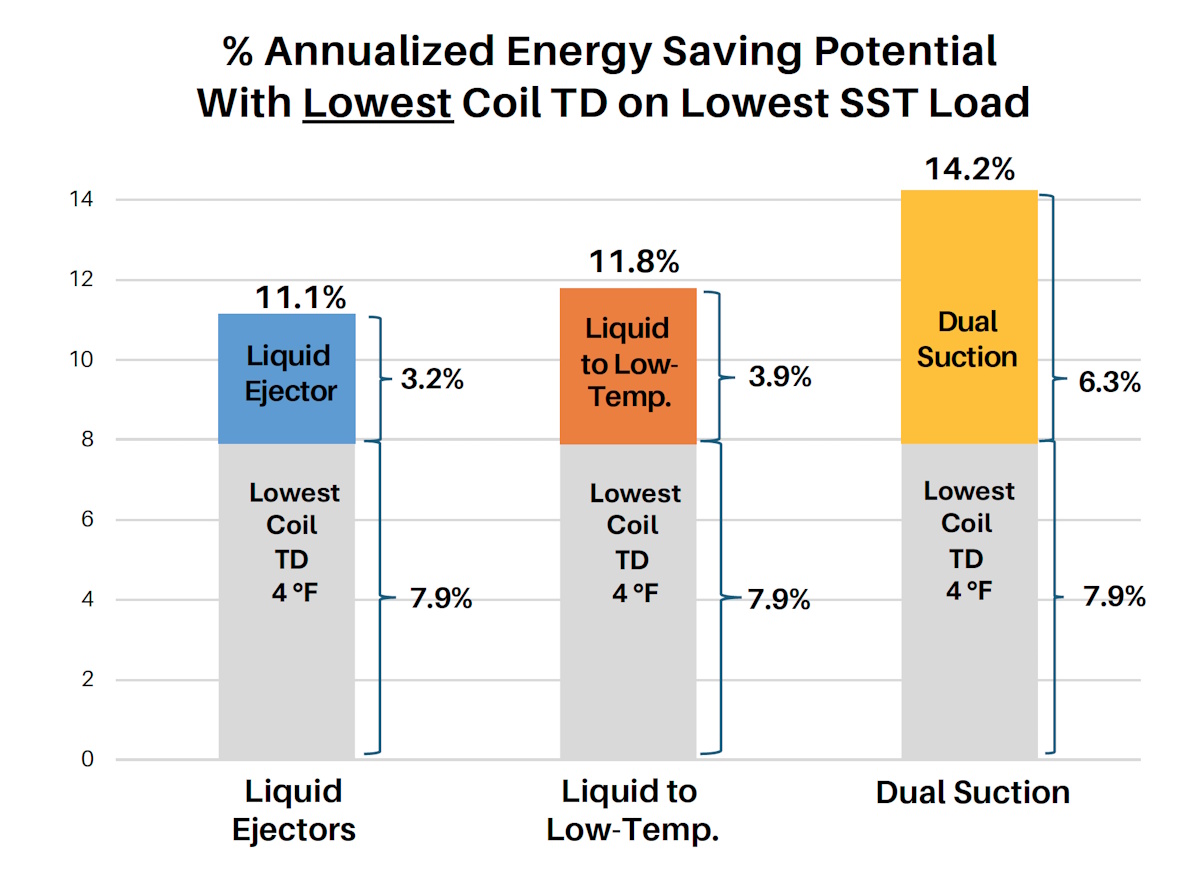
FIGURE 2: Energy savings comparison of low-side strategies using 4°F TD evaporators on the lowest-temperature loads to those using standard 10°F TD coils. (Courtesy of Copeland)
Year-Round Energy Optimization
Low-side evaporator optimization strategies can have positive year-round impacts on a CO2 system's energy efficiency and thus, its TCO. Doing so requires understanding the roles of evaporator TDs and employing applicable low-side optimization strategies.
When selecting evaporators on display cases or unit coolers, their TDs alone can have significant impacts on energy efficiency, especially when applied to the lowest-temperature load in a single-suction group. Generally, a lower TD results in a higher SST required to achieve the same air temperature, thereby increasing suction pressure, lowering compression ratios, and improving system energy efficiency.
When combining evaporator TD selection with an ultra-low to zero superheat optimization strategy, it’s essential to understand the efficiency impacts. For example, superheat optimization may have significant annualized savings when employed with high-TD evaporators but may demonstrate incrementally less savings with a low-TD coil.
Finally, among the three low-side technologies explored in the CO2 superheat study, the dual-suction architecture — considered the least complex to deploy — provided the highest potential annualized energy savings of 14.2% when combined with a low-TD coil.
Looking for a reprint of this article?
From high-res PDFs to custom plaques, order your copy today!