ACHR News
search
Ask ACHR NEWS AI
cart
facebook twitter instagram linkedin youtube
  • Sign In
  • Subscribe
  • Sign Out
  • My Account
ACHR News
  • NEWS
    • Breaking News
    • New HVAC Products
    • Featured Products
    • Manufacturer Reports
    • HVAC Data
    • Legislation
    • ACHR NEWS Centennial
  • RESIDENTIAL
    • Air Conditioners
    • Furnaces
    • Residential Heat Pumps
    • Ductless
    • Residential IAQ
    • Testing, Monitoring, Tools
    • Components & Accessories
  • COMMERCIAL
    • Air Handlers
    • Rooftop Units
    • Chillers and Cooling Towers
    • Commercial Heat Pumps
    • Boilers and Hydronics
    • VRF/Ductless
    • Commercial IAQ
  • REFRIGERATION
    • Refrigerants
    • Refrigerant Regulations
    • Leak Management
  • CONTRACTOR PRO
    • Geothermal
    • Homeowner Study
    • VRF and VRV Ductless
    • Unitary Trends
  • EDUCATION
    • Training and Education
    • Business Management
    • Service and Maintenance
    • Continuing Education
    • Market Research >
      • HVAC Brand Awareness Report
      • VRV, VRF, VRVZ Report
      • Unitary Trends Report
      • Water Heat Professionals Report
    • Webinars
    • Sponsor Insights
    • eProducts Info
    • White Papers
  • EVENTS
    • HVAC Contractor Forum
    • Industry Events and Webinars
  • MEDIA
    • Videos
    • AHR Expo 2025 Videos
    • Podcasts >
      • ACHR News Podcast
      • HARDI Podcasts
      • AHR Expo Podcasts
      • ACCA Podcasts
    • Interactive Spotlights
    • Quizzes
    • eBooks
    • HVAC Talkback
  • HVAC GROUP
    • ACHR NEWS >
      • Current Issue
      • Digital Edition
      • Subscribe
    • Distribution Trends
    • SNIPS NEWS >
      • Join SNIPS NEWS
    • Engineered Systems News >
      • Join ES News
    • HVACR Directory
    • Contests
    • Newsletters
    • Contact
    • Advertise
    • My Account
HVAC ContractingNewsService and MaintenanceRefrigerationRefrigerants

CO2 Refrigeration Fundamentals: Servicing Tips
By Andre Patenaude
Andre-emerson-quote.jpg
June 10, 2022

In the first installment of this technical series from Emerson, we’ll review some key tips that technicians need to be aware of when servicing CO2 transcritical booster systems. 


How do you store CO2 refrigerant?

From a refrigerant storage best practices perspective, R-744 tank storage is similar to standard HFC storage, including stacking procedures, safety precautions, and keeping them chained off in a designated storage area. But that’s where the similarities end. Because CO2 tanks are designed to handle its high pressures, they weigh significantly more than standard HFC bottles. Empty CO2 tanks can weigh close to 150 pounds; when loaded with 50 pounds of refrigerant, each cylinder can potentially weigh nearly 200 pounds.

Many supermarkets prefer to have an entire system charge on hand, which could potentially be up to 2,000 pounds. Storing that would require 40 cylinders totaling a weight of 8,000 pounds, or 4 tons. It’s important for contractors to understand where to store the reserve refrigerant and whether it will affect building codes by having that much CO2 in one space. And if stored on a mezzanine, it must be capable of handling the total storage weight.


How do you charge a CO2 refrigeration system?

When charging a CO2 refrigeration system, the most important consideration a technician should keep in mind is the triple point pressure of CO2. 60.4 psi is the pressure at which CO2 will turn to dry ice. As a result, contractors must be careful not to charge with liquid CO2 when the system is below this pressure, and instead charge with vapor until the system reaches triple point. Failure to do so will result in the formation of dry ice. There are various anecdotes about technicians — who are more familiar with charging HFC systems — charging a CO2 system with liquid and causing the formation of dry ice.

Begin charging by introducing CO2 vapor into the system, and then build system pressure to 60.4 psi and beyond based on equipment manufacturer recommendations — up to 145 pounds. Then it will be safe to switch to liquid CO2 to finish charging the system quickly and effectively without the risk of dry ice formation.

Looking for quick answers on air conditioning, heating and refrigeration topics? Try Ask ACHR NEWS, our new smart AI search tool. Ask ACHR NEWS →


What is trapped liquid in a CO2 refrigeration system?

CO2’s coefficient of expansion (COE) is higher than a typical HFC refrigerant. One potential scenario that can occur in a CO2 system is when liquid refrigerant gets trapped in between two valves. In this instance, the pressure can increase 145 psi for every 1.8 °F increase in temperature. As a result, some systems may need to be fitted with appropriate pressure relief valves at the location of the trapped liquid to assist with system operation and service.


How do you detect leaks in CO2 systems?

Since there is an abundance of CO2 already present in the atmosphere, R-744 refrigerant can be difficult to detect and requires the use of a capable leak detection system. CO2 is colorless, odorless, and heavier than air, requiring leak detectors to be mounted 18 inches off the ground and below the breathing level. Like HFC systems, it’s important to immediately detect and mitigate CO2 leaks as they occur.

Manufacturers such as Emerson have designed CO2-specific leak detection technology that quickly can sense the presence of higher levels of carbon dioxide in a machine room or a walk-in box. Emerson offers both a stand-alone CO2 leak detection solution as well as devices that can be seamlessly integrated into a building management system (BMS), such as the Lumity supervisory control platform.


Are there safety issues to be aware of when handling CO2 refrigerant?

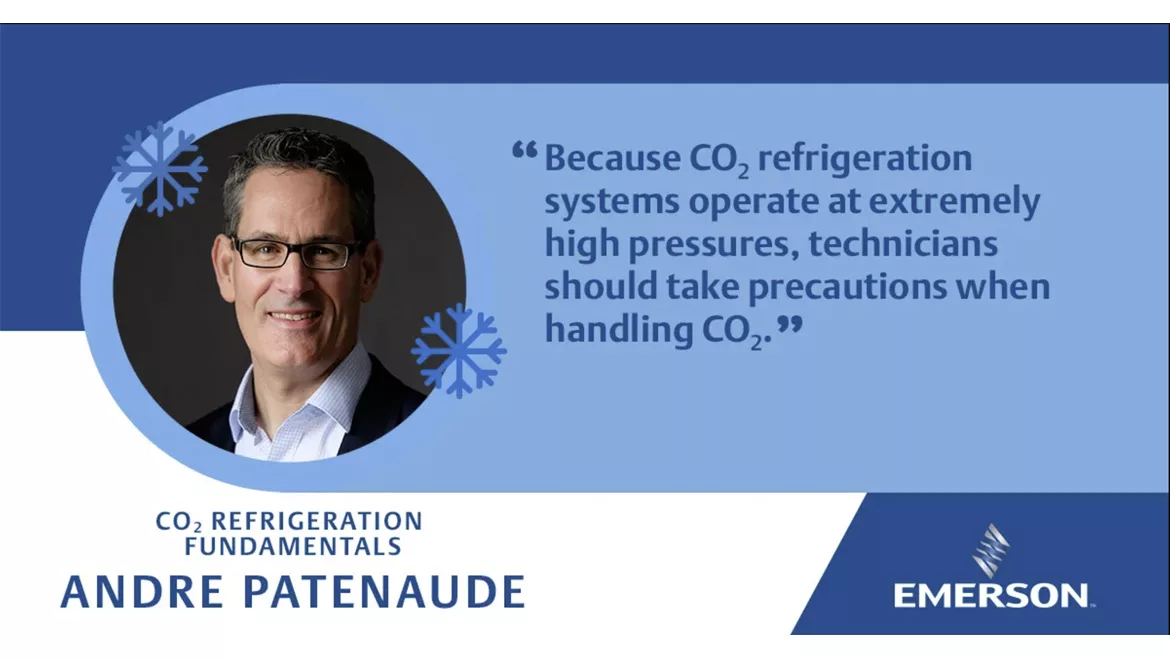
Because CO2 refrigeration systems operate at extremely high pressures, technicians should take precautions when handling CO2. Even when the system is shut off, standstill pressures are extremely high and need to be handled carefully. In addition, CO2 can displace oxygen and release it in excessive amounts because it’s heavier than air. As a result, technicians should avoid handling it in confined spaces. But with proper training and equipment design, CO2 can be used safely.


To learn more about Emerson’s comprehensive CO2 products and capabilities, please visit climate.emerson.com/co2solutions.

KEYWORDS: CO2 refrigeration Copeland refrigeration systems safety and HVAC transcritical CO2

Share This Story

Looking for a reprint of this article?
From high-res PDFs to custom plaques, order your copy today!


Andre emerson

Andre Patenaude, C.E.T. is the director of solutions strategy at Copeland. He is responsible for supporting system-related innovation and leveraging Copeland’s global cold chain to drive adoption of integrated solutions in North America. He has led marketing efforts pertaining to Copeland’s food retail and chiller markets, as well as managed Copeland’s global CO2 development. 

Recommended Content

JOIN TODAY
To unlock your recommendations.

Already have an account? Sign In

  • HVAC-enrollment

    The Trades Are Back: HVACR Programs See Nearly 30% Enrollment Spike

    A new wave of future technicians is entering the pipeline.  
    News
    By: Matt Jachman
  • 2025 Top 40 Under 40

    2025 Top 40 Under 40 HVACR Professionals List

    The 11th annual Top 40 Under 40 list highlights those...
    HVAC Light Commercial Market
    By: Hannah Belloli-Oster
  • LG Ductless Mini-Split Systems

    The 9 Types of Heat Pumps

    As the U.S. moves toward electrification, heat pumps are...
    Heat Pumps
    By: Joanna R. Turpin
Subscription Center
  • Create an Account
  • Start a Subscription
  • Manage My Account
  • Sign Up for Newsletters
  • Visit Customer Service
  • Update Preferences

More Videos

Sponsored Content

Sponsored Content is a special paid section where industry companies provide high quality, objective, non-commercial content around topics of interest to The News audience. All Sponsored Content is supplied by the advertising company and any opinions expressed in this article are those of the author and not necessarily reflect the views of The News or its parent company, BNP Media. Interested in participating in our Sponsored Content section? Contact your local rep!

close
  • Piggy Bank
    Sponsored byWatercress Financial

    Energy Prices, Inflation, and HVAC: What Today’s Homeowners Care About

  • Refrigerated Food
    Sponsored bySolstice Advanced Materials

    R-455A Refrigeration: A Cold Storage Solution for the Future

  • Airex Rooftop Units
    Sponsored byAirex Manufacturing Inc

    Consolidating Roof Penetrations: A Growing Trend in Multifamily HVAC Design

Popular Stories

HVAC-Price-Increase-graphic

HVAC Price Increase List: June 2026

Trump-Section-232.jpg

Trump Reduces Section 232 Tariffs on HVAC Equipment to 15%

Refrigerants-and-gauge.jpg

HVAC Industry Warns of Counterfeit Refrigerants Entering U.S. Supply Chain

U.S. Supreme Court building

95% Furnace Efficiency Rule to Get New Hearing

Midea-training.jpg

HVAC Workforce Crisis Expands Beyond Technicians to Instructor Shortages

View The ACHR NEWS
Centennial Anniversary Timeline

The ACHR News Timeline Chart
Submit a Letter
Submit a letter to our editors.

Events

November 6, 2025

Next-Gen Data Center Cooling: HVAC Innovation and Real-World Solutions

On Demand As AI workloads and high-density computing push traditional cooling methods to their limits, the data center industry is accelerating the adoption of next-generation HVAC technologies.

June 23, 2026

HVAC Duct Sealing Mastics: Why Selection Matters

In this webinar we will detail what HVAC material buyers and technicians need to know when selecting duct mastics, including matching mastic to substrate, alternatives to liquid mastic, and where UL 181 Listings fit into real world installations.

View All Submit An Event

Poll

Summer Staff

Are you fully staffed for the summer season?
View Results Poll Archive

Products

BNI Mechanical/Electrical Square Foot Costbook, 2026 Edition

BNI Mechanical/Electrical Square Foot Costbook, 2026 Edition

See More Products
HVAC Duct Sealing Mastics: Why Selection Matters - Free Webinar - 6/23/2026

Related Articles

  • Copeland-Supermarket-Photo.jpg

    Distributed Refrigeration Gets a Natural Boost with CO₂

    See More
  • Webinar Explores Servicing CO2 Refrigeration Systems

    See More
  • Copeland_ConnectPlus.jpg

    Flattening the CO2 Learning Curve

    See More

Related Products

See More Products
  • Refrigeration Fundamentals for HVAC/R Technicians DVD

  • HVACR-Troubleshooting-Fundamentals-Cover-Image-One-Sheet.jpg

    HVACR Troubleshooting Fundamentals - Refrigeration & Air Flow Systems Training Package for Instructors & Service Managers

  • HVACR Troubleshooting Fundamentals Cover Image One Sheet.jpg

    HVACR Troubleshooting Fundamentals: Refrigeration and Air Flow Systems - Student Text

See More Products

Related Directories

  • NDL Industries Inc.

    A trusted HVAC-R, CO2 Refrigeration, and Hydronics component manufacturer offering CO2/ACR/PAC/Press Copper Fittings, NBV/CO2 Ball Valves, and Filter Driers--committed to top-quality products and exceptional customer service.
  • Energy Recovery

    Energy Recovery's PX G1300 pressure exchanger for CO2 refrigeration systems lowers operating costs and energy consumption, increases efficiency, and reduces emissions.
  • Refrigerant Services Inc.

    Replacement refrigerants.
×

Sign Up. Stay Informed.

The #1 trusted source for the HVACR industry since 1926

SUBSCRIBE
  • RESOURCES
    • Advertise
    • Contact Us
    • Advisory Board
    • Classifieds
    • Submit a Letter
    • Directories
    • Store
  • ACCOUNT CENTER
    • Create an Account
    • Start a Subscription
    • Manage My Account
    • Sign Up for Newsletters
    • Visit Customer Service
    • Update Preferences
  • SERVICES
    • Marketing Services
    • Reprints
    • Market Research
    • List Rental
    • Survey/Respondent Access
  • STAY CONNECTED
    • LinkedIn
    • Facebook
    • Instagram
    • YouTube
    • X (Twitter)
  • PRIVACY
    • PRIVACY POLICY
    • TERMS & CONDITIONS
    • DO NOT SELL MY PERSONAL INFORMATION
    • PRIVACY REQUEST
    • ACCESSIBILITY

Copyright ©2026. All Rights Reserved BNP Media, Inc. and BNP Media II, LLC.

Design, CMS, Hosting & Web Development :: ePublishing