ACHR News
search
Ask ACHR NEWS AI
cart
facebook twitter instagram linkedin youtube
  • Sign In
  • Subscribe
  • Sign Out
  • My Account
ACHR News
  • NEWS
    • Breaking News
    • New HVAC Products
    • Featured Products
    • Manufacturer Reports
    • HVAC Data
    • Legislation
    • ACHR NEWS Centennial
  • RESIDENTIAL
    • Air Conditioners
    • Furnaces
    • Residential Heat Pumps
    • Ductless
    • Residential IAQ
    • Testing, Monitoring, Tools
    • Components & Accessories
  • COMMERCIAL
    • Air Handlers
    • Rooftop Units
    • Chillers and Cooling Towers
    • Commercial Heat Pumps
    • Boilers and Hydronics
    • VRF/Ductless
    • Commercial IAQ
  • REFRIGERATION
    • Refrigerants
    • Refrigerant Regulations
    • Leak Management
  • CONTRACTOR PRO
    • Geothermal
    • Homeowner Study
    • VRF and VRV Ductless
    • Unitary Trends
  • EDUCATION
    • Training and Education
    • Business Management
    • Service and Maintenance
    • Continuing Education
    • Market Research >
      • HVAC Brand Awareness Report
      • VRV, VRF, VRVZ Report
      • Unitary Trends Report
      • Water Heat Professionals Report
    • Webinars
    • Sponsor Insights
    • eProducts Info
    • White Papers
  • EVENTS
    • HVAC Contractor Forum
    • Industry Events and Webinars
  • MEDIA
    • Videos
    • AHR Expo 2025 Videos
    • Podcasts >
      • ACHR News Podcast
      • HARDI Podcasts
      • AHR Expo Podcasts
      • ACCA Podcasts
    • Interactive Spotlights
    • Quizzes
    • eBooks
    • HVAC Talkback
  • HVAC GROUP
    • ACHR NEWS >
      • Current Issue
      • Digital Edition
      • Subscribe
    • Distribution Trends
    • SNIPS NEWS >
      • Join SNIPS NEWS
    • Engineered Systems News >
      • Join ES News
    • HVACR Directory
    • Contests
    • Newsletters
    • Contact
    • Advertise
    • My Account
HVAC ContractingNewsService and MaintenanceGuest Column

Common Combustion Testing Errors to Avoid This Fall

By David Richardson
Combustion Performance and Carbon Monoxide Safety Class
SAFETY FIRST: National Comfort Institute Instructor Mark Hunt, teaches students how to properly use a combustion analyzer in an NCI Combustion Performance and Carbon Monoxide Safety class.
August 14, 2024

The fall maintenance season is right around the corner. As you plan for it, you may be considering adding carbon monoxide (CO) testing to your services. If this sounds like you, there are improper test procedures you need to be aware of. They can cause you to overlook dangerous problems and often provide a false sense of security. Let’s look at common testing errors that lead to misdiagnosing CO issues and how you can avoid them.


Incorrect Test Locations

Proper test locations are important for diagnosing a CO problem. However, a discussion with many technicians reveals a lot of different opinions about the best test locations.


One common opinion is to test for CO in the ambient air. While this is a valuable test, it only shows if CO is in the air you’re breathing. Another shared opinion is testing around the cabinets of fuel-fired equipment. Techs often assume this is where they will pick up flue gas spillage. Unfortunately, neither of these tests identifies a CO source. They only tell you CO is present.

I once encountered a situation where a company, responding to a CO alarm, red-tagged the hall closet furnace because they measured 5 ppm near the cabinet. Upon further investigation, we found the gas oven dumping more than 1,000 ppm into the living space. There was nothing wrong with the furnace. This initial test at the furnace cabinet could have proven fatal without a second opinion. It’s essential to test in the correct locations to avoid dangerous inaccuracies like these.

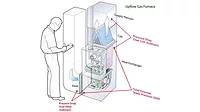
Testing for CO with a combustion analyzer above the drafthood of natural draft equipment is also incorrect. Air entering the drafthood dilutes how much CO the combustion analyzer measures. I’ve measured CO readings of 15 ppm above a drafthood and over 1,500 ppm under the drafthood, in the heat exchanger outlet.

You should measure CO in the flue gas before additional air dilutes it. You can test fan-assisted (80%+) and condensing (90%+) equipment in the flue since they don’t have drafthoods.


Wrong Test Equipment

Besides testing in the right location, you also need to use proper test equipment. Using the wrong test equipment usually leads to misdiagnosed systems.

Looking for quick answers on air conditioning, heating and refrigeration topics? Try Ask ACHR NEWS, our new smart AI search tool. Ask ACHR NEWS →

Heat exchanger inspections with a flashlight and mirror are a perfect example. If a technician doesn’t discover cracks in the heat exchanger with these tools, they assume the furnace is safe. Unfortunately, that isn’t enough information to make the right diagnosis. A technician won’t know how much CO is in the flue gas or if it is spilling into the living space. We’ll dig deeper into heat exchanger cracks later.

Another commonly misapplied test is to place a store-bought CO alarm on top of a supply register. If the alarm remains silent, technicians assume the heat exchanger is intact, and no CO is “leaking” from it. Remember, most store-bought CO alarms don’t read low levels of CO. The first alarm level for these devices is typically 70 ppm for one to four hours of exposure.

Testing for CO the right way means using the correct test instruments. At a minimum, you’ll need a combustion analyzer and draft gauge to test correctly. Unless you measure the right way with these instruments, you’re misdiagnosing CO problems.


Smoking the Drafthood

A commonly taught test is smoking the drafthood of natural draft equipment. This test assumes if smoke draws (drafts) up the hood, the equipment is venting correctly. However, if smoke spills out from the hood, the equipment is spilling and dangerous.

This test assumes two conditions. One is that spillage only occurs at one location — the drafthood. Unfortunately, this assumption is wrong — flue gases can also spill from the burner compartment. The second assumption is that flue gas and dilution air flow evenly into the drafthood.

Air takes the path of least resistance. If too much dilution air enters the drafthood, there isn’t any room left for flue gases to draw from the equipment. When this occurs, they spill from the burner compartment. Ever seen discoloration or rust around a burner compartment? If so, you’ve seen the results of spillage.

You’ll need additional tests to discover this phenomenon. It requires a minimum of three flue gas CO readings during the run cycle to diagnose burner compartment spillage. If CO readings rise during the run cycle, carbon dioxide (CO2) is backing up in the burner compartment and displacing oxygen. But if CO readings are stable, flue gases are venting properly with no spillage.


Eyeballing the Flame

A common myth found in textbooks teaches technicians to “eyeball” the flame. If the flame is blue, we assume it is safe and clean burning. If the flame has yellow tips or burns yellow, it is an incomplete burn that produces CO. While this sounds good, it’s not a measurement, it’s a guess.

Flame color doesn’t determine a safe burn — CO readings do. Flue gas CO levels under 100 ppm and stable during equipment operation indicate a safe burning flame. CO levels that are excessive and/or rising indicate an unsafe burning flame.

While you can’t trust flame color to determine safe operation, you can trust combustion analyzer readings. They tell you if a flame is the right color or not. For example, if flue gas CO readings are less than 100 ppm and stable during the run cycle, the flame color is right, even if it’s purple with neon green sparkles at the flame tips.


No Crack, No Problem

The last testing error is to assume that no heat exchanger cracks equal a safe operating furnace. The belief here is that heat exchanger cracks are primary sources of CO. Such an assumption usually stops technicians in their tracks from looking for additional CO sources.

It’s possible to have a furnace with a perfectly sound heat exchanger that still produces dangerous CO levels. This happens because of other problems with fuel input, cleanliness, and other mechanical issues that may be present. It’s also easy to overlook other CO sources with this line of thinking, such as water heaters, gas ovens, generators, unvented heaters, and attached garages.

Don’t let this common error keep you from looking at the entire picture and prevent you from correctly diagnosing a problem.


Fixing the Top Testing Errors

The top CO testing errors described in this article have been around our industry for decades. Yet, field testing has proven all of them are unreliable. Why do we still depend on them?

We’re one of the few industries crazy enough to start a fire in someone’s home and assume it’s safe. If something goes wrong, we toss around blame and opinions instead of facts and accurate test results.

Just because you install a system according to current codes and standards, it doesn’t always mean it’s safe. Start testing the right way and prove it for yourself. Don’t take my word for it. Your customers deserve your very best. Let’s work to fix these errors and replace them with live measurements and proper diagnosis.

KEYWORDS: carbon monoxide detectors combustion analyzer installing HVACR National Comfort Institute (NCI) safety and HVAC

Share This Story

Looking for a reprint of this article?
From high-res PDFs to custom plaques, order your copy today!


David richardson
David Richardson serves the HVAC industry as Vice President of Training for National Comfort Institute, Inc. (NCI). NCI specializes in training focused on improving, measuring, and verifying HVAC and Building Performance. If you’re an HVAC contractor or technician interested in learning more about building science applied to HVAC, contact David at ncilink.com/ContactMe.

Recommended Content

JOIN TODAY
To unlock your recommendations.

Already have an account? Sign In

  • HVAC-enrollment

    The Trades Are Back: HVACR Programs See Nearly 30% Enrollment Spike

    A new wave of future technicians is entering the pipeline.  
    Training and Education
    By: Matt Jachman
  • 2025 Top 40 Under 40

    2025 Top 40 Under 40 HVACR Professionals List

    The 11th annual Top 40 Under 40 list highlights those...
    News
    By: Hannah Belloli-Oster
  • LG Ductless Mini-Split Systems

    The 9 Types of Heat Pumps

    As the U.S. moves toward electrification, heat pumps are...
    Ground Source Heat Pumps
    By: Joanna R. Turpin
Subscription Center
  • Create an Account
  • Start a Subscription
  • Manage My Account
  • Sign Up for Newsletters
  • Visit Customer Service
  • Update Preferences

More Videos

Sponsored Content

Sponsored Content is a special paid section where industry companies provide high quality, objective, non-commercial content around topics of interest to The News audience. All Sponsored Content is supplied by the advertising company and any opinions expressed in this article are those of the author and not necessarily reflect the views of The News or its parent company, BNP Media. Interested in participating in our Sponsored Content section? Contact your local rep!

close
  • Piggy Bank
    Sponsored byWatercress Financial

    Energy Prices, Inflation, and HVAC: What Today’s Homeowners Care About

  • Refrigerated Food
    Sponsored bySolstice Advanced Materials

    R-455A Refrigeration: A Cold Storage Solution for the Future

  • Airex Rooftop Units
    Sponsored byAirex Manufacturing Inc

    Consolidating Roof Penetrations: A Growing Trend in Multifamily HVAC Design

Popular Stories

Lennox equipment

Platinum Equity to Sell Heat Controller to Lennox

HVAC-tech-van.jpg

Report: Only 65% of HVAC Technician Time is Billable Hours

Trade groups challenge EPA refrigerant rule

HVACR Trade Groups Challenge EPA Refrigerant Rule in Federal Court

heat-pump-tech-customer.jpg

DOE Updates $8.8B Home Energy Rebate Program Guidance

Lovato-refrigerant-rooftop_AC_Units_.jpg

When Refrigerants Change, So Do the Contactors

View The ACHR NEWS
Centennial Anniversary Timeline

The ACHR News Timeline Chart
Submit a Letter
Submit a letter to our editors.

Events

November 6, 2025

Next-Gen Data Center Cooling: HVAC Innovation and Real-World Solutions

On Demand As AI workloads and high-density computing push traditional cooling methods to their limits, the data center industry is accelerating the adoption of next-generation HVAC technologies.

July 28, 2026

How Top Home Services Companies Turn Every Conversation Into Predictable Revenue

In this webinar, we'll outline how top contractors are turning every conversation into predictable revenue by coaching every comfort advisor visit, not just the ones a manager rides along on.

View All Submit An Event

Poll

Summer Staff

Are you fully staffed for the summer season?
View Results Poll Archive

Products

BNI Mechanical/Electrical Square Foot Costbook, 2026 Edition

BNI Mechanical/Electrical Square Foot Costbook, 2026 Edition

See More Products
Designing Systems Using A2L Refrigerant - Free Webinar - 7/22/2026

Related Articles

  • Combustion Testing

    How to Add Combustion Testing Services to Your Company

    See More
  • Seven Combustion Testing Skills Diagram

    Duct Dynasty: Seven Combustion Testing Skills of Elite Service Technicians

    See More
  • How to persuade homeowners to schedule preventative maintenance this fall

    See More

Related Products

See More Products
  • Lessons Learned in a Boiler Room: A common sense approach to servicing and installing commercial boilers

See More Products

Related Directories

  • National Comfort Institute (NCI)

    National Comfort Institute (NCI) is a High-Performance HVAC contractor training, certification, and membership organization. NCI offers a full range of advanced technical, business, and sales training.
×

Sign Up. Stay Informed.

The #1 trusted source for the HVACR industry since 1926

SUBSCRIBE
  • RESOURCES
    • Advertise
    • Contact Us
    • Advisory Board
    • Classifieds
    • Submit a Letter
    • Directories
    • Store
  • ACCOUNT CENTER
    • Create an Account
    • Start a Subscription
    • Manage My Account
    • Sign Up for Newsletters
    • Visit Customer Service
    • Update Preferences
  • SERVICES
    • Marketing Services
    • Reprints
    • Market Research
    • List Rental
    • Survey/Respondent Access
  • STAY CONNECTED
    • LinkedIn
    • Facebook
    • Instagram
    • YouTube
    • X (Twitter)
  • PRIVACY
    • PRIVACY POLICY
    • TERMS & CONDITIONS
    • DO NOT SELL MY PERSONAL INFORMATION
    • PRIVACY REQUEST
    • ACCESSIBILITY

Copyright ©2026. All Rights Reserved BNP Media, Inc. and BNP Media II, LLC.

Design, CMS, Hosting & Web Development :: ePublishing