Duct Dynasty: Seven Combustion Testing Skills of Elite Service Technicians
Combustion issues can be a service technician’s most challenging and intimidating problem to diagnose. Unless you’re equipped with the proper skills to tackle these issues, it’s easy to become frustrated and just start guessing. I know because that’s exactly what I did for years. Fortunately, I learned there was a better way.
Tracking down combustion problems is like looking for a needle in a haystack. Unless you know where to look, you could spend days searching for something you’ll never find. Proper testing skills systematically give you a way to eliminate big chunks of the haystack until you’re left with a smaller area to focus on. It takes a specially trained HVAC technician to know how and which chunks to eliminate.
These technicians understand the principles necessary to solve safety, comfort, and efficiency issues. They know that everything from system defects to building interactions make up that proverbial haystack. This understanding equips these elite technicians to track down the invisible problems that lead to carbon monoxide (CO) poisoning, high fuel bills, uncomfortable rooms, and cracked heat exchangers.
Let’s look at seven key skills they frequently use to solve combustion problems that baffle so many.
1: Combustion Testing
Since we’re discussing combustion problems, let’s talk about combustion testing. A technician depends on accurate test instruments, including a combustion analyzer that measures CO, O2 (oxygen), and flue temperature.
These measurements help the technician determine proper flue gas venting, ignition, and shut down, and verify safe mechanical operation. However, unless they know how to interpret the numbers and distinguish measurement patterns, these readings can lead them to inconclusive or inaccurate results. That can be dangerous!
They also know where to install proper test locations. Part of their training helps them understand testing in the wrong places can also lead to inconclusive results. Many well-intentioned technicians have missed dangerous conditions because of this one overlooked detail.
Looking for quick answers on air conditioning, heating and refrigeration topics? Try Ask ACHR NEWS, our new smart AI search tool. Ask ACHR NEWS
2: Draft Testing
Draft testing is the second skill that helps technicians further identify hidden issues that combustion testing alone might not reveal. They use a draft gauge capable of measuring inches of water column (in. w.c.) in the -.01 to -.10 in. w.c. range. The go-to instrument for many of them is the Dwyer 460.
Draft testing helps determine if the flue functions as intended. It also identifies external influences that lead to spillage and backdrafting, such as duct leakage and exhaust fans. This often-overlooked test is crucial for verifying combustion air performance and identifying flue restrictions that could easily go unnoticed.
3: Static Pressure Testing
Every technician needs a good understanding of airflow and how it affects system operation. However, elite technicians who track down combustion problems take this measurement one step further. They use it to identify airflow restrictions within a system that could lead to furnace overheating and eventual heat exchanger failure.
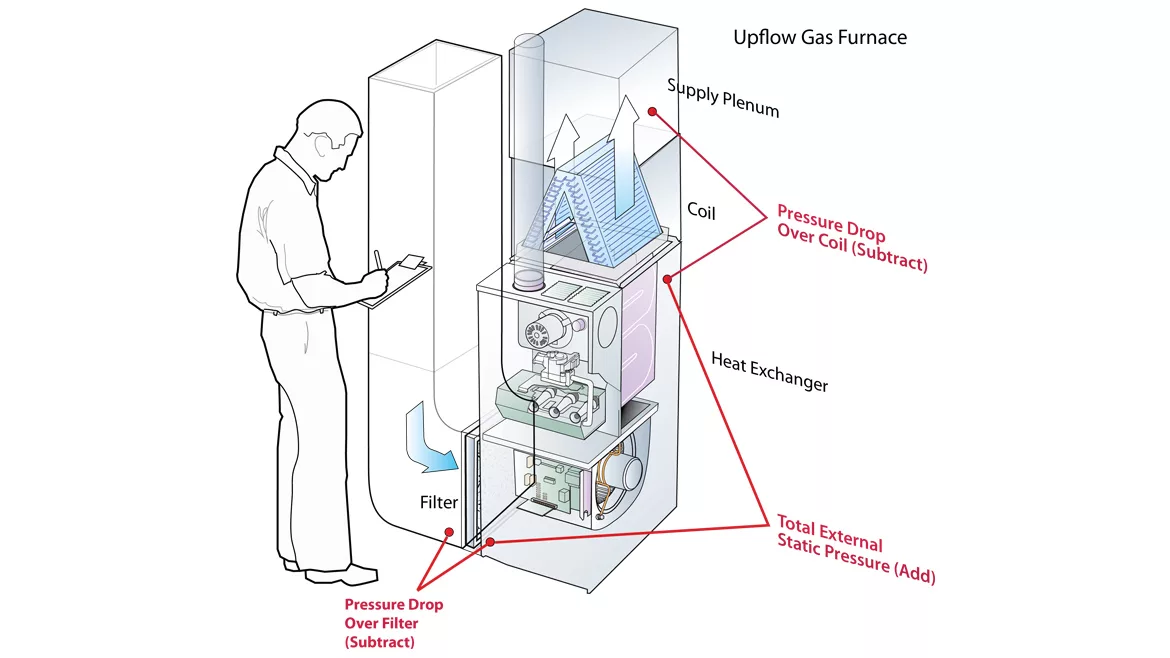
Total external static pressure (TESP) is the most common test used to identify airflow issues. If TESP is excessive, chances are high that the airflow is low. Since improper airflow causes many heat exchanger failures, these technicians start with a TESP measurement. Next, they measure pressure drop across system components and the duct system to identify restriction locations.
These technicians know that unless they measure and verify static pressure before a heat exchanger replacement, they might sign the death sentence for the new component. Remember, most heat exchangers don’t fail — they’re murdered by bad installations and assumptions.
4: Fan Airflow Testing
The fourth testing skill is fan airflow. Fan airflow testing reveals that low fan speed isn’t always the best heating fan speed. By performing this test, technicians also discover the reasons some furnaces cycle on high-limit and have premature heat exchanger failure.
You can test fan airflow in a couple of ways. The most common is to plot fan airflow using the measured TESP, fan speed setting, and manufacturer’s fan table. It’s easy to learn and fast to use. However, it has its limitations.
Another method is to take a direct airflow measurement using an instrument like the Digital TrueFlow from The Energy Conservatory (TEC). This approach is more accurate and leaves no room for guessing or interpretation. But there is more of an investment required from the technicians who choose to purchase this instrument.
If the technician discovers low airflow, they then try to make adjustments to get within an acceptable range. If not, they use their static pressure measurements to identify airside restrictions and try to improve them.
5: Temperature Testing
Temperature is the fifth measurement used to further identify airflow and comfort issues. A quick-reacting dry bulb thermometer works best for these tests. The equipment temperature rise, or Delta t (∆t), is the first and most common measurement. The technician compares the result to the manufacturer data-plate range to assure it isn’t on the high or low side. If the ∆t is out of range, they know there could be an airflow or fuel input issue.
Once they have airflow and temperature rise, they calculate the furnace Btu output and compare it to the output rating. If they’re within ± 10% of the data-plate rating, the equipment’s operating well. However, if their measurements are off, they know it’s time to visit the gas meter to assure input is correct.
Sometimes the furnace will perform great, but customers still complain of uncomfortable rooms. When this problem arises, use supply register temperatures to identify duct system issues causing heat loss before the air makes it to the conditioned space.
Technicians start by measuring supply register temperature in the most uncomfortable room or the farthest point from the furnace. They then compare it to the supply air temperature at the furnace. The two readings should be within two to three degrees (2-3°F) of each other. If the ∆t exceeds this range, it’s time to inspect the duct system for leakage and insulation issues.
6: Building Pressure Testing
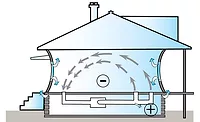
The sixth testing skill is also the rarest. It involves measuring the static pressure of the building, or room pressures. Many of the most challenging combustion problems relate to the building’s influence on combustion air. This is especially true with natural draft and fan-assisted equipment that depend on interior room air for combustion.
Technicians who master this skill use it to track down sources of combustion air interference and see what they can do to resolve the issues. They understand that the building is an extension of the duct system and to ignore it may leave out an important piece of information.
Their testing process includes measuring room pressures with doors opened and closed, and turning on various fans to see what they do to the building and how they affect combustion air and draft. These interactions help them focus on a part of the haystack that few even know exist.
Another obstacle to performing this test is the cost of the high-precision manometer needed for the testing. However, the expense is minimal once the tech uses the test instrument to uncover and solve issues that no one else could.
7: Deductive Reasoning
A technician might be capable of taking all the test measurements we just reviewed, but without deductive reasoning, they’re only gathering numbers. They must be able to put all the test measurements together and interpret the information.
It’s challenging to determine the cause of a problem with all the possible interactions that might take place. This is one reason proper diagnosis requires an understanding of what is happening and what could happen. The technicians know the best way to isolate issues is to eliminate potential suspects one at a time. Before any guessing starts, they first figure out what the problem isn’t and eventually, they’re left with the culprit.
Endless Testing Opportunities
There are plenty of additional tests a technician can learn and perform. However, there is a fine line between getting the necessary information and turning a customer’s house into a science project. Every test should have an intended outcome narrow down the haystack.
It’s important to know which test applies to which defects to avoid any potential rabbit holes. Remember, if you don’t test, you’re just guessing, but you shouldn’t measure everything just because you can.
Evaluate the skills presented here and see where you are. How many of these tests do you currently perform, and do you know how to interpret their results? If not, ask yourself: What it would take for you to become the newest member of this elite group?
Looking for a reprint of this article?
From high-res PDFs to custom plaques, order your copy today!