The Future of Commercial Refrigeration in a Low-GWP World
Copeland’s Andre Patenaude describes some of the opportunities and challenges facing the industry
As the HVACR industry navigates the transition to low-GWP refrigerants, Copeland has been hard at work, developing advanced technologies that are optimized to work with these eco-friendly alternatives. To learn more about these advancements, The ACHR NEWS asked André Patenaude, director of solution strategy at Copeland, about some of the new technologies the company has developed for refrigerants such as CO2, A3, and A2L — and how HVACR contractors can help their food retail customers prepare for a low-GWP future.
ACHR NEWS: How has Copeland prepared for the HFC phasedown?
Patenaude: Copeland has prepared for this industry-wide equipment migration by optimizing compressors, condensing units, electronic controls, leak detection and associated components for use with lower-GWP CO2, A3, and A2L alternatives. For the past decade, we’ve supported the early and increased adoption of CO2 centralized and R-290 self-contained systems. In recent years, we’ve actively developed a wide range of lower-GWP, A2L-optimized solutions designed for self-contained and distributed (i.e., remote) commercial refrigeration applications.
To help meet the increasing demand for lower-GWP solutions, we’ve made significant investments in research and development in Sidney, Ohio, and around the world, while expanding our domestic manufacturing capabilities. Our organization has been structured to support the needs of our diverse customer base, and we are well-positioned to help them navigate the dynamic regulatory and market challenges that lie ahead. Copeland is also an active member of global industry committees and working groups addressing this topic, including AHRI, ASHRAE, and European Partnership for Energy and the Environment (EPEE). We will continue to serve as an industry resource for driving innovation, stewardship, and guidance as the market evolves rapidly over the next several years.
ACHR NEWS: Describe some of Copeland’s newer commercial refrigeration technologies that are designed to meet low-GWP regulations.
Patenaude: Copeland has been anticipating approval of A2Ls in commercial refrigeration for several years. Our new A2L-optimized, refrigeration compressors and condensing units will help OEMs meet future GWP and application requirements. Our optimization process follows applicable safety standards mandated by the Underwriters Laboratories (UL) and ASHRAE that govern the safe use of A2Ls in commercial refrigeration applications. We’re also developing A2L-optimized leak detection and refrigeration controls to help maximize the safety, reliability, and efficiency of A2L installations.
As part of our commitment to growing our comprehensive CO2 portfolio, Copeland continues to invest in R&D and new product development. Examples of new product development include the recently expanded 4MTLS transcritical CO2 semi-hermetic compressor lineup, which is designed for medium temperatures and supports supercritical operation in CO2 booster systems. Combined with the E3 supervisory control for CO2 applications, robust high-pressure control, and the user-friendly CC200 case control, we’re developing seamlessly integrated CO2 ecosystems designed to address every aspect of CO2 booster refrigeration — from installation and commissioning to energy optimization and automated system management.
From an R-290 perspective, Copeland has invested in developing a full portfolio of scroll and hermetic reciprocating compression and condensing unit products for operators looking for improved system efficiency using natural refrigerants. Most recently, Copeland has introduced an R-290 variable-speed scroll compressor to deliver twice the capacity and higher speeds, enabling up to 7 HP systems with the recently approved charge limit increases.
ACHR NEWS: Besides low-GWP, how do these new technologies help food retailers?
Patenaude: Low GWP is just one factor in the next-generation equipment equation. Many food retailers are working toward holistic operational sustainability, which will require the migration to more energy-efficient HVACR equipment, increasing electrification, and the decarbonization of their supply chains.
Looking for quick answers on air conditioning, heating and refrigeration topics? Try Ask ACHR NEWS, our new smart AI search tool. Ask ACHR NEWS
Copeland is an expert in reducing the carbon footprint and maximizing the sustainability potential of low-GWP CO2 booster systems. We’re helping retailers leverage CO2’s performance characteristics for heat reclaim from compressor discharge and repurpose it for HVAC, hot water, or slab heating. We’ve also conducted comprehensive CO2 climate analyses to help retailers design and select the optimal CO2 booster systems and support the highest possible energy efficiencies that are specifically tailored to various climate zones. These optimization strategies can help retailers lower their carbon footprints, while ensuring long-term operational strategies that significantly lower lifecycle costs.
Electronic controls have also advanced along with the evolution of low-GWP systems, which has helped contractors and technicians simplify servicing, troubleshooting, and diagnostics. Integrated controls strategies, such as those enabled by Copeland’s E3 supervisory control and CC200 case control, provide holistic visibility to system status and performance. With low-GWP systems, end users and technicians have expanded toolsets for remote and on-site access and the abilities to quickly review and respond to critical system alarms. In addition, the advancement of machine-learning algorithms and artificial intelligence supports the continuous and autonomous fine-tuning of system performance and increases the potential for predictive analytics.
ACHR NEWS: How is your company educating contractors about the new low-GWP technologies?
Patenaude: We’ve been committed to helping the industry ease the migration to lower-GWP HVACR technologies for more than a decade, starting with CO2 and R-290, and most recently, with the emergence of A2Ls. Under our E360 stewardship initiatives, we’ve produced myriad webinars, videos, articles, white papers, and blogs that address every aspect of the refrigerant transition, including regulatory updates, total cost of ownership, safety requirements, performance benefits, and caveats.
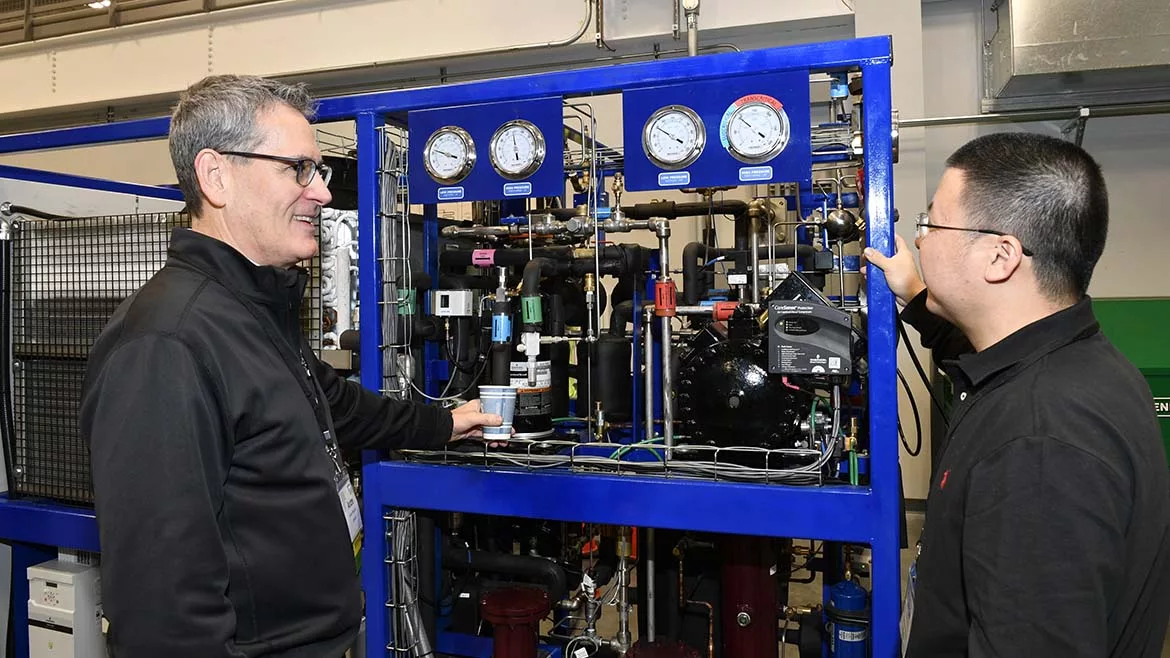
In addition, we’re active participants in industry organizations helping promote the low-GWP refrigerant transition, including the North American Sustainable Refrigeration Council (NASRC), ASHRAE, the Food Industry Association (FMI), and many others — conducting workshops, seminars, and webinars on the latest industry trends and updates. Our education services division offers classes to help technicians and stakeholders prepare for the future of commercial refrigeration. We have worked diligently to bring our mobile CO2 training units to various locations across North America, giving technicians opportunities to have hands-on CO2 booster system training.
ACHR NEWS: What should HVACR contractors be doing now to help their food retail customers respond to the refrigerant transition?
Patenaude: Contractors should be working closely with their retail customers to evaluate their existing HFC equipment and help them plan for repairs or end-of-life replacement strategies. Doing so will require them to be well-versed in the equipment options emerging for CO2 A2Ls and R-290, including:
- CO2 in centralized booster systems and distributed systems and condensing units;
- A2Ls in self-contained and distributed (i.e., remote) systems; and
- R-290 in higher-capacity, self-contained systems.
Contractors should prioritize education and training — especially if they’re not prepared to work with A2L, A3, and CO2 refrigerants. It’s also important to remember that the HFC production cut of 40% this year will likely cause HFC prices to rise. Contractors need to practice proper recovery and reclamation of HFC refrigerants in existing systems to help retailers preserve their equipment and offset rising refrigerant costs.
ACHR NEWS: What advice would you give food retailers, as well as commercial refrigeration contractors, about the refrigerant transition?
Patenaude: The refrigerant transition is officially here, and the time to prepare is now. With finalized equipment GWP limits on the horizon as soon as 2025, the rubber will meet the road next year. Retailers need to decide which refrigerant and/or equipment they will be using in 2026 and beyond, as this process can take two to three years to complete. If retailers haven’t started with their lower-GWP equipment trials or proof-of-concept systems, now is the time to begin deciding which equipment strategy may align with their long-term operational and sustainability goals.
Contractors need to be sure they can support lower-GWP systems, especially when it comes to helping with installation, commissioning, and startup. By developing the technical competencies they need now, they’ll be able to alleviate fear of the unknown and help their customers get it right the first time — which is perhaps the most marketable skill for contractors to promote in the coming years.
Looking for a reprint of this article?
From high-res PDFs to custom plaques, order your copy today!