Forging Ahead into the Uncertain Future of Commercial Refrigeration
Danfoss EnVisioneering Symposium spotlights challenges, progress in commercial refrigeration
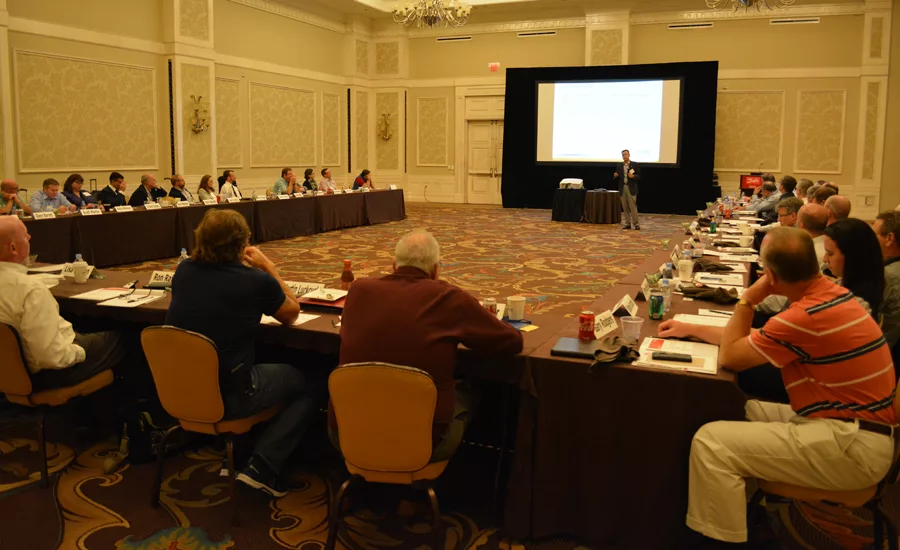
INCREASED VENTILATION: Attendees at Danfoss’ 30th EnVisioneering Symposium, Refrigerants2Sustainability, listen as Xudong Wang, director of research, Air-Conditioning, Heating, & Refrigeration Institute (AHRI), discusses the approvals process for flammable refrigerants. Photo courtesy of Danfoss
“I don’t think I’ve ever seen a subject area where so many of the strategic questions are being sorted out in the field,” said Robert Cavey, a partner with Praxis Inc., in kicking off Danfoss’ 30th EnVisioneering Symposium, Refrigerants2Sustainability, which was held Sept. 27 in Orlando, Florida.
The symposium, convened to explore the forces and ideas driving commercial refrigeration strategy, brought together leaders from across stakeholder communities to discuss the probabilities, possibilities, timelines, and new lights by which market players can gain greater clarity, build effective collaborations, and learn which paths will help them best meet their business and societal goals.
Cavey said the event was designed as a conversation around a dinner table in which the knowledge and expertise of the faculty and the student body were equal, and he urged the attendees to take advantage of the opportunity.
“We have a very diverse group of people here today who don’t typically have a chance to sit together and have a dialogue; that dialogue and discussion among the participants is really the heart of this program,” added Lisa Tryson, director, corporate communications and public relations, Danfoss.
Tryson pointed out that refrigerant regulations and the recent District of Columbia District Court ruling on the fate of hydrofluorocarbons (HFCs) under the U.S. Environmental Protection Agency’s (EPA’s) Significant New Alternatives Policy (SNAP) program are creating disruption and uncertainty in the industry.
“I think most of us in the room still see the end game as low-global warming potential [GWP] technologies, and equipment manufacturers and end users are going to continue to look over the horizon at how we achieve low-global warming potential and energy efficiency in our systems,” Tryson said. “These changes are going to impact supermarkets and commercial refrigeration equipment — how it’s designed, installed, and maintained.”
The event covered regulations, safety, climate, and consumer expectations in presentations by Mark Menzer, director of public affairs, Danfoss; Glenn Gallagher, senior air quality scientist, research division, California Air Resources Board (CARB); Xudong Wang, director of research, Air-Conditioning, Heating, & Refrigeration Institute (AHRI); Peter Dee, sales director, Danfoss; KC Kolstad, lead mechanical engineer, refrigeration, Target Properties Management; Brad Morris, senior manager of engineering and energy, Giant Eagle Inc.; Aaron Daly, global director for energy management, Whole Foods; and Dr. Marcel Christians, chief technology officer, Ice Energy.
Looking for quick answers on air conditioning, heating and refrigeration topics? Try Ask ACHR NEWS, our new smart AI search tool. Ask ACHR NEWS
Among the topics of conversation:
The future of SNAP — Menzer discussed how a recent lawsuit, Mexichem Fluor and Arkema v. U.S. EPA, raised the issue of whether the EPA has the authority to make manufacturers move away from non-ozone depleting potential (non-ODP) chemicals such as HFCs based on their GWP.
A district court determined that the EPA lacked the statutory authority to mandate the phasedown of non-ODP substances, placing a cloud over the future of SNAP HFC regulation. The ruling sent the 2015 SNAP rule back to the EPA for a rewrite. What exactly the EPA will do and whether the decision will be appealed to the Supreme Court remains to be seen. For now, the court’s decision raised the specter of stranded investments and fueled a good deal of confusion in the marketplace.
The power of states — Individual states are not pre-empted by federal authority in the regulation of the relevant chemicals for GWP purposes. So, the possibility emerges of states moving ahead with delisting HFCs while the federal government either sorts out the next steps or backs away from regulation of non-ODP refrigerants.
For example, Gallagher explained that California is moving forcefully to develop regulations to phase out the use of high-GWP chemicals. California Senate Bill 1383 (2016) requires a 40 percent reduction in HFC emissions below 2013 levels by 2030. State officials emphasize that despite the court ruling sending the rule back for recrafting, EPA SNAP rules remain in effect for now.
Gallagher noted that CARB’s Short-Lived Climate Pollutant Strategy puts sales restrictions on very high-GWP refrigerants with 100-year GWPs of 2,500 or greater, prohibits high-GWP refrigerants in new stationary refrigeration and stationary air conditioning equipment, and provides financial incentives for new low-GWP systems.
In addition, the state is continuing work on codes and standards updates, exploring ways to continue HFC reductions based on the EPA’s SNAP rules, and developing requirements and timelines for phaseouts.
Flammable refrigerants — If global trends are an indicator of the direction the U.S. will take, flammable refrigerants are poised to play a larger role in the overall refrigerant regime. However, the approval process can be laborious.
According to Wang, today’s projected path for employing flammable refrigerants has refrigeration systems and equipment meeting ASHRAE, UL, and ISO safety standards by 2018, creating model building codes by 2021, and crafting state and local codes in 2022 and beyond. AHRI and ASHRAE are conducting research programs to help make that timeline work, Wang said. Several studies are complete, including benchmarking risks of A2L (mildly flammable) refrigerants and HVACR equipment leak detection of A2L refrigerants. Others are expected to be finished by the end of 2017, including hot surface ignition testing; flammable refrigerant handling guidelines; and an effort to explore the grounds for setting charge limits of A2L, A2, and A3 refrigerants (flammable including hydrocarbons and HFOs) for various types of products. Other research projects are slated for 2018 completion.
End users moving beyond HFCs — Kolstad said Target has set the goal of being HFC-free in food distribution centers and stand-alone refrigerated display cases by 2020 and is requiring all new purchases of stand-alone units less than 2,200 Btuh cooling capacity to use HFC-free refrigerants. Starting in 2016, Target told its suppliers that it is moving to hydrocarbon R-290 for units less than 2,200 Btuh.
Morris said Giant Eagle is putting the emphasis on general maintenance, floating head pressure and suction pressure, anti-sweat control, and the like — where he said a good deal of low-hanging fruit is available. For new technology, Morris explained how Giant Eagle is looking to distributed refrigeration controls rather than a centralized approach. Distributed controls, he noted, can offer 30 percent estimated energy savings, which justifies the first cost of the controls investment.
Thermal energy storage — Christians explained how ice batteries can enable a supermarket or grocery store owner to decide when to use electricity from the grid to create cooling, offering the ability to use stored cooling to provide three to 20 tons of cooling for up to six hours. The basic formula is simple: Use lower cost, off-peak energy, and tap storage during high-cost peak hours. The time of use energy cost differential and lower demand charges cover the cost of the investment within a few years, and improved grid stability justifies utility incentives.
Financing the paradigm shift — Population growth, the growth in retail food outlets, an aging grid, and less appetite for building new generation capacity all point to energy use containment. Generally speaking, utilities are capitalized to finance the shift.
“Many utilities are sitting on large sums of capital, and they’re very interested in finding ways to get that capital employed to their advantage,” Daly said. “In my view, they increasingly need our assistance in understanding how to do that.”
To that end, he added, understanding each utility that you’re dealing with and why they want to engage with you is absolutely critical to success when it comes to leveraging incentives or rate structures and determining which steps and technologies to employ.
In summary, court-imposed ambiguity, uncertain standards and codes, and a diversity of technological options and risks complicate the relevant refrigerant questions.
Recent U.S. regulatory strategy has focused on transforming the refrigerant sector based on GWP impact, and industry stakeholders have, therefore, been exploring appropriate new directions and solutions. But, when the courts recently placed a question mark over EPA’s SNAP regulations, the issue shifted — this time to questions such as how far the country would move, what new investments would be genuinely necessary, and whether the basic strategic issues for refrigerants had again been put on ice. The resulting uncertainty is causing states, refrigeration equipment manufacturers, and end users to take individual actions to move toward low-GWP, energy-efficient technologies that stand to future-proof business and benefit the bottom line today.
Amidst the uncertainty, however, the overarching facts are clear enough: there is ample convergence of interest to support a strategic, industry-wide dialogue, and global refrigerant trends suggest it should begin sooner rather than later.
Publication date: 11/20/2017
Want more HVAC industry news and information? Join The NEWS on Facebook, Twitter, and LinkedIn today!
Looking for a reprint of this article?
From high-res PDFs to custom plaques, order your copy today!