ACHR News
search
Ask ACHR NEWS AI
cart
facebook twitter instagram linkedin youtube
  • Sign In
  • Subscribe
  • Sign Out
  • My Account
ACHR News
  • NEWS
    • Breaking News
    • New HVAC Products
    • Featured Products
    • Manufacturer Reports
    • HVAC Data
    • Legislation
    • ACHR NEWS Centennial
  • RESIDENTIAL
    • Air Conditioners
    • Furnaces
    • Residential Heat Pumps
    • Ductless
    • Residential IAQ
    • Testing, Monitoring, Tools
    • Components & Accessories
  • COMMERCIAL
    • Air Handlers
    • Rooftop Units
    • Chillers and Cooling Towers
    • Commercial Heat Pumps
    • Boilers and Hydronics
    • VRF/Ductless
    • Commercial IAQ
  • REFRIGERATION
    • Refrigerants
    • Refrigerant Regulations
    • Leak Management
  • CONTRACTOR PRO
    • Geothermal
    • Homeowner Study
    • VRF and VRV Ductless
    • Unitary Trends
  • EDUCATION
    • Training and Education
    • Business Management
    • Service and Maintenance
    • Continuing Education
    • Market Research >
      • HVAC Brand Awareness Report
      • VRV, VRF, VRVZ Report
      • Unitary Trends Report
      • Water Heat Professionals Report
    • Webinars
    • Sponsor Insights
    • eProducts Info
    • White Papers
  • EVENTS
    • HVAC Contractor Forum
    • Industry Events and Webinars
  • MEDIA
    • Videos
    • AHR Expo 2025 Videos
    • Podcasts >
      • ACHR News Podcast
      • HARDI Podcasts
      • AHR Expo Podcasts
      • ACCA Podcasts
    • Interactive Spotlights
    • Quizzes
    • eBooks
    • HVAC Talkback
  • HVAC GROUP
    • ACHR NEWS >
      • Current Issue
      • Digital Edition
      • Subscribe
    • Distribution Trends
    • SNIPS NEWS >
      • Join SNIPS NEWS
    • Engineered Systems News >
      • Join ES News
    • HVACR Directory
    • Contests
    • Newsletters
    • Contact
    • Advertise
    • My Account
NewsHVAC Residential MarketHeat PumpsResidential ControlsThermostatsAir Source Heat Pumps

FROSTlines

Predictive Heat Pump Thermostat Could Reduce Energy Bills

New control designed by researchers at Purdue University may save homeowners $300/year
By Jared Pike
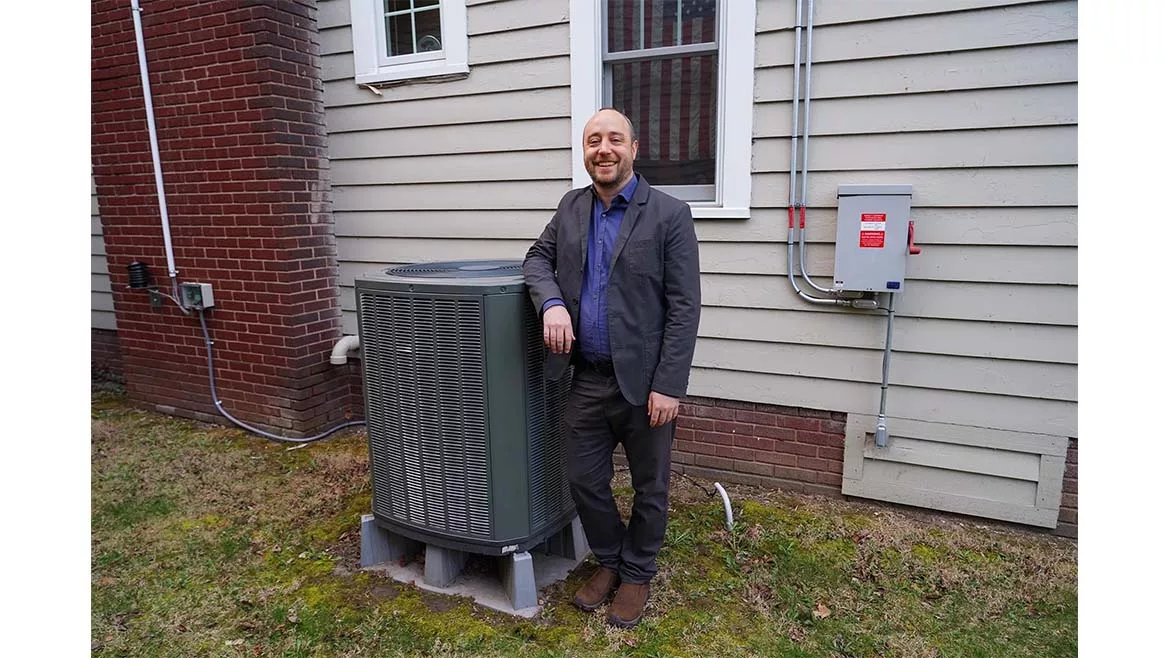
Kevin Kircher with Heat Pump
SUSTAINABLE HOMES: Kevin Kircher, assistant professor of mechanical engineering, studies how heat pumps and electrification can help make homes more sustainable. (Courtesy of Purdue University / Jared Pike)
June 4, 2024

Heat pumps are quickly overtaking traditional heating systems in American homes, as they are more efficient and environmentally friendly. But without a proper control system, they could spike a homeowner’s electricity bills. Purdue University researchers have demonstrated a novel predictive control system for heat pumps, which has the potential to reduce electricity usage by about 20% and save homeowners an average of $300 every year.

“A heat pump is just an air conditioner in reverse -- using electricity to remove heat from the outside and transfer it inside,” said Kevin Kircher, assistant professor of mechanical engineering at Purdue University and an acknowledged expert on heat pumps and home electrification. “Using electricity in this way is far more efficient than the heating systems in most of our homes, with the added benefit of burning less fossil fuel.”


Cost and Comfort

One of the biggest issues to the adoption of heat pumps is the perceived cost, both of the equipment itself and its continued operation. “Heat pumps can increase electricity demand,” said Elias Pergantis, a Ph.D. student co-advised by Kircher and Davide Ziviani. “What we wanted to find out is how we can use machine learning and predictive control to reduce the energy required but still maintain the same level of human comfort.”

Purdue has a unique living laboratory to test their theories. The DC Nanogrid House is a 1920s-era West Lafayette, Indiana, home retrofitted with solar panels, batteries, electric appliances, electric heat pumps, and a bevy of sensors in every room. Graduate students live at the house, serving as test subjects for researching human comfort and new smart home technologies.

“Most people adjust the temperature in their home by manually operating a thermostat -- they feel cold, so they push the button to make the temperature go up,” said Pergantis. “But when they do that, they don’t take into account the predicted solar radiation, the humidity, the forecasted temperature that day, or which rooms they’re going to occupy in the house, and for how long. As a result, most of the time they end up overheating their house and wasting energy. Even the best ‘smart’ thermostats don’t incorporate all this information.”

Thankfully for Pergantis, the DC Nanogrid House has a plethora of sensor data on the temperature of the house, historic climate data, and which parts of the house are occupied when. So Pergantis used this data to build a model for predictive control using machine learning, which he could then verify based on actual conditions observed at the house.

Then it was time for an experiment. “We implemented the algorithm in the middle of winter,” said Pergantis. “Basically for a month and a half, the algorithm predicted when the house would need heating, in which rooms, and how many kilowatts it would take. The human occupants could adjust set points, but for the most part, the computer took charge of the thermostat.”

Looking for quick answers on air conditioning, heating and refrigeration topics? Try Ask ACHR NEWS, our new smart AI search tool. Ask ACHR NEWS →

The results were striking. During the 40-day test of the model predictive control system, the house consumed 19% less energy than a comparable stretch from a previous winter. In dollar terms, that’s a $300 energy savings for just one household. Extrapolated to all US households, that’s a total savings of more than $22 billion every year.

And what about the comfort of the home’s occupants? How do you scientifically gauge whether people “felt” cold throughout the experiment?

“We have two methods of quantifying comfort,” said Kircher. “One uses a complex mathematical formula to estimate when typical subjects would feel discomfort; the other involves quick digital surveys of the occupants, which we conduct before, during, and after the experiment. Both methods showed a near equal amount of time that the occupants ‘felt’ cold, both during the model predictive control experiment, and during normal operation. In short, our occupants had the same level of comfort with model predictive control, but with much less energy being used.”

Their research has been published in Applied Energy.


More Benefits

“This approach has many other side benefits,” said Pergantis. “As we increase our demands on the electricity grid, having predictive control like this can help reduce the chances of spikes or brownouts. And this also has the chance to help low-income families, for whom utility bills can be a huge burden; reducing their electricity bill by $300 or more per year can really help to lift that burden.”

The results also suggest a change in the way we think about heating and cooling our homes. “We’ve demonstrated that a data-rich predictive control system can save electricity, with no impact on human comfort,” said Kircher. “What we envision is a thermostat that doesn’t use degrees, but operates in modes, like your car. In ‘Eco’ mode, you reduce the operation time, but save huge amounts of energy. In ‘Performance’ mode, you can blast the heat for a short period of time before returning to normal.”

The DC Nanogrid House is one of the multiple initiatives of the Center for High Performance Buildings, a Purdue organization dedicated to partnering with industry and academia to advance the technologies of smart homes and high-performance buildings. Purdue hosts the largest academic HVAC lab in the world at Herrick Labs, including a unique building-within-a-building facility that tests smart home technologies and their impact on human comfort.

“Data is the key,” said Kircher. “Based on just one month of data, we could build a relatively simple model for predictive heating, which demonstrated tangible energy savings in a real-world home. Imagine expanding that technology to a neighborhood, a city, or the entire country.”

KEYWORDS: control systems energy efficiency upgrades FROSTlines smart thermostat market Technology and HVACR

Share This Story

Looking for a reprint of this article?
From high-res PDFs to custom plaques, order your copy today!


Jared Pike, senior communications director at Purdue University’s School of Mechanical Engineering.

Recommended Content

JOIN TODAY
To unlock your recommendations.

Already have an account? Sign In

  • HVAC-enrollment

    The Trades Are Back: HVACR Programs See Nearly 30% Enrollment Spike

    A new wave of future technicians is entering the pipeline.  
    Training and Education
    By: Matt Jachman
  • 2025 Top 40 Under 40

    2025 Top 40 Under 40 HVACR Professionals List

    The 11th annual Top 40 Under 40 list highlights those...
    HVAC Contracting
    By: Hannah Belloli-Oster
  • LG Ductless Mini-Split Systems

    The 9 Types of Heat Pumps

    As the U.S. moves toward electrification, heat pumps are...
    HVAC Commercial Market
    By: Joanna R. Turpin
Subscription Center
  • Create an Account
  • Start a Subscription
  • Manage My Account
  • Sign Up for Newsletters
  • Visit Customer Service
  • Update Preferences

More Videos

Sponsored Content

Sponsored Content is a special paid section where industry companies provide high quality, objective, non-commercial content around topics of interest to The News audience. All Sponsored Content is supplied by the advertising company and any opinions expressed in this article are those of the author and not necessarily reflect the views of The News or its parent company, BNP Media. Interested in participating in our Sponsored Content section? Contact your local rep!

close
  • Piggy Bank
    Sponsored byWatercress Financial

    Energy Prices, Inflation, and HVAC: What Today’s Homeowners Care About

  • Refrigerated Food
    Sponsored bySolstice Advanced Materials

    R-455A Refrigeration: A Cold Storage Solution for the Future

  • Airex Rooftop Units
    Sponsored byAirex Manufacturing Inc

    Consolidating Roof Penetrations: A Growing Trend in Multifamily HVAC Design

Popular Stories

HVAC-Price-Increase-graphic

HVAC Price Increase List: June 2026

Trump-Section-232.jpg

Trump Reduces Section 232 Tariffs on HVAC Equipment to 15%

ACHR NEWS Editor Chris Gray Presenting HVAC Minute 5-18-2026

HVAC Manufacturers Fight Pricing Lawsuits

R410A-Refrigerant-Cylinder.jpg

Refrigerant Recovery is a Revenue Opportunity

Heat-pump-cutaway.jpg

PFAS Rules and A2L Building Codes Continue to Evolve

View The ACHR NEWS
Centennial Anniversary Timeline

The ACHR News Timeline Chart
Submit a Letter
Submit a letter to our editors.

Events

November 6, 2025

Next-Gen Data Center Cooling: HVAC Innovation and Real-World Solutions

On Demand As AI workloads and high-density computing push traditional cooling methods to their limits, the data center industry is accelerating the adoption of next-generation HVAC technologies.

June 9, 2026

Before You Go All In on AI: Set Up Your Business to Actually Win

In this webinar, we'll walk you through exactly what to get in place before you add AI to your business. You'll leave with a clear picture of where you stand today and a practical action plan to set yourself up for real results.

View All Submit An Event

Poll

Summer Staff

Are you fully staffed for the summer season?
View Results Poll Archive

Products

BNI Mechanical/Electrical Square Foot Costbook, 2026 Edition

BNI Mechanical/Electrical Square Foot Costbook, 2026 Edition

See More Products
A2L Refrigerants - Free Webinar - May 21, 2026

Related Articles

  • Sept. 25, 2008: The 2 Degree Pledge Is Designed to Help Reduce Energy Bills

    See More
  • Alabama

    Improved Sensors Could Reduce Energy Used for HVAC Systems

    See More
  • Alabama SENSORS

    University of Alabama Explores How Improved Sensors Could Reduce Energy Used for HVAC Systems

    See More

Related Products

See More Products
  • Uncomplicating The Heat Pump: Refrigeration & Air Flow Systems DVD

  • Uncomplicating The Heat Pump: Electrical System Troubleshooting DVD

  • HPOIS.png

    Heat Pump Operation, Installation, Service

See More Products

Related Directories

  • BP Porter Inc. (Heat Pump Controls/Thermostats)

    BP Porter Inc., the products of this company BPC-1 Bill Porter Control (a fossil fuel control) and BPC-ODS micro'stat was developed (invented) by Bill Porter, an HVAC technician in early 1994.
  • IGSHPA-International Ground Source Heat Pump Assn.

    IGSHPA is an association of companies, professionals and users dedicated to promoting the science, utility and use of geothermal (ground source) heating and cooling technology.
  • Network Thermostat

    Network Thermostat delivers user-friendly HVAC solutions with powerful time and energy savings features to our institutional, commercial, and industrial customers.
×

Sign Up. Stay Informed.

The #1 trusted source for the HVACR industry since 1926

SUBSCRIBE
  • RESOURCES
    • Advertise
    • Contact Us
    • Advisory Board
    • Classifieds
    • Submit a Letter
    • Directories
    • Store
  • ACCOUNT CENTER
    • Create an Account
    • Start a Subscription
    • Manage My Account
    • Sign Up for Newsletters
    • Visit Customer Service
    • Update Preferences
  • SERVICES
    • Marketing Services
    • Reprints
    • Market Research
    • List Rental
    • Survey/Respondent Access
  • STAY CONNECTED
    • LinkedIn
    • Facebook
    • Instagram
    • YouTube
    • X (Twitter)
  • PRIVACY
    • PRIVACY POLICY
    • TERMS & CONDITIONS
    • DO NOT SELL MY PERSONAL INFORMATION
    • PRIVACY REQUEST
    • ACCESSIBILITY

Copyright ©2026. All Rights Reserved BNP Media, Inc. and BNP Media II, LLC.

Design, CMS, Hosting & Web Development :: ePublishing