Three Reasons to Learn Building Science Principles This Year

The new year is a time when many of us set resolutions and commit to improving. We do this for personal reasons, so why not professional ones? One professional resolution I would encourage anyone in our industry to make is learning more about building science.
If you’re unfamiliar, building science involves principles influencing a building such as physics and thermodynamics. While most of us don’t use these words much, they drive HVAC system results and determine safe, healthy, and comfortable conditions.
You might ask yourself, “Why should I care about building science?” That’s the exact question I asked when I first discovered it one January over 20 years ago. I soon found these concepts helped me better understand some challenging problems that I couldn’t resolve. One of these problems hit close to home — literally.
I suspect that some of you have at least one problem job that’s driving you crazy and you don’t know what to do next. If that sounds familiar, keep reading as we look at three reasons to learn building science this year.
Diagnose Combustion Safety Problems
Combustion safety problems are tough to diagnose and solve without a proper understanding of building science. There’s much more to combustion safety than heat exchanger inspections, blue flames, and making sure your customer has a carbon monoxide alarm.
Some problems leading to dangerous and even life-threatening conditions have nothing to do with the HVAC system. Instead, they are building-related issues. Unless you understand how a building works or doesn’t work, and the resulting side effects, you will be guessing at the causes and looking in the wrong places for answers.
One example is how our industry assumes older, leaky buildings and combustion air ducts provide plenty of fresh air to fuel-fired equipment. An understanding of building science helps you recognize that these factors may be more of the problem than the solution. Under certain conditions, the building becomes a competing chimney through a phenomenon known as ‘stack effect.’ It causes equipment to backdraft and spill flue gases into the conditioned space.
Looking for quick answers on air conditioning, heating and refrigeration topics? Try Ask ACHR NEWS, our new smart AI search tool. Ask ACHR NEWS
Natural draft equipment is most susceptible to this building pressure interaction because it depends on inside air for proper operation. The two most common are atmospheric equipment with a drafthood, such as boilers and water heaters, and fan-assisted 80% furnaces.
Most of us remember that “air takes the path of least resistance” and “hot air rises, cold air falls.” Building science helps you apply these fundamentals in the field to diagnose and solve combustion safety problems.
Troubleshoot Comfort Problems
Your customers rely on you to provide comfort. Unfortunately, sometimes you’ve done everything you can think of to ensure a comfortable home, but something is still missing. We all know the common complaints that include:
- Uncomfortable rooms
- Drafts
- Cold floors
- Large temperature differences between the first and second floors
- The HVAC system can’t maintain temperature.
Building science might be the missing puzzle piece. Building pressure issues that affect combustion safety also contribute to comfort problems. However, there’s also the addition of temperature that affects comfort.
We usually focus on dry bulb temperature as an indicator of comfort, but there are other temperatures to consider. One of them is building surface temperature. This includes the floors, walls, and ceilings in buildings you condition. If you forget to account for them, you could install the perfect HVAC system and still have comfort problems.
For ideal comfort conditions to exist, building surfaces should be close to the thermostat display temperature. If surface temperatures and air temperatures are close, customers are likely more comfortable. However, if surface temperatures differ from the thermostat display temperature, it’s harder for customers to stay comfortable.
Mean radiant temperature (MRT) accounts for the effects of surface temperature on a building. It accounts for how floor, wall, and ceiling surface temperatures affect conditioned space temperatures. While it’s doubtful you will measure MRT in the field, you can see similar results with a thermal imaging camera. This camera can help you see building defects like hot or cold spots that may cause comfort problems unrelated to the HVAC system.
Identify IAQ Issues
Indoor air quality (IAQ) has again become a popular topic in our industry since the COVID-19 pandemic. Talk to any HVAC professional and they will have an opinion about IAQ solutions. Some like gadgets and silver bullets, but those who understand building science know the sources of IAQ problems go much deeper.
This reason hits close to home for me because it’s how I unintentionally found out about building science. We had a dust problem in our home, and I couldn’t find any answers after exhausting every HVAC resource I could think of. Thankfully, a friend who worked with East Kentucky Power pointed me in the right direction. He recommended I check out the recently published Builder’s Guide to Mixed-Humid Climates written by Joe Lstiburek of the Building Science Corporation. I bought the book that night and devoured it over a few days. As I read, I underlined and highlighted pages while wondering, “How had I missed this?” Joe’s writing style and diagrams made it all click and opened up a new world of understanding and diagnostics (Thanks Joe!).
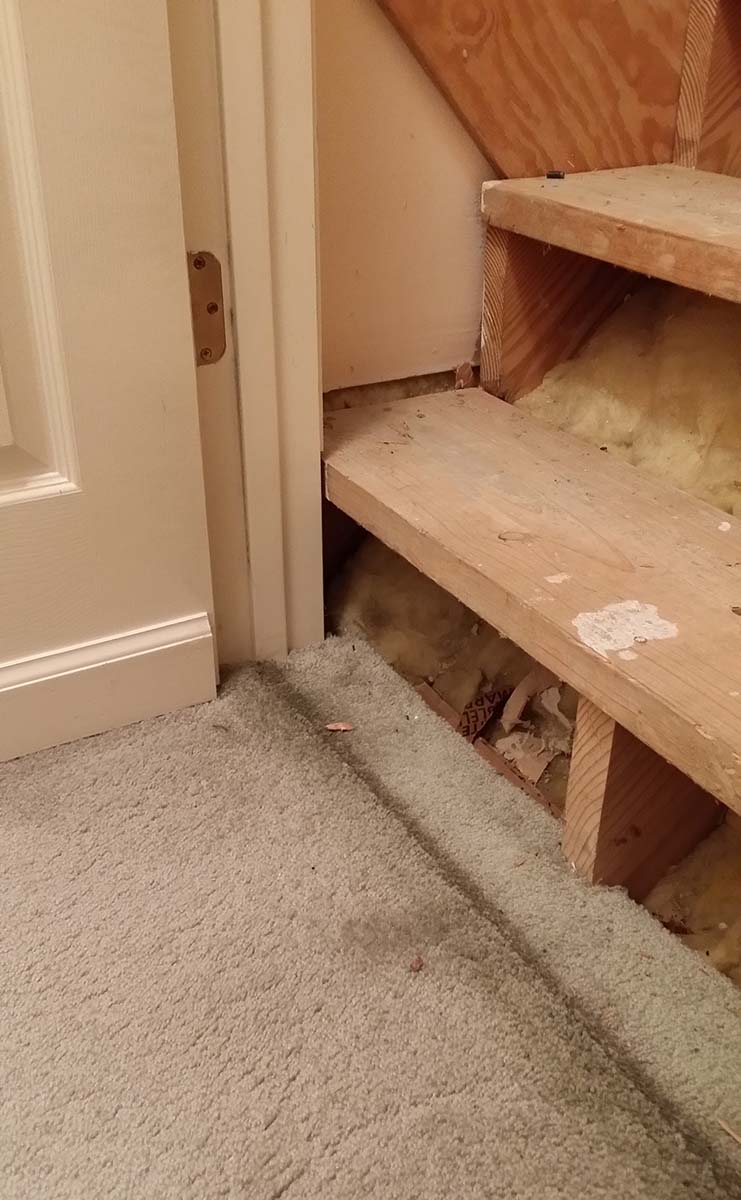
ATTENTION TO DETAIL: There are visual clues to building pressure problems everywhere. Dirt at carpet seams and door jambs often shows air movement as seen in this photo from a bedroom to an attic.
I learned pressures and airflow within my home were all messed up. Building pressure and airflow imbalances were the primary drivers of my dust issues. My home suffered because of another common building science principle: one cfm in = one cfm out. The HVAC system pulled more air out of my home than it supplied.
Our basement had two supply registers, but no return. There was roughly 175 cfm (cubic feet per minute) supplied to my basement and none made it back to the return grilles upstairs. The difference had to come from my main floor. When it did, the result was a pressure imbalance that caused the system to pull air from wherever it could.
Remember the path of least resistance statement earlier? When the blower kicked on, my home basically went into a vacuum. I had air coming from my attic and walls — air loaded with cellulose insulation fibers that settled on every surface in my home. Now that I knew what was happening, I could fix it. We sealed off the basement supply registers and added controlled ventilation. Since we have all hardwood floors, the changes were easy to spot.
There are other side effects caused by this type of interaction. You may have issues with uncontrollable humidity (also a comfort problem) or poor air quality. If so, your customers are likely breathing air from places no one wants to, like an attic or crawlspace — just like my family was.
Moving From Resolutions to Application
Now for the bad news — most New Year’s resolutions fail. It’s estimated that over 80% of people who make resolutions quit by February. Unless you plan for daily actions that are easy to apply, your chances of succeeding with building science principles are slim to none.
Figure out the smallest first step you can take and then start. If there are no immediate problems to solve, like the one I had with my house, I suggest you consider the combustion safety or health route. These are actual problems that your customers have and want answers to. You can often uncover them with some basic room pressure testing.
Start by testing your own home or office and then expand to new jobs, sales, or diagnosing problem jobs as they come in. You can maintain this New Year’s resolution if you commit to learning one principle per quarter or as the opportunity arises.
Some of you are already thinking about those problem jobs where building science can help. What’s wild is I have barely touched on all the interactions between HVAC and building science and what you can do with it. This is just the beginning!
As you learn, don’t take the focus off your core HVAC business. This is the biggest danger to implementing any building science principle. It can become the shiny object that gains all your attention while the rest of your business suffers. I’ve seen profitable companies lose their focus on HVAC and take a financial hit because they were too busy chasing leaky can lights and holes under bathtubs. Know when and where to apply these principles in your everyday business.
Successful companies make building science part of their premium packages. These solutions are not for everyone, but you’ll never know unless you learn them and offer them. As you commit to being a lifelong learner, you’ll become one of the industry elite who differentiate themselves from box-changers.
Looking for a reprint of this article?
From high-res PDFs to custom plaques, order your copy today!