Geothermal Industry Expects a Boom
New Incentives Will Drive Commercial, Homeowner Demand, Experts Say

president, Geothermal Exchange Organization
The U.S. geothermal industry is gearing up to meet increased demand for ground-source heat pump systems that’s expected to be sparked by incentives offered through the Inflation Reduction Act (IRA).
Signed into law last August, the IRA earmarks $369 billion toward energy security and fighting climate change - including by incentivizing energy efficiency, electrification, and renewable energy. Nearly $9 billion of this is set aside for direct-to-homeowner rebates for the installation of high-efficiency and renewable-source HVAC equipment, such as geothermal systems, and for energy-saving home improvements, which could include geothermal. Billions more in IRA-enhanced tax incentives - for high-efficiency equipment, renewables, and energy-saving building measures - are potentially available for homeowners as well as for the owners of commercial and other types of buildings.
“We have a problem which we’ve always dreamed of, which is demand exceeding supply,” said Ryan Dougherty, president of the Geothermal Exchange Organization, a trade association. “That’s a big issue we’re going to be tackling over the next 10 years - building up a capable workforce, ensuring that the manufacturing, our capability on the manufacturing side of things, is there.”
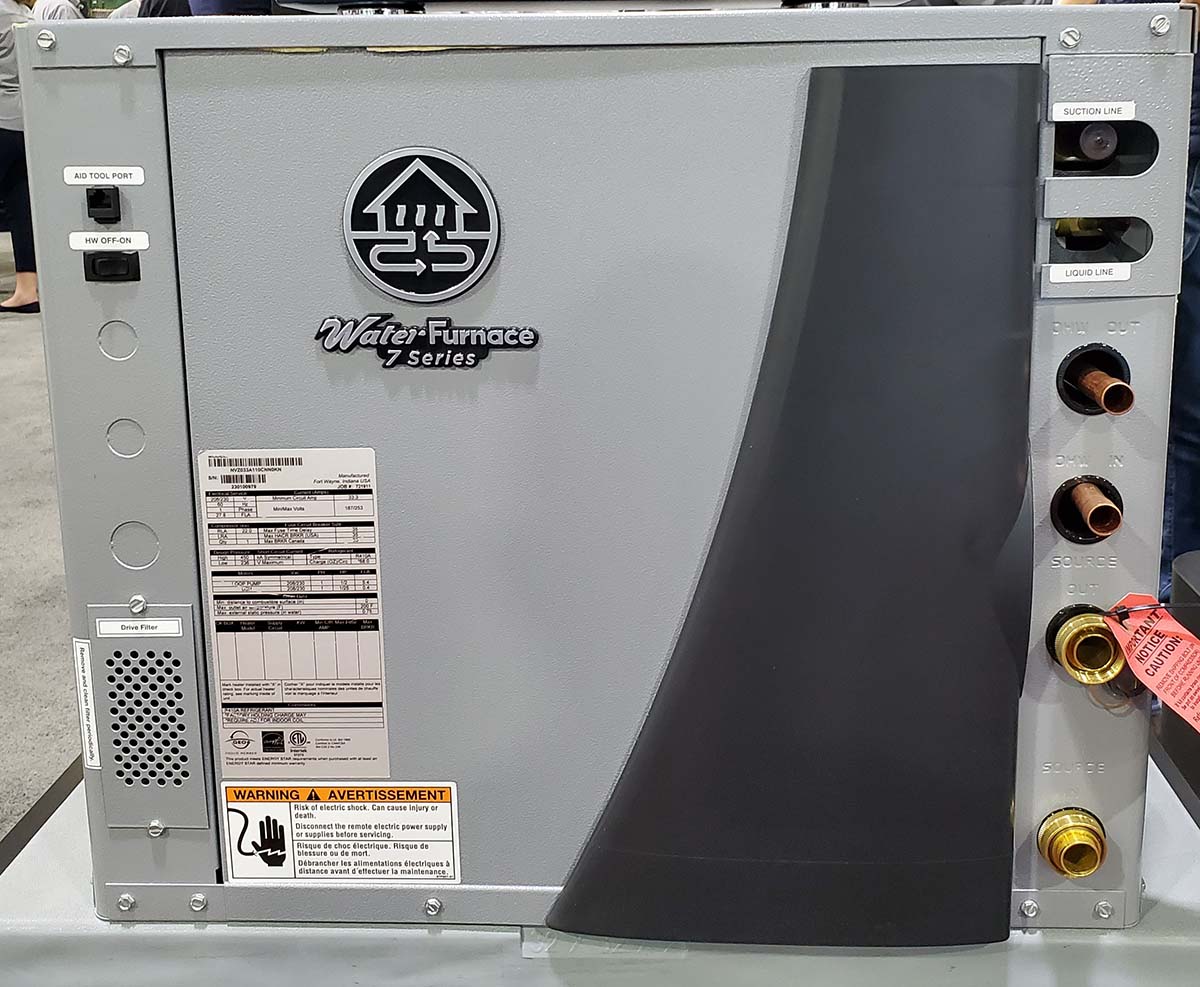
ALL IN ONE: A WaterFurnace 7 Series ground-source heat pump, which can provide heating, cooling, and hot water when linked with a geothermal well field. (Staff photo)
The next 10 years are crucial for the domestic geothermal market, as some of the tax incentives that apply to geothermal systems expire or start to sunset after 2032. The U.S. geothermal heat pump market is expected to grow by 3.8% annually, to about $3.5 billion, between this year and 2032, according to the research firm Global Market Insights.
The IRA’s major incentive for the installation of a qualified geothermal system is a 30% federal clean energy credit, which can be used at filing time to offset taxes owed or add to any refund. The clean energy credit is available to homeowners and commercial building owners, as well as to organizations that pay no taxes and historically been shut out of such incentives, such as nonprofits, religious organizations, local units of government, and schools.
Both purchase and installation costs qualify in the calculation of the credit; a couple that has a home geothermal system installed at a cost of $30,000, for example, would get a $9,000 credit.
“We feel like there’s going to be a great deal of traction,” said Joe Parsons, senior marketing sustainability manager at ClimateMaster, a geothermal equipment manufacturer. “I think it’s going to make a huge difference.”
Looking for quick answers on air conditioning, heating and refrigeration topics? Try Ask ACHR NEWS, our new smart AI search tool. Ask ACHR NEWS
On the commercial side, a clean energy credit for a geothermal system could get even larger. If the equipment meets domestic content requirements (details are still being worked out), the credit could increase by up to 10%. If the project is located in a federally recognized “energy community,” such as one that’s been economically impacted by the closure of a coal mine or a coal-fired power plant, another 10% could be added. That means some commercial geothermal projects could be eligible for a tax credit of as much as 50%.
“The amount of incentives out there for commercial building owners is tremendous now,” said Parsons. “We’ve had a commercial tax credit that’s been 10% for multiple years now. Never had parity (with solar energy). Now we do.”
ClimateMaster has published online guidance on claiming the clean energy credit, both for homeowners and for the owners of commercial and other types of buildings.
Here’s a look at some of the other geothermal incentives that were either established by or enhanced by the IRA.
179D Tax Deductions
The energy efficient commercial buildings deduction, dubbed 179D for its place in the tax code, is generally used by the owners of commercial buildings that are outfitted to increase energy efficiency. Tax deductions are subtracted from a taxpayer’s taxable income.
To be eligible, a building owner must show that building improvements have achieved a minimum energy cost savings compared to a defined baseline. The deduction increases, up to a maximum of $1 per square foot, in proportion to the demonstrated savings in energy costs.
“What’s the biggest energy hog in a building? It’s the heating, cooling, and hot water production,” Dougherty said. A geothermal heat-pump system, he said, meets those needs efficiently.
The HVAC equipment installed in such a project must meet the most recent ASHRAE 90.1 standard.
The 179D deduction, which is a permanent part of the tax code, has a prevailing wage and apprenticeship incentive that can increase the deduction to up to $5 per square foot if those requirements are met.
“Whereas paybacks on these systems used to come in, you know, year seven, maybe year 10, we’re talking about cash-flow positive in a matter of months now,” when incentives are combined, Dougherty said. “And that’s why there is a groundswell in interest on the commercial side for geothermal heating and cooling systems.”
Rebate Programs
The IRA also provides for nearly $9 billion in rebates for certain high-efficiency HVAC equipment, including ground-source heat pumps, and for energy-saving home upgrades more broadly.
The High-Efficiency Electric Home Rebate Program, or HEEHRP, is aimed at low- and moderate-income households. Homeowners with a household income of less than 80% of the median in the area in which they live will be able to get up to $8,000 for a heat pump; those at between 80% and 150% of the median will be able to get up to $4,000.
The Home Owner Managing Energy Savings, or HOMES, rebate program, similar to the 179D tax credits on the commercial side, requires home improvements that lead to provable energy savings. A geothermal system, for example, could be combined with better insulation, air sealing and new windows to result in energy savings that would qualify a homeowner for a HOMES rebate.
HOMES rebates are available to homeowners at all income levels, although consumers in lower-income households may be eligible for enhanced rebates.
“All of a sudden, geothermal is making a great deal of sense from an economic standpoint,” Dougherty said. “Payback will be very rapid, you’re going to cut your bills in half over conventional equipment because of the high, high efficiency of the system, and you’re going to be very comfortable. And you’re doing a good thing for the environment.”
Both HEEHRP and HOMES are to be managed by the states, and the Department of Energy (DOE) has not yet issued final guidance for them.
A HEEHRP or HOMES rebate can be used in conjunction with a clean energy tax credit, but the rebate must be deducted from the amount used to calculate the credit.
“You can’t double dip,” said Parsons.
Industry experts expect the IRA’s rebate money to be claimed fairly quickly once the state programs are up and running.
45L Tax Credits
The IRA extended so-called 45L tax credits through 2031. They are available for the builders of single-family, multifamily, and mobile-home dwellings.
The credits require homes be built to meet specific Energy Star standards, or to be “zero-energy ready,” which the DOE defines as “so energy efficient that a renewable energy system can offset all or most of its annual energy consumption.”
The credit is $2,500 for each single-family home that meets the Energy Star standards, and $5,000 for each single-family zero-energy ready home. In multifamily projects, the credit is $500 for each unit that meets the minimum standard, and $1,000 for each unit deemed zero-energy ready.
Builders of multifamily projects who adhere to prevailing wage and apprenticeship requirements can claim credits of up to $2,500 per unit for those that meet applicable Energy Star standards, and up to $5,000 per unit for zero-energy ready units.
Drilling a ‘Pinch Point’
Dougherty said the industry has been working to straighten out supply-chain kinks and speed up delivery time for heat pumps. But a major “pinch point,” he said, is the availability of qualified crews to dig geothermal wells.
“There are simply not enough drillers to meet the needs and the demand that is growing for these systems,” Dougherty said. “We are we are now mounting a very serious, concerted industry effort to build out capacity. This is this is really about a market development strategy, and really increasing capacity.
“You’re not going to do that overnight,” he continued. “But we have some great early steps that we’re already taking, building coalitions of like-minded interest groups,” such as environmental organizations, labor unions, and manufacturers.
Looking for a reprint of this article?
From high-res PDFs to custom plaques, order your copy today!