From the ACHR NEWS Archives: The A/C Boom of the 1950s
Surge in a/c demand raised concerns over electric demands and wiring
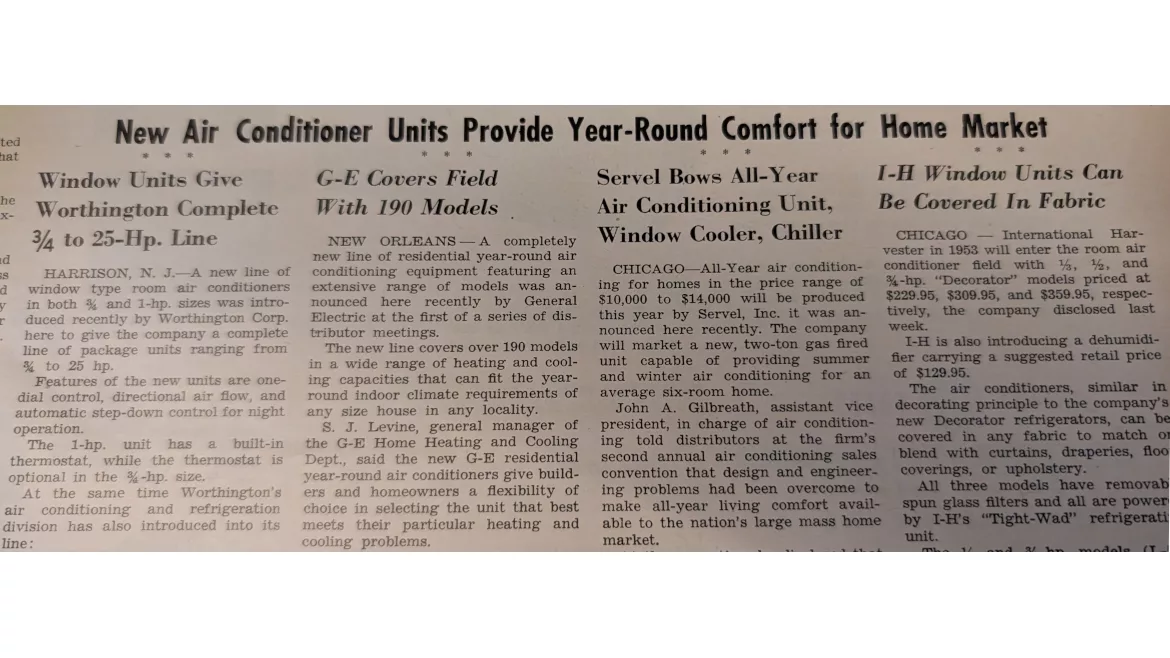
A/C BOOM: Manufacturers responded to the demand for residential a/c in the early 1950s, fueled by the housing market and post-World War II prosperity in the United States.
Air conditioning is a must these days. If a home or establishment doesn’t have it, it’s a rarity. It’s a trend that can be traced back to the 1950s, when the a/c boom really took off, and shows how critical HVAC has been over the decades.
Following World War II, the United States experienced a prosperous era that included a massive increase in housing. Modern homes could be built rapidly and were more affordable due to building techniques. As veterans returned to resume their lives and start families, the baby boom took off. All this led to a desire for home comfort, and a/c manufacturers and contractors met that demand.
Reports from January 1953 show Worthington released a new line of window-type room air conditioners, while GE announced a new line of residential, year-round air conditioning equipment. Servel Inc. revealed the production of all-year a/c for homes at a price range of $10,000 to $14,000 (about $124,140 to $173,796 today, accounting for inflation). Meanwhile, International Harvester entered the room a/c field with units priced between $299 to $359 ($3,711 to $4,456).
In May 1953, Air Conditioning & Refrigeration News noted that Fortune magazine reported a bright future for residential systems following $1.25 billion in sales for 1952. The article cautioned that contractors would need to educate themselves on the latest technology to capitalize.
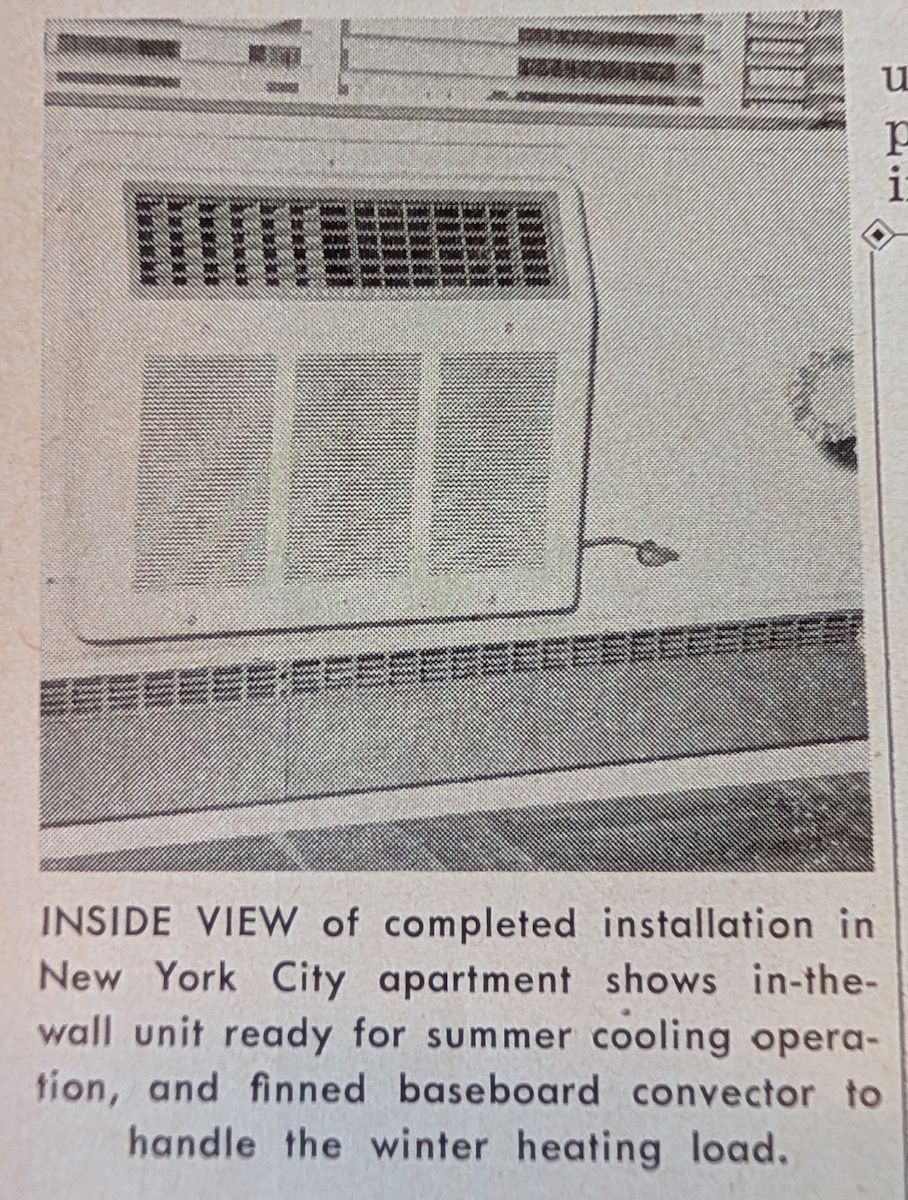
ROOM UNITS: Shipments of a/c room units first hit 1 million in 1953. (Staff photo)
“The trouble, it seems, is the heating contractor and the complexity of the installation,” the magazine said. “Like the master plumber, the heating contractor regards himself as a professional man rather than as a commercial animal. And as a salesman, the saying goes, he is often ‘all back and no front.’”
The article noted that room units were being purchased by “nearly all income groups,” highlighting widespread usage. In May 1953, Austin Rising, then-vice president and general sales manager of the O.A. Sutton Corp., predicted the potential for room coolers at 125 million units, based partly on 42 million families needing an average of 2.5 units per home.
In June, a/c dealers said they were prepared to produce 1.3 million room coolers in 1953, well above the 600,000 predicted earlier that year. In Chicago, dealers said they sold double the number of room units than in 1952. In July 1953, it was enough of a trend for the Air Conditioning & Refrigeration News to declare it a banner year for room unit sales.
Looking for quick answers on air conditioning, heating and refrigeration topics? Try Ask ACHR NEWS, our new smart AI search tool. Ask ACHR NEWS
“The ‘climatic’ factor in air conditioning market (in which southern and southwestern areas are generally considered to offer a greater market potential than other areas of equal population) was not quite so prominent a factor this year, according to some reports,” the article says.
Still, some retailers argued that pricing was too high. Some, such as Empire Cooler Service Inc., then-President Lee Kulp, said in a June 29, 1953, article that the room cooler business was tough due to poor installation and service practices.
It’s a reflection of how, like today with modern technology, a contractor needs to be up to date on training their workers so they’re installing systems properly to avoid costly callbacks.
Meanwhile, central residential “year-round” systems installed in both older homes and new ones were on the rise. In 1952, central residential units peaked at 20,000.
“Some manufacturers have failed to keep up with the demand for complete home (residential) comfort cooling systems to the point where dealers have flatly told them that they were buying competitive makes,” the Air Conditioning & Refrigeration News reported in July 1953.
According to figures from the Air-Conditioning & Refrigeration Institute, at the end of 1953, 1.04 million room units were shipped by manufacturers. Compare this to 365,5451 in 1952.
“Although room air conditioners have been sold for over 20 years, about 90% of all units have been sold in the last five years,” the Air Conditioning & Refrigeration News reported in a Dec. 13, 1954, article.
In 1954, shipments of room air conditioners hit 1.23 million units, up 18% from the previous year.
Selling the Benefits
Some markets resisted a/c units, claiming there were only a few days of hot weather. A manager for Carrier encouraged readers to sell on more than cooling — a/c units offered both comfort and health benefits as well. At the time, 70% of room a/c units were installed in the home, and four out of five were in bedrooms.
“Air conditioning, by producing more healthful conditions in the home, will save them money on their doctor and medicine bills,” said H.W. Bransom, then-Carrier district manager in Cleveland, Ohio.
An article from the May 8, 1954, edition highlighted a survey of medical opinions stating how well-designed and operated air conditioning can be healthier for individuals than the normal hot weather it replaces.
“Today, especially in the South, many homes of the well-to-do, and most stores, restaurants, and theaters are air conditioned. And I am much in favor of this cooling of the air,” an unnamed physician was quoted as saying.
In an article printed in the June 7, 1954 issue, the American Society of Heating and Ventilating Engineers, along with the U.S. Public Health Service and University of Illinois, concluded there were no unfavorable reactions when “people with abnormalities in regulation of body temperature undergo sudden climatic variation.” Tests included studying people ages 18 to 61 as they moved from a room set to 76°F to a room at 98.5°F.
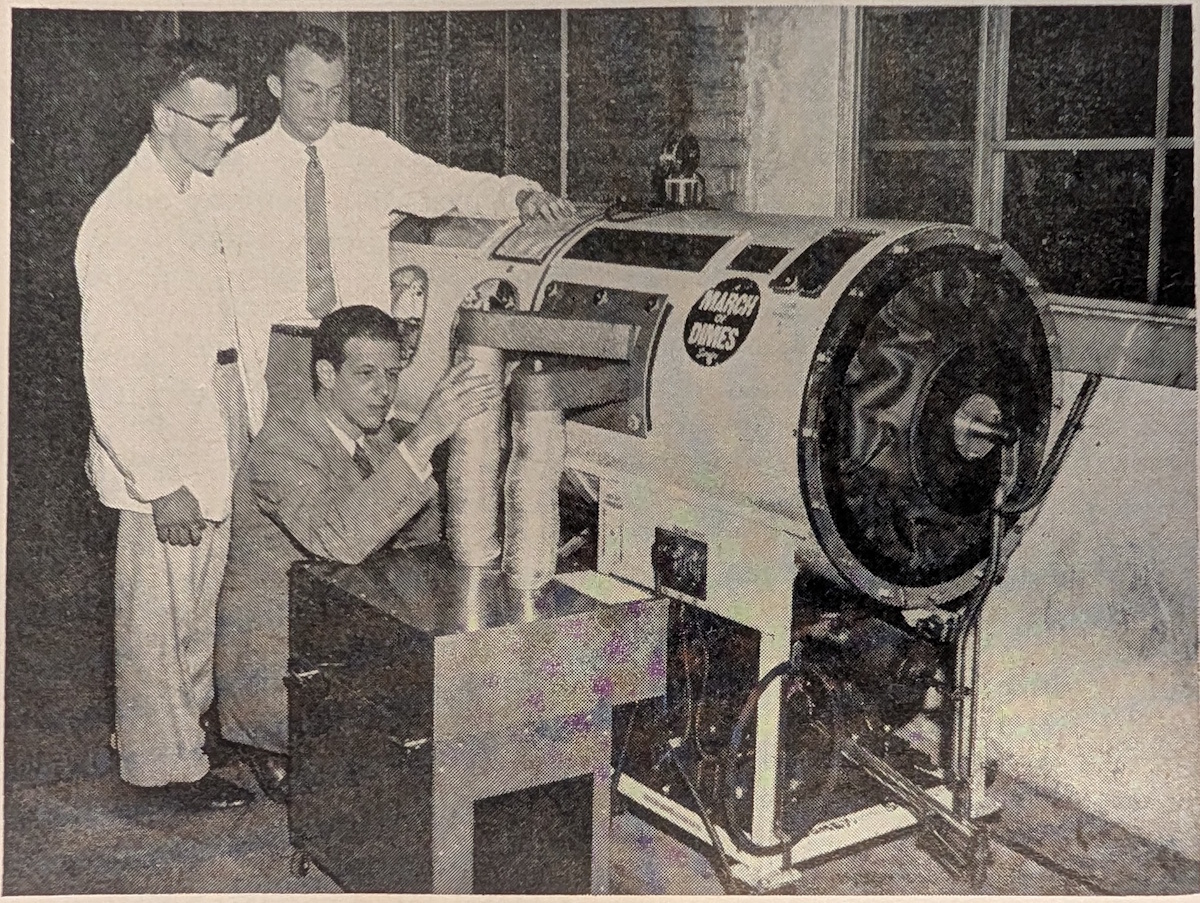
HEALTH BENEFITS: Manufacturers and suppliers came together to create a portable a/c unit for an “iron lung” mechanical aspirator. (Staff photo)
In October 1954, a portable air conditioner for a mechanical aspirator, or “iron lung,” was completed and presented to researchers at the Toomey Pavilion of Cleveland City Hospital “as a contribution to medical science by the refrigeration industry.” Iron lungs were famously used to treat victims of polio, with the air conditioner helping reduce fevers in patients.
By 1957, an editorial in the March 18 edition highlighted how adding a/c to a home increases its resale value, as well as improving “the health, good looks, and good tempers of your family.” The column also touted it as being fully automatic.
“For the first time in his life, Mr. Average Citizen wants air conditioning PERSONALLY, and is willing to pay for it,” the editorial says.
A Familiar Problem
With the surge in a/c unit sales and installations, experts raised a valid concern: Can the country’s electrical infrastructure support this technology boom?
In November 1954, J.M. McKibbin, then-vice president of consumer products, Westinghouse Electric Corp., predicted the a/c market would see spectacular growth over the next decade. He based it on utilities selling 5 billion kilowatt hours in 1953, and expected that to jump to 34 billion in 1963.
However, the electric utility industry expressed its own concerns during the Room Air Conditioner Conference held during the 41st semiannual meeting of the American Society of Refrigerating Engineers in Seattle, Washington. They said most units would be installed in homes not wired for heavy-duty motor-operated appliances, and that a/c demands have already been “substantial enough to change the time of system peaks to the summer months.”
“The utility industry has met the problems occasioned by this phenomenon, but not without difficulty,” said Clive Baugh, then-manager of electrical distribution for Pacific Gas and Electric Co. in San Francisco.
They also pointed to sizing issues, noting ¾-horsepower units — the most widely-sold unit at the time — were too large for 15-amp, 120-volt circuits. It’d cost a utility company $1 million ($123 million today) to correct circuit power factors based on motor powers, and they called for power factors to be improved by equipping them with capacitor-run motors or separate, built-in capacitor units.
“If utilities must spend unduly large sums of money for proper power factor correction on circuits supplying domestic load, this expense eventually would be reflected in rate schedules,” Baugh said.
In the 1950s, utility companies encouraged homeowners to use more electricity to keep costs low, as the creation of electricity wasn’t as efficient as it is today. In 1956, the electricity industry launched its “Live Better Electrically” campaign, touting the benefits of going fully electric.
This wasn’t embraced by all. In the Oct. 12, 1959, edition, G. Gatchell, of Gatchell & Burwell Consulting Engineers, wrote a letter deriding the push for electric heating, calling it propaganda, and stating that most schools and churches refused electric heating.
“None of them have seen fit to have electric heating systems installed after reading our reports, despite pressure extended by Utility Companies and Sales Engineers,” they wrote.
HVAC is still playing a role in today’s utility constraints and electrification. The HVAC industry is benefiting from data center cooling demands, though data centers are driving up electricity costs. This is influencing data centers to generate on-site power, which in turn will require more sophisticated cooling requirements.
Meanwhile, electrification is creating a new boom for a different piece of heating and cooling technology: heat pumps. However, the federal government has recently stepped in to curtail legislation that promotes one energy source over another.
Looking for a reprint of this article?
From high-res PDFs to custom plaques, order your copy today!