From the ACHR NEWS Archives: ‘Industry Pulls Together to Help Win World War II’
All HVACR hands on deck for the war
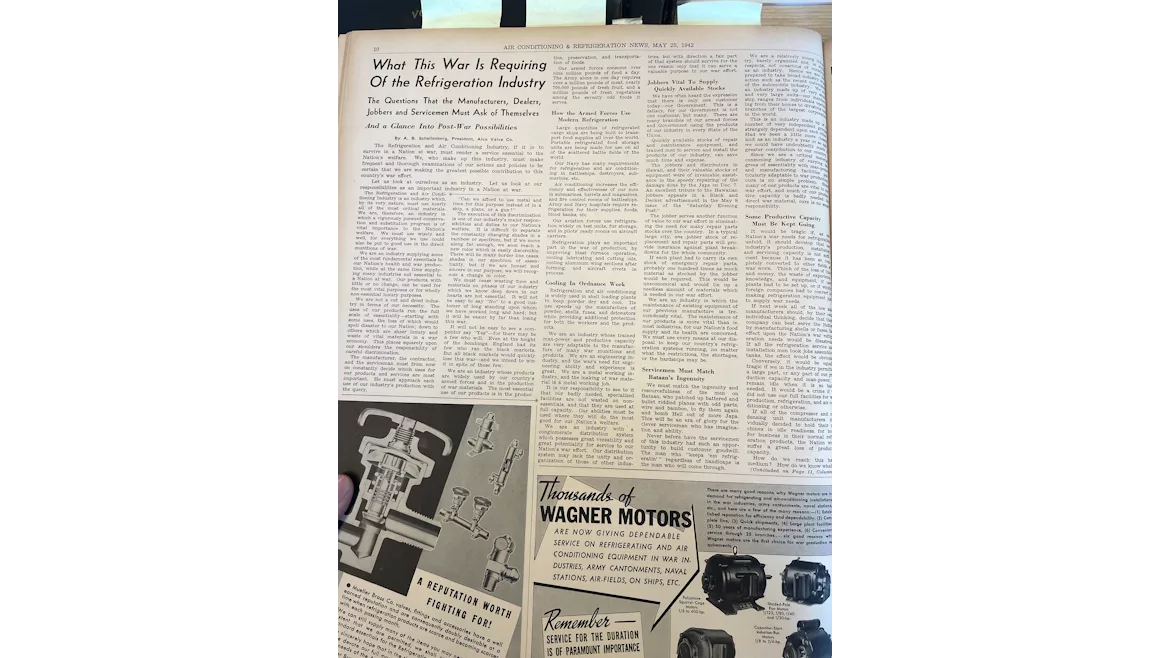
WAR NEEDS: If there was a need for World War II that the HVACR industry could meet, they did.
As the ACHR NEWS continues to celebrate its 100-year anniversary, it’s impossible to look back at the 1940’s and not talk about one of the most defining events in the history of the world: World War II.
Here is something I never really considered about World War II until conducting research for this decade: The HVACR industry played a pivotal role in effectively ending the deadliest conflict in history.
How did they do that? Well, by pivoting their innovations. Manufacturers, engineers, and technicians across the industry shifted their focus almost overnight and rallied their efforts into channeling their expertise to support the war. Equipment originally designed for grocery or retail stores was taken, for the time being, and repurposed to be used in the war. If the equipment didn’t exist, it was created. Technicians who worked on residential equipment were called upon as soldiers, and to also repair HVACR equipment during the war.
The following article, originally written by Peter Powell for the ACHR NEWS 75th anniversary, explores how the industry came together during this time — highlighting the companies, technologies, and people who helped power a global effort that aided us in ultimately winning the war.
“Industry Pulls Together to Help Win World War II”
The ACHR NEWS, April 2001
“When it comes to the 1940s, there was a major reason why air conditioning and refrigeration didn’t make the quantum leaps of the decades that came before and those that would follow. That reason can be summarized with the remark, “There was a war on, you know.”
Never before and never since have the manpower and machinery of one nation been united so wholly for a single purpose — that of winning a war.
Looking for quick answers on air conditioning, heating and refrigeration topics? Try Ask ACHR NEWS, our new smart AI search tool. Ask ACHR NEWS
Service technicians able to handle heavy equipment, diagnose problems, and find solutions in the field were prime candidates for military service. The factories of the major manufacturers were ideal locales to build machinery to aid the war effort.
With the advent of U.S. involvement in World War II, the primary goal was not to create new, innovative, and totally different products for the comfort of customers in the domestic market; it was to provide equipment for the war effort.
Manufacturers Help Out
During World War II, Trane, for instance, utilized the proven technologies of heating, piping, and air conditioning to create a number of products for the armed forces. According to Trane, it created “blackout ventilators, heaters for food dehydration processes, oil coolers for tempering steel Howitzer shells, as well as straps, fittings, and heaters for thousands of ships.”
Trane also developed the aircraft inter-cooler that allowed warplanes to fly higher and faster than ever before. The aircraft inter-cooler was an entirely new design for heat exchangers made possible through a Trane-developed aluminum brazing process.
Carrier also “converted its production for the war effort,” according to that company’s history. Carrier systems were used in the production of synthetic rubber and in high-octane gasoline. “Carrier centrifugal chillers were actually removed from department stores such as Tiffany’s, Hudson’s, Lord & Taylor’s and Macy’s for installation in war production facilities,” according to the company’s written history. (By the way, the stores got the chillers back after the war.)
Carrier air conditioning found its way into warships, cargo vessels, munitions plants, and factories specializing in the production of bombsights. The company made refrigeration units for walk-in coolers used by the Navy on the home front and in war zones to preserve perishables. The company even made portable coolers for the servicing of planes in hot climates.
An example of how HVAC factories went beyond their intended purposes when it came to the war can be demonstrated by Carrier plants being used to produce engine mounts, sight hoods for guns, and tank adapters. The company also redesigned and exclusively produced the “Hedgehog,” a device for discharging 24 anti-submarine bombs simultaneously in a prearranged pattern.
Willis Carrier himself said his greatest engineering achievement was designing and insulating a wind tunnel in Cleveland to simulate freezing high-altitude conditions for the testing of prototype planes.
Lennox responded to the call by purchasing a precision machine shop in Lima, Ohio, to produce “military equipment requiring close-tolerance parts,” the company said.
Doing Their Part
In late 1940, a year before Pearl Harbor, York received a government contract to make air conditioning equipment “for windowless industrial plants, powder plants, factories, army camps, naval bases, and ships,” according to The Legend of York International, published in 1996 by Write Stuff Syndicate.
By 1942, 80% of York production was geared to the war effort, and the remaining 20% was “held for essential civilian applications,” such as hospitals and schools, according to the history.
The company had produced a self-contained flake ice machine in 1940 capable of making 2,000 pounds of ice a day. On Christmas Eve in 1942, such a machine arrived at an airfield on Guadalcanal that the Allies had captured a few months earlier. “Cherished by hot and hungry soldiers, the FlakIce Machine provided a measure of relief from the hot tropical jungle,” so it is written.
The needs of the war required York to speed up production of Yorkaire refrigerators that were said to be able to run 24/7 in hot and humid tropical conditions. Design work and the first four units were completed in 30 days. Hundreds of additional units were ready to be shipped within a few months.
In 1942, the company won a contract to provide gas compressors and refrigeration equipment for the government’s synthetic rubber and aviation gasoline production programs. By 1944, the focus was on outfitting self-propelled landing barges (amphibious “ducks”) and tank landing craft. And York participated in the controversial Manhattan Project that produced the atomic bombs dropped on Japan in 1945.
For its part, York installed what was then the largest water-cooling system. It consisted of 10 centrifugal turbo-compressors, capable of cooling the equivalent of 15,000 tons of ice per day, at a research facility in the state of Washington.
Amana was one of a number of companies to receive the Army-Navy “E” award for excellence “in recognition for its work as a major supplier of walk-in coolers for the U.S. Military,” according to the company’s history.
Postwar Production
With the war’s end came the retooling of those factories for domestic uses. A construction boom followed. Home air conditioning was not yet the necessity it would be many years in the future, but companies saw it coming and also picked up where they had left off in the 1930s, putting air conditioning in more and more public places.
Trane expanded its air conditioning and fan lines after the war and geared up for the launch of its own reciprocating compressors.
Carrier’s postwar credits in the 1940s included obtaining four U.S. patents for Conduit Weather-master systems, paving the way for cooling skyscrapers. The company also provided air conditioning in the Atlanta trolley system, cooling in San Antonio buses, and air conditioning for the 40-story Secretariat Building of the United Nations in New York City.
In peacetime, York moved its flake ice machine into the domestic market for use by fishmongers, poultry shippers, and sausage makers. In 1946, the company entered the frozen food market. In 1948, the company was making air conditioning for churches. Also that year, hermetically sealed refrigeration circuits for single-room air conditioning were introduced.
Amana shifted from walk-in cooler production to the development of home freezers. In 1947, it became the first manufacturer to market upright freezers for the home.
Based on radar research during the war, Raytheon discovered the principle of microwave cooking and in 1947 built its first micro-wave. (It weighed more than 750 pounds and stood 5 feet tall.)
Best and Brightest
World War II was more than companies and the equipment they made. It was the people who joined the war effort in battlefields and on the home front. For all the air conditioning and refrigeration equipment that was made for the war effort, there needed to be people who knew how to install, operate, and maintain it.
“Business as usual is definitely out,” reported the official journal of the Refrigeration Service Engineers Society in June 1941. By 1942, “military service has taken many servicemen.” By 1943, 50% of RSES members were in military service or working in war production plants.
There were pleas from within the industry that more draft deferments be granted to technicians so they could keep domestic refrigeration running.
World War II created, by necessity, a level of technical training that stood the HVACR industry in good stead for close to 50 years.
In 1941, York and the Navy inaugurated a school to instruct fleet personnel to operate and maintain air conditioning and refrigeration systems.
An Armed Forces Refrigeration School at Camp Lee, Virginia, conducted courses with emphasis on portable equipment and company field installations. There were other private schools under contract to the Army.
Technician skills and ingenuity abounded during the war. In his history of RSES written in the early 1980s, Willis Stafford reported on one such effort:
“A quartermaster unit on the coast of Normandy was faced with storing up to 3,000 tons of fresh meat coming off ships for ultimate transfer by refrigerated trucks to front-line kitchens. They discovered three underground tunnels nearby that were 250 feet long and 30 feet high with four lateral bays each running off at right angles that were formally used by the French for ammunition storage. A system of overhead pipes was installed and by using both ammonia and ‘Freon’ machines, cave temperatures were held at 14°F.”
After the war, the GI Bill was one method to augment “frontline” learning. Schools and the private sector provided training in anticipation of commercial growth and a housing boom.
For example, after the war, York started an institute for refrigeration and air conditioning, offering everything from two-week refresher courses up to a five-year engineering course.
The war was the great motivator to learn the trade. Postwar growth gave opportunities to further use those skills. Those young men, many still in their 20s when the war ended, were ready to serve the industry for 40 or more years, well into the 1980s.”
Looking for a reprint of this article?
From high-res PDFs to custom plaques, order your copy today!


