Checklists Can Help Determine What Is Causing the Problem in a Refrigeration System
Confusing High-Side Temperatures
HVACR service technicians using a checklist when servicing a troubled refrigeration system may wonder how the compressor discharge temperature can be so high when the condensing temperature is not. There could be several reasons why. In this article, we will examine two scenarios for a low-temperature, TXV/receiver refrigeration system using R-134a as the refrigerant. The service checklist in the first scenario is for a refrigeration system that has an undercharge of refrigerant.
Scenario 1
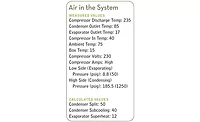
| Measured Values | |
| Compressor discharge temperature | 215°F |
| Condenser outlet temperature | 78°F |
| Evaporator outlet temperature | 10°F |
| Compressor inlet temperature | 50°F |
| Ambient temperature | 70°F |
| Box temperature | 22°F |
| Compressor volts | 230 |
| Compressor amps | Low |
| Low-side (evaporator) pressure | 3.94-in. Hg (-20°F) |
| High-side (condensing) pressure | 86.4 psig (80°F) |
| Calculated Values | |
| Condenser split | 10°F |
| Condenser subcooling | 2°F |
| Evaporator superheat | 30°F |
| Compressor superheat | 70°F |
The symptoms showing that the system is undercharged are:
- Low condenser subcooling;
- Low condenser split;
- High evaporator superheat;
- High compressor superheat; and
- Low amp draw.
The above checklist shows a 215°F compressor discharge temperature, but the condensing temperature is only 80°F. In fact, the condensing temperature is only 10°F above the ambient temperature. This 10°F is referred to as the condenser split. The question is, why is there such a big difference in the two temperatures when they are both on the high side of the refrigeration system?
Part of the answer lies in the fact that the compressor’s discharge temperature is a superheated temperature, while the condensing temperature is a saturated temperature. Also, the fact that the compressor’s discharge temperature is a reflection of how much superheat is coming from the evaporator and suction line, along with the heat of compression from the compressor and refrigerant.
In the first scenario, the starved evaporator from the undercharge has given the system a lot of evaporator and suction line superheat (70°F). This has elevated the compressor’s discharge temperature to 215°F. However, the starved evaporator means there will not be much heat absorbed in the evaporator for the condenser to reject. This is why the condensing temperature is so low (80°F). Notice that this scenario has caused a high compressor discharge temperature with a low condensing temperature.
Now we’ll look at a service checklist for a low-temperature, TXV/receiver refrigeration system that uses R-134a as the refrigerant and has a partial restriction in the liquid line. The liquid line begins at the outlet of the receiver and includes the filter drier, sight glass, and any other components located between the receiver and TXV, such as solenoid valves, hand valves, etc. A system with a restricted metering device has the very same symptoms as a system with a liquid line restriction. This happens because the TXV is actually part of the liquid line.
Scenario 2
| Measured Values | |
| Compressor discharge temperature | 215°F |
| Condenser outlet temperature | 70°F |
| Evaporator outlet temperature | 30°F |
| Compressor in temperature | 60°F |
| Ambient temperature | 70°F |
| Refrigerated space temperature | 30°F |
| Compressor volts | 230 |
| Compressor amps | Low |
| Low side (evaporator) pressure | 1.8 psig (-10°F) |
| High side (condensing) pressure | 95 psig (85°F) |
| Calculated Values | |
| Condenser split | 15°F |
| Condenser subcooling | 15°F |
| Evaporator superheat | 40°F |
| Compressor superheat | 70°F |
The symptoms showing that the system has a liquid line restriction are:
- Normal-to-high condenser subcooling;
- Low condenser split;
- High evaporator superheat; and
- High compressor superheat.
Again, notice a high compressor discharge temperature of 215°F and a low condensing temperature of 85°F. In this scenario, the condensing temperature is only 15°F above the ambient temperature. This system also has a starved evaporator from the liquid line restriction, giving it both high evaporator and suction line superheats. Again, because the evaporator is being starved of refrigerant, there is little heat being absorbed in the evaporator, which means that there will be less heat to give to the condenser to reject. That is why the condenser temperature of 85°F is so low.
Compressor Discharge Temperature
Since the compressor’s discharge temperature is a superheated vapor temperature measurement, a pressure/temperature relationship does not exist, and a pressure gauge cannot be used for its measurement. The compressor discharge temperatures reflect all of the latent heat absorbed in the evaporator, the evaporator superheat, all of the suction line superheat, and all of the heat of compression and motor heat generated within the compressor. It is at the compressor’s discharge temperature where all of this heat is accumulated and now must start to be rejected in the discharge line and condenser.
Looking for quick answers on air conditioning, heating and refrigeration topics? Try Ask ACHR NEWS, our new smart AI search tool. Ask ACHR NEWS
The discharge line exiting the compressor is the hottest part of a refrigeration or air conditioning system that the service technician can measure. The back of the compressor’s discharge valve is actually the hottest part of the system, but it is impossible for a service technician to measure. The next closest place, however, is the discharge line of the compressor. The compressor’s discharge line temperature can be measured by placing an insulated temperature measuring device on the discharge line about 3 inches from the compressor.
This discharge line temperature is a measure of the superheated refrigerant’s vapor temperature. Remember, superheated refrigerant refers to a refrigerant vapor that is at a higher temperature than its saturation temperature for a certain pressure. In this case, the certain pressure would be the condensing pressure for the high side of the system.
The compressor’s discharge temperature is a reflection of the hottest part of a refrigeration system, and there are limits as to how hot a discharge temperature should be. Most compressor manufacturers agree that the highest range for a compressor’s discharge temperature should not exceed 225° to 250°F. Compressor overheating problems are today’s most serious field problems, so service technicians must always keep compressor discharge temperatures under 225°F, and never more than 250°F.
Having a system with a high compressor discharge temperature doesn’t necessarily mean there will also be a high condensing temperature for that system. The high compressor discharge temperatures in the above two scenarios came from the compressor experiencing very high superheats from the evaporator and suction line. On the other hand, the low condensing temperatures in the above scenarios came from the low heat load on the evaporator, which led to low heat to be rejected by the condenser.
Next month’s article will concentrate on other reasons for high compressor discharge temperatures.
Looking for a reprint of this article?
From high-res PDFs to custom plaques, order your copy today!