The Professor: The Importance of a Refrigeration System’s Operating Pressures
Calculating and analyzing compression ratios can aid system troubleshooting

A refrigeration system’s compression or pressure ratio is defined as the absolute discharge pressure divided by the absolute suction pressure. Calculating this ratio can be a big help when it comes to troubleshooting a system.
This article will use the term compression ratio instead of pressure ratio, but they refer to the same measurement. In addition, discharge pressure and condensing pressure are one and the same, as are suction pressure and evaporating pressure.
By way of background, keep in mind that although a gauge is calibrated to read zero at atmosphere pressure, in reality, there is 14.7 psi (standard atmospheric pressure) of pressure being applied to it. This is called gauge pressure, which is not a true pressure. To attain the true (absolute) pressure, one must add 14.7 to a gauge reading. True, or absolute, pressure must be used when utilizing an equation like the one below.
Compression ratio = Absolute discharge pressure ÷ Absolute suction pressure
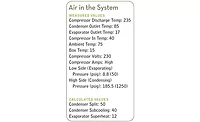
Let’s start with a quick quiz. Determine the compression ratio for a system with the following pressures:
Discharge pressure = 145 psig
Suction pressure = 5 psig
Compression Ratio = (145 psig + 14.7 psi) / (5 psig + 14.7 psi) = (159.7 psia) / 19.7 psia) = a ratio of 8.1:1
Looking for quick answers on air conditioning, heating and refrigeration topics? Try Ask ACHR NEWS, our new smart AI search tool. Ask ACHR NEWS
This means the discharge pressure is 8.1 times the magnitude of the suction pressure.
COMPRESSION RATIO MAGNITUDES AND DISCHARGE TEMPERATURES
High compression ratios are a result of high condensing pressures, low evaporator pressures, or both. High compression ratios add more work to the compression stroke of the compressor. More work on the compression stroke will cause the heat of compression to increase and the compressor to have a higher discharge temperature.
The compressor’s discharge temperature is often an overlooked temperature when troubleshooting a refrigeration or air conditioning system. However, the discharge temperature is very important because it’s an indication of the amount of heat absorbed in the evaporator and suction line and any heat of compression generated by the compression process. Since the compressor’s discharge temperature is superheated, a pressure-temperature relationship does not exist, and it must be read directly on the discharge line by a temperature-measuring device. The compressor’s discharge temperature should be taken about 1-2 inches away from the compressor on the discharge line. This discharge temperature should never exceed 225°F as carbonization can occur at temperatures exceeding 225°.
The three causes for high discharge temperatures are high condensing pressures, low evaporator pressures, and high compression ratios.
HIGH CONDENSING PRESSURES
When the condensing pressure is high, the compressor must compress the refrigerant from the low-side (evaporating) pressure to an elevated high-side (condensing) pressure. This added work of compression done by the compressor will cause the heat of compression to be higher. Thus, the compressor’s discharge temperature will to be higher.
Remember, the condensing pressure is the pressure at which the refrigerant is changing phase from a vapor to a liquid in the condenser. There is a pressure-temperature relationship with the condensing pressure because of the phase change. A gauge reading on the high side of the system is all that is needed to find the condensing pressure. Convert this pressure to a temperature using a pressure-temperature chart, and this will be the condensing temperature. However, there are many causes for high condensing temperatures (pressures) that also cause high discharge temperatures, such as a dirty condenser, high ambient temperature, noncondensable (air) in the system, a faulty condenser fan, restricted airflow over the condenser, refrigerant overcharge, use of the wrong refrigerant, and a high heat load on the evaporator.
LOW EVAPORATOR PRESSURES
Low evaporator pressures also will cause a high compressor discharge temperature.
When evaporator pressures are low, the compressor must compress refrigerant from this lower evaporator pressure to the condensing pressure. This added work of compression done by the compressor will increase the heat of compression, thus increasing the compressor’s discharge temperature. Remember, evaporator pressure is the pressure at which the refrigerant is phase-changing from a liquid to a vapor in the evaporator. There is a pressure-temperature relationship with the evaporating pressure because of the phase change. A gauge reading on the low side of the refrigeration system is all that is needed to find the evaporating pressure. Convert this pressure to a temperature using a pressure-temperature chart; this will be the evaporating temperature. There are many causes for low evaporating pressures (temperatures), which cause high compressor discharge temperatures, such as a dirty evaporator coil, an iced-up evaporator coil, the evaporator fan’s motor is out, a shortage of airflow over the evaporator, a frosted evaporator coil due to high humidity, a frosted evaporator coil from a bad defrost heater or other defrost component malfunction, a low heat load on the evaporator coil, defrost intervals set too far apart on the time clock, an undercharge of refrigerant, the end of the running cycle, a partially plugged filter drier, a compressor inlet screen that’s partially plugged, a restricted liquid line, use of the wrong refrigerant, and a starving metering device.
VOLUMETRIC EFFICIENCY
The volumetric efficiency is expressed as a percentage from 0 to 100. Volumetric efficiency is defined as the ratio of the actual volume of the refrigerant gas pumped by the compressor to the volume displaced by the compressor pistons. A high volumetric efficiency means that more of the piston’s cylinder volume is being filled with new refrigerant from the suction line and has not re-expanded clearance volume gases.
The higher the volumetric efficiency, the greater the amount of new refrigerant that will be introduced into the cylinder with each downstroke of the piston. Thus, more refrigerant will be circulated with each revolution of the crankshaft. The system will now have better capacity and a higher efficiency. Therefore, the lower the discharge pressure, the less re-expansion of discharge gases to suction pressure. Similarly, the higher the suction pressure, the less re-expansion of discharge gases. This happens because the discharge gases will experience less re-expansion to the higher suction pressure, causing the suction valve to open sooner.
The compressor’s volumetric efficiency depends mainly on system pressures. In fact, the farther apart the discharge pressure’s magnitude is from the suction pressure’s magnitude, the lower the volumetric efficiency will be. As stated earlier, compression ratio is the ratio that measures how many times greater the discharge pressure is than the suction pressure; in other words, their relative magnitudes. Lower compression ratios will cause higher volumetric efficiencies and lower discharge temperatures. So, keep those compression ratios as low as possible by keeping condensing pressures low, evaporator pressures high, or both.
Publication date: 1/11/2016
Want more HVAC industry news and information? Join The NEWS on Facebook, Twitter, and LinkedIn today!
Looking for a reprint of this article?
From high-res PDFs to custom plaques, order your copy today!