ACHR News
search
Ask ACHR NEWS AI
cart
facebook twitter instagram linkedin youtube
  • Sign In
  • Subscribe
  • Sign Out
  • My Account
ACHR News
  • NEWS
    • Breaking News
    • New HVAC Products
    • Featured Products
    • Manufacturer Reports
    • HVAC Data
    • Legislation
    • ACHR NEWS Centennial
  • RESIDENTIAL
    • Air Conditioners
    • Furnaces
    • Residential Heat Pumps
    • Ductless
    • Residential IAQ
    • Testing, Monitoring, Tools
    • Components & Accessories
  • COMMERCIAL
    • Air Handlers
    • Rooftop Units
    • Chillers and Cooling Towers
    • Commercial Heat Pumps
    • Boilers and Hydronics
    • VRF/Ductless
    • Commercial IAQ
  • REFRIGERATION
    • Refrigerants
    • Refrigerant Regulations
    • Leak Management
  • CONTRACTOR PRO
    • Geothermal
    • Homeowner Study
    • VRF and VRV Ductless
    • Unitary Trends
  • EDUCATION
    • Training and Education
    • Business Management
    • Service and Maintenance
    • Continuing Education
    • Market Research >
      • HVAC Brand Awareness Report
      • VRV, VRF, VRVZ Report
      • Unitary Trends Report
      • Water Heat Professionals Report
    • Webinars
    • Sponsor Insights
    • eProducts Info
    • White Papers
  • EVENTS
    • HVAC Contractor Forum
    • Industry Events and Webinars
  • MEDIA
    • Videos
    • AHR Expo 2025 Videos
    • Podcasts >
      • ACHR News Podcast
      • HARDI Podcasts
      • AHR Expo Podcasts
      • ACCA Podcasts
    • Interactive Spotlights
    • Quizzes
    • eBooks
    • HVAC Talkback
  • HVAC GROUP
    • ACHR NEWS >
      • Current Issue
      • Digital Edition
      • Subscribe
    • Distribution Trends
    • SNIPS NEWS >
      • Join SNIPS NEWS
    • Engineered Systems News >
      • Join ES News
    • HVACR Directory
    • Contests
    • Newsletters
    • Contact
    • Advertise
    • My Account
NewsRefrigerationRefrigerants

Reducing Refrigerant Leaks Is Industry Concern

Research details where leaks are usually located in refrigeration systems
By Joanna R. Turpin
Supermarket Refrigeration

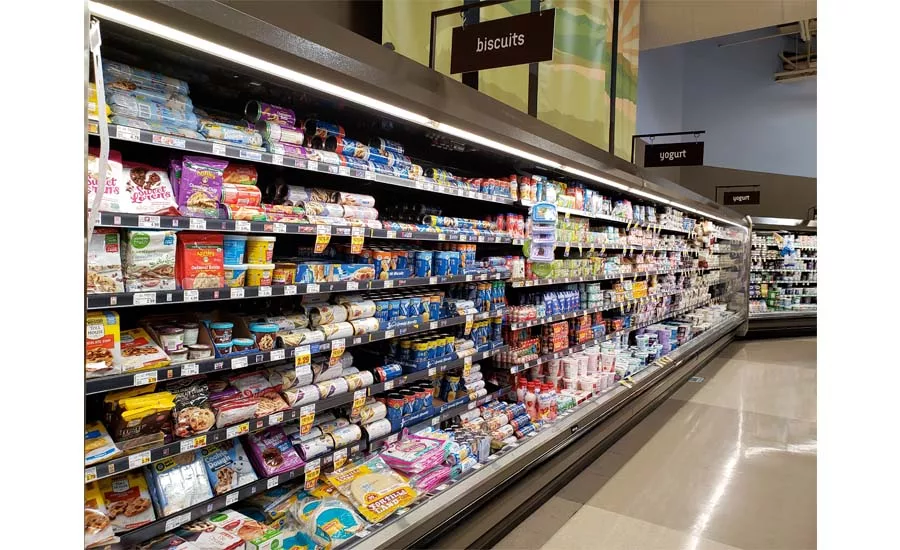
LARGE BURDEN: For food retailers, refrigerant leaks represent a large financial and operational burden, which is why it is important that they be found and fixed quickly. (Staff photo)

November 22, 2021

Refrigerant leaks in HVACR equipment — particularly commercial refrigeration systems — are a significant problem. According to the Environmental Protection Agency’s (EPA’s) GreenChill program, the typical supermarket has an annual leak rate of about 25%, and the average store contains about 3,500 pounds of refrigerant. Multiply that by thousands of stores across the U.S., and it’s easy to see why leaks are such a big concern for end users, as well as the environment.

For food retailers, refrigerant leaks represent a large financial and operational burden, especially since the cost of refrigerants will likely be increasing in the near future due to the impending HFC phasedown. For the environment, leaks represent a large source of annual emissions; indeed, leaks in supermarkets across the U.S. may account for as much as 129 billion pounds of CO2e each year.

The North American Sustainable Refrigeration Council (NASRC) is addressing this issue through a leak reduction initiative that is being spearheaded by six of its retailer-members. Under this initiative, retailers identified the top 10 leak issues in refrigeration equipment and are developing equipment specifications that are designed to mitigate those leaks. In its recent online summit, NASRC offered details on some of those common sources of leaks and what causes them to occur.


Leak Locations

According to Morgan Smith, program and communications director at NASRC, the top 10 leak issues identified by the retailers in the leak reduction initiative are:

In cases and fixtures:

  1. Evaporator leaks due to tubing failures;
  2. Access valves;
  3. Lines rubbing together, either through contact/vibration or through thermal expansion;
  4. Electrical wiring failure, causing leaks;

In machine rooms and racks:

  1. Compressor vibration relative to the rack structure, causing displacement, breaking tubing;
  2. High-side lines;
  3. Mechanical fitting connections;
  4. Tubing isolation from similar and dissimilar metals;

In the condenser:

  1. Tube sheet leaks at condensers; and
  2. Fan breakage/motors falling into the coil and causing leaks.

As a response, the retailers in the initiative proposed the following best practices and are working on drafting the language for the specification:

  1. Require 45 bar working pressure (Type K) in fixtures (coil and all piping) and on racks;
  2. Any tubing or part that carries refrigerant cannot come in contact with any other metal;
  3. Eliminate any pipe fitting with a mechanical thread;
  4. Limit Rotolock fittings (ideally transition to another alternative, if not, institute quality controls);
  5. Add a temporary pressure gauge or indicator to visually confirm that the system is pressurized after arriving on site; and
  6. Regulating release valves.

Leia Waln, associate partner and program manager at Refrigerant Management Solutions, confirmed these major sources of leaks. She shared the details of a study of 100 supermarkets that showed that the largest number of leaks occur at the compressor racks, which accounted for 57% of all leaks. The second largest number of leaks occur within the display cases, which are out on the sales floor. These two locations comprise about 89% of leaks that occur in refrigeration systems, while 7% of the leaks occur in piping and 3% in remote condensers.

“In looking specifically at the components on a traditional compressor rack, the largest number of leaks occur on the compressors, with 28% of the overall leak locations occurring there, followed by leaks in the liquid line, suction line, receiver, and discharge line,” she said. “The highest percentage of leak locations are on the suction service valve, followed by fittings, discharge service valve, discharge piping, liquid injection valve, and flanges/couplings.”

Display cases account for 26% of the leaks, and the majority of these leaks occur in the evaporator, followed by the suction line and then the liquid line, said Waln. “If we look further into the data under the evaporator, we'd see that these leaks are mostly on the evaporator coils and the evaporator expansion devices.”

While it is sometimes difficult to determine the root cause of a leak, Waln noted that for a traditional rack system, vibration is the main cause of leaks, followed by normal mechanical wear, seal failure, corrosion, gasket failure, and physical damage. The number one cause of leaks in display cases is corrosion, followed by normal mechanical wear, and vibration.


Finding/Fixing Leaks

Finding — and fixing — leaks are key in reducing refrigerant emissions, and Clay Rohrer, director of connected solutions at Hussmann, offered the following comprehensive guidance on this subject:

  • If equipped with an electronic refrigerant leak detection system:
    • Check and graph all of the different zones’ ppm concentrations and test the most suspicious areas first with a portable, accurate leak detector.
    • Check fittings and piping for oil residue.
  • Test the compressor room with an electronic or ultrasonic leak detector and look for signs of oil on the fittings or on the floor.
    • Use soap bubbles to help pinpoint any suspected areas. Service valves, caps, flares, control hoses, and missing clamps are all good points to check. De-energize the electrical supply before using soap on pressure switches, transducers, terminal plates, etc., to avoid a shock hazard.
    • To help minimize trouble, temporarily turn off exhaust fans to help pinpoint leak, if safe to do.
  • Walk the store with an electronic or ultrasonic leak detector and place the probe in, around, over, and under all the cases and walk-in boxes. If a leak is detected, check the case bottom area for oil and possibly apply soap bubbles to any service caps and fittings in the cases or piping to pinpoint the source.
  • Walk the condenser area with a detector. Check the piping, valves, pressure controls, coil tube sheet, and return bends for any signs of oil or a possible leak. Apply soap bubbles, if necessary, to pinpoint the source.
  • Walk the accessible piping with the electronic detector. Check for signs of oil around fittings. Be sure to look in or around the insulation on the piping.
  • If unable to locate a leak, it may be necessary to shut down the HVAC and exhaust hoods, if store management does not object and it is safe to do so. This may need to be one after hours to minimize air currents. Let the leak stratify to see if concentration increases in any specific area.
  • Look in the harder-to-access areas, such as the pits, underground piping, above ceilings, and inside of walls. Look for oil or oil residue.

“It's all about using detectors and data to focus and pinpoint the area and then confirming that the leak is fixed,” said Rohrer. “If you don't confirm the fix, and if you don't have any refrigerant management tools in place, you're just constantly leaking. It's critical to constantly use data to continuously improve a site's leaks.”

Looking for quick answers on air conditioning, heating and refrigeration topics? Try Ask ACHR NEWS, our new smart AI search tool. Ask ACHR NEWS →

KEYWORDS: EPA (Environmental Protection Agency) FROSTlines leak prevention NASRC (North American Sustainable Refrigeration Council) refrigerant leaks refrigerant management supermarket refrigeration

Share This Story

Looking for a reprint of this article?
From high-res PDFs to custom plaques, order your copy today!


Tn joanna 2017
Joanna Turpin is a Senior Editor at The ACHR NEWS. She can be contacted at 248-786-1707 or joannaturpin@achrnews.com. Joanna has been with BNP Media since 1991, first heading up the company’s technical book division before moving over to The ACHR NEWS, where she frequently writes about refrigerants and commercial refrigeration. She obtained her bachelor’s degree in English from the University of Washington and worked on her master’s degree in technical communication at Eastern Michigan University.

Recommended Content

JOIN TODAY
To unlock your recommendations.

Already have an account? Sign In

  • HVAC-enrollment

    The Trades Are Back: HVACR Programs See Nearly 30% Enrollment Spike

    A new wave of future technicians is entering the pipeline.  
    Training and Education
    By: Matt Jachman
  • 2025 Top 40 Under 40

    2025 Top 40 Under 40 HVACR Professionals List

    The 11th annual Top 40 Under 40 list highlights those...
    HVAC Contracting
    By: Hannah Belloli-Oster
  • LG Ductless Mini-Split Systems

    The 9 Types of Heat Pumps

    As the U.S. moves toward electrification, heat pumps are...
    Ground Source Heat Pumps
    By: Joanna R. Turpin
Subscription Center
  • Create an Account
  • Start a Subscription
  • Manage My Account
  • Sign Up for Newsletters
  • Visit Customer Service
  • Update Preferences

More Videos

Sponsored Content

Sponsored Content is a special paid section where industry companies provide high quality, objective, non-commercial content around topics of interest to The News audience. All Sponsored Content is supplied by the advertising company and any opinions expressed in this article are those of the author and not necessarily reflect the views of The News or its parent company, BNP Media. Interested in participating in our Sponsored Content section? Contact your local rep!

close
  • Piggy Bank
    Sponsored byWatercress Financial

    Energy Prices, Inflation, and HVAC: What Today’s Homeowners Care About

  • Refrigerated Food
    Sponsored bySolstice Advanced Materials

    R-455A Refrigeration: A Cold Storage Solution for the Future

  • Airex Rooftop Units
    Sponsored byAirex Manufacturing Inc

    Consolidating Roof Penetrations: A Growing Trend in Multifamily HVAC Design

Popular Stories

HVAC-Price-Increase-graphic

HVAC Price Increase List: June 2026

Trump-Section-232.jpg

Trump Reduces Section 232 Tariffs on HVAC Equipment to 15%

R410A-Refrigerant-Cylinder.jpg

Refrigerant Recovery is a Revenue Opportunity

Heat-pump-cutaway.jpg

PFAS Rules and A2L Building Codes Continue to Evolve

Midea-training.jpg

HVAC Workforce Crisis Expands Beyond Technicians to Instructor Shortages

View The ACHR NEWS
Centennial Anniversary Timeline

The ACHR News Timeline Chart
Submit a Letter
Submit a letter to our editors.

Events

November 6, 2025

Next-Gen Data Center Cooling: HVAC Innovation and Real-World Solutions

On Demand As AI workloads and high-density computing push traditional cooling methods to their limits, the data center industry is accelerating the adoption of next-generation HVAC technologies.

June 17, 2026

Decarbonization Without Disruption

This webinar will explore practical HVAC decarbonization strategies that minimize disruption while maximizing long-term performance and ROI.

View All Submit An Event

Poll

Summer Staff

Are you fully staffed for the summer season?
View Results Poll Archive

Products

BNI Mechanical/Electrical Square Foot Costbook, 2026 Edition

BNI Mechanical/Electrical Square Foot Costbook, 2026 Edition

See More Products
Decarbonization Without Disruption - Free Webinar - 6/17/2026

Related Articles

  • Joanna's Point of View

    Reducing Refrigerant Leaks Should Be Top Priority for HVACR Contractors

    See More
  • Testing refrigeration or a/c equipment that utilizes R-22 refrigerant.

    Analyze This: Refrigerant Purity Is an Ongoing Industry Concern

    See More
  • Finding and Fixing Refrigerant Leaks Is Frustrating but Necessary

    See More

Related Products

See More Products
  • SMACNA-logo8.gif

    Accepted Industry Practices for Sheet Metal Lagging

See More Products

Events

View AllSubmit An Event
  • May 21, 2026

    The A2L Genie is Out of the Refrigerant Canister – What Now?

    On Demand Join this webinar to learn about key updates to refrigerant regulations. We will cover practical installation and servicing content gathered from thousands of our interactions with contractors across the US and Canada.
View AllSubmit An Event

Related Directories

  • Hussmann Corp.

    Hussmann manufactures and sells refrigerated display cases, refrigeration systems, self-contained display cases, specialty display cases and aftermarket parts. It also provides installation and service.
×

Sign Up. Stay Informed.

The #1 trusted source for the HVACR industry since 1926

SUBSCRIBE
  • RESOURCES
    • Advertise
    • Contact Us
    • Advisory Board
    • Classifieds
    • Submit a Letter
    • Directories
    • Store
  • ACCOUNT CENTER
    • Create an Account
    • Start a Subscription
    • Manage My Account
    • Sign Up for Newsletters
    • Visit Customer Service
    • Update Preferences
  • SERVICES
    • Marketing Services
    • Reprints
    • Market Research
    • List Rental
    • Survey/Respondent Access
  • STAY CONNECTED
    • LinkedIn
    • Facebook
    • Instagram
    • YouTube
    • X (Twitter)
  • PRIVACY
    • PRIVACY POLICY
    • TERMS & CONDITIONS
    • DO NOT SELL MY PERSONAL INFORMATION
    • PRIVACY REQUEST
    • ACCESSIBILITY

Copyright ©2026. All Rights Reserved BNP Media, Inc. and BNP Media II, LLC.

Design, CMS, Hosting & Web Development :: ePublishing