Five Things HVAC Contractors Should Know About Cold-Climate VRF
As technology advances, manufacturers talk tips, trends, and putting outdoor units indoors
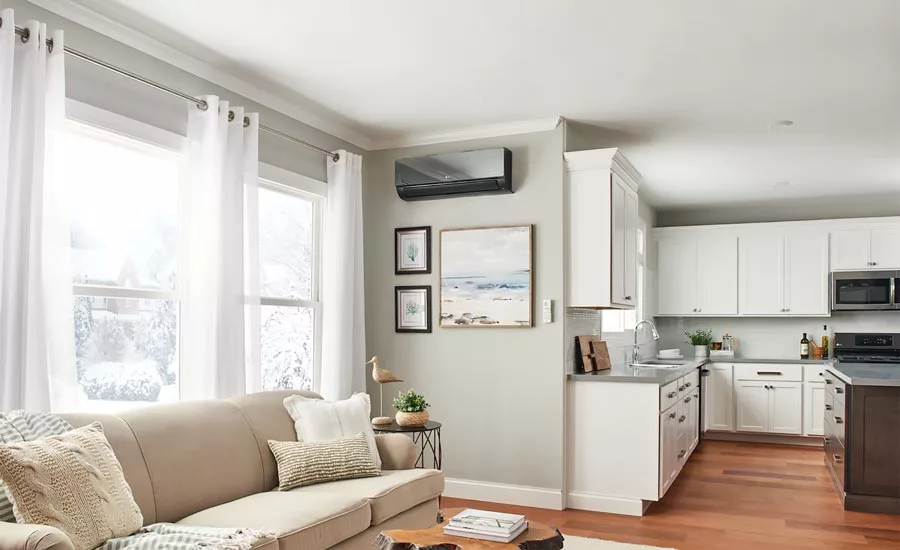
COLD COMFORT: Manufacturers are building the case that VRF equipment can and should make itself at home where snow outside the window is common. (Courtesy of LG Air Conditioning)
As performance and efficiencies have marched upward over the last several years, VRF has made steady advances in the last frontier of cold climates.
This part of the industry has chipped away at both market share and preconceived notions about planning and executing commercial or residential projects in those areas, and it has learned a few things for HVAC contractors to keep in mind as well.
Auxiliary Options
Cold-climate consumers are used to the concept of auxiliary heat. VRF has made progress, but what about trends in the auxiliary part of the design?
“In line with the electrification movement sweeping the country, we are seeing more electric strip heaters being used as an auxiliary heat source when needed,” said Wade McCorkel, CEM, regional sales manager for Samsung.
In commercial projects, he sees electric heat commonly going in the ductwork downstream of the VRF fan coil. He noted that most manufacturers can handle this via the unit’s built-in fan coil controls.
It may sound retro, but McCorkel says he also sees electric baseboard for older retrofit applications and ductless applications as a convenient no-ductwork option.
“From time to time,” he added, “we still see hot water loops serving VAVs or baseboard radiant heat, as well as natural gas duct heaters.”
Looking for quick answers on air conditioning, heating and refrigeration topics? Try Ask ACHR NEWS, our new smart AI search tool. Ask ACHR NEWS
James DeBerry, manager, commercial marketing with Mitsubishi Electric Trane HVAC US (METUS), has spotted a different trend that aligns with VRF advances but still may come as a surprise.
“One of the biggest trends we’ve observed in auxiliary heating is to have none at all.”
DeBerry said that flash-injection technology makes this more frequently possible for commercial jobs.
“With flash-injection technology, a VRF system injects a small amount of mixed-phase refrigerant to cool the compressor and allows it to perform at higher speeds without failing due to friction and heat buildup,” he explained. “This method enables VRF systems to deliver significant heat at low temperatures. Flash-injection technology creates the opportunity to size units based upon heating loads and use the VRF system as a sole source for heating.”
While DeBerry noted that flash injection should continue to make changeover to auxiliary increasingly rare in “most regions,” it follows that it will add to the inroads in colder climates as well.
What About Installation?
“Contractors should ask for specific cold climate installation guidelines, and investigate and apply the available cold climate accessories — such as wind baffles, base pan electric heaters, as examples — which serve as extra precautions to prevent defrost water from re-freezing,” said Ken Kastl.
Kastl is senior manager, distribution sales Northeast U.S., for LG Air Conditioning Technologies USA. Beyond checking manufacturer recommendations for cold climate, Kastl advised contractors to make the effort to explain to the owner why it’s a good idea to locate the outdoor unit in a more protected area, if possible, with a sunlight-facing orientation during the day.
In broader terms, he reinforced the value of searching out the most advanced models for extreme temperature and reviewing full lifecycle cost projections when evaluating options.
DeBerry’s team advises METUS contractors to install units at least 12 inches above the maximum expected snow depth. A stand with an open design helps, as can snow hoods and hail guards. These measures not only protect from damage but can improve defrost efficiency.
“We also recommend contractors use base pan or panel heaters to prevent ice buildup on the unit caused by condensation produced during defrost,” said DeBerry. “They should make sure the water drains away from sidewalks and consider an area drain to minimize the risk of condensation turning to puddles or ice on a walkable surface near the unit.”
It’s not always the snow and ice, either. Sometimes, the enemy is the wind. DeBerry says best practice includes using cables to secure outdoor units to the ground or to the structure, especially if they are located in a location exposed to unimpeded winds.
On the front end, METUS’ McCorkel said, contractors should confirm whether there is a “high heat” unit available compared to a standard offering.
“Commercially,” he continued, “when building heating loads are close to equal or greater than building cooling loads, these ‘high heat’ units can be more economical, provide more heating capacity, better efficiency, and less refrigerant charge in comparison to standard units.”
McCorkel echoed the call for open stands and avoiding siting a unit on a solid curb or platform.
Bringing The Outdoor Inside
One thing contractors in most parts of the U.S. never have to consider is locating the outdoor unit indoors. McCorkel sees this as as a “great option” in the right conditions.
“Things to consider include indoor mechanical room space, ambient design temperature, auxiliary heat source for the mechanical room, noise, and additional installation costs to make an indoor installation work properly,” he said.
Alternately, he noted, a contractor may opt for a water-source VRF strategy to remove extreme ambient air temperatures from the equation.
“The caveat is that a condenser water loop is needed, which would include a closed loop cooling tower or fluid cooler for heat rejection and a boiler for heat injection,” McCorkel said.
“Geothermal wells could also serve as the condenser loop and would provide a very efficient system overall.”
DeBerry felt that it can work to install air-source condensers “in a mechanical room serving as a recirculation air plenum or a pass-through air plenum.”
He pointed out that bringing an outdoor unit indoors will require additional dampers and louvers, however, for both contractor and owner to consider.
Mental Hurdles
Manager, commercial marketing Mitsubishi Electric Trane HVAC US
While it recedes at least a little each year, the impression of VRF as not up to cold weather demands may come up in some customer conversations.
Kastl said his company works in multiple ways to arm contractors to succeed in those cases. It starts by participating in industry trade groups that share best practices and continues by applying experiences shared by its customer base.
“We have dedicated LG training academies and curriculums to ensure our U.S. contracting teams have access to the latest VRF application and installation procedures,” Kastl said. “This helps contractors become proficient and confident in VRF application and communication of the value of the technology to home and facility owners.”
As with any innovative technology, he said, “knowledge is the key.”
Meanwhile, METUS has developed educational resources showing how VRF can replace fossil fuel-burning equipment in almost any climate, DeBerry reported.
“Third-party studies and reports from the field prove how VRF zoning systems are reliable sole heating sources in most climate zones, so we’re on firm ground when we correct misconceptions about cold-climate performance,” he said.
Flash-injection compressor technology and water-source options only add to VRF’s cold-weather case for those weighing VRF and conventional heat pump options, he said.
The Next Hill To Climb
To a degree, the trends noted above are a continuation of a decade of progress in serving cold-weather occupants. What, then, does truly next-level VRF advancement look like for these regions?
Matt Wall is director of project management and applications at Samsung.
For Samsung, ‘next level’ will include “AI (artificial intelligence) to optimize compressor operation, defrost cycle activation, and defrost cycle operation in our next generation VRF systems set to release Q1 2022,” he shared.
The manufacturer also plans new compressor designs with higher displacement and higher mass flow.
For DeBerry, next-level performance would mean completely eliminating the need for auxiliary heat.
“Being able to offer continued performance down to -13° F without the need for supplemental heat is a huge feat,” he said, “but the goal is always to improve upon our last advancement.”
LG’s Kastl looks at the longer arc and feels optimistic. For its part, the manufacturer has focused on LG Smart Load control for fine-tuning sensible heat ratios, plus the LG ThinQ app to empower the customer to make the most of the VRF system.
It has taken decades, he said, for air source heat pumps to catch gas furnaces in terms of U.S. installations.
Looking at the last 10 years, though, Kastl said “it is clear to me variable-speed inverter-driven air source heat pumps will not take decades to overtake sales of all home heating systems that in the past were limited to only moderate temperature regions, if this growth curve trend continues.”
The classic “cold climate regions” may be enjoying an all-too-brief break from excessively frigid temps at the moment, but residents know what awaits in a few months. While the pace may fluctuate, the growing VRF track record and ongoing research suggest that with each year, residents will be better equipped than the winter before.
Looking for a reprint of this article?
From high-res PDFs to custom plaques, order your copy today!