Keys for Small HVAC Distributors in 2021: Churn and Pricing
Pricing and data are signs of a small distributor headed for bigger things

Speaking strictly business, 2020 turned out not so bad and often even pretty good for many HVACR companies. However, the toughest stretches tended to hit smaller distributors and contractors the hardest.
At this year’s virtual HARDI Summit, the cofounder/managing directors of ActVantage spent an hour looking through the eyes of small to mid-size distributors at the year that was and the future that could be.
2020 Hindsight
As always, location mattered. Senthil Gunasekaran noted how the severity of local economic disruption depended on what exactly makes up a distributor’s local economy. What are the economic drivers? Locales with a reliance on hospitality or health care or education may have quite different experiences of spring 2020.

Senthil Gunasekaran.
Part of the challenge for smaller distributors, Gunasekaran said, is that they often have 60% to 70% of their business tied up in just one or two segments, leaving them more vulnerable to a jolt in a given sector.
Gunasekaran said companies often chose one of two fairly opposite strategies: Some opted to retain the top line, with a willingness to sacrifice gross margins, while others worked to protect their margins with the help of deeper inventory across their range of equipment and supplies.
Lead time (assuming one could get the equipment at all) became the prime challenge during the worst of 2020. Here, Gunasekaran said, some distributors could benefit from the data they were able to share with manufacturers. That was critical in periods where everyone was trying to get a reading on exactly what was happening.
That type of collaboration, data-based planning for upcoming peaks, and taking a territory-by-territory approach represent not only some successful crisis management maneuvers that resulted in better product allocation, he said, but they also stand as good post-pandemic tactics.
Looking for quick answers on air conditioning, heating and refrigeration topics? Try Ask ACHR NEWS, our new smart AI search tool. Ask ACHR NEWS
In the e-commerce realm, distributors with limited resources were already having to sort out how much their customers would respond to investments in e-commerce capabilities. Here, Gunasekaran echoed a finding from the Voice of the Contractor session: smaller contractors put substantial value on strong counter service and personnel.
That product knowledge can be critical, and small customers were most likely to feel the pinch of limited availability or outright closures.
The most unexpected part of the presentation came in the form of psychiatrist and author Elizabeth Kubler-Ross’ model that is often used to track the stages of grief. Here, framed as steps along an organizational change curve, are denial, frustration, depression, experiment, decision, and integration.
The duo highlighted that it matters how staff discuss and process each aspect. Citing the importance of local economic drivers, they reminded owners that each territory manager has a different set of challenges, and the sales manager must be prepared to deal with that on an individual basis.
Churn and Charts
From there, Gunasekaran started looking ahead and discussing a key question: Which customers will most likely churn?
The answer, he said, is not in recent purchases, as sales staff are naturally inclined to consider, but in analytics. Sales managers should be telling salespeople their three most likely churn candidates, rather than the company relying on sales’ gut feeling or a recent visit.
As a case study, Gunasekaran outlined seven product categories and ranked each customer in those categories. Then analytics could identify which current customers are exhibiting the same kinds of patterns as the customers that had been lost over the last six months.
That, he pointed out, is a way to get beyond old habits: Don’t expect those prediction from sales, but instead get on the phone and give your team that customer intelligence.
The equally helpful question on the other side of the coin: Who will be my next core customer?
Here, Gunasekaran used the example of a two-axis graph with each customer plotted along it. The analytics that go into that plot rate customers as opportunistic/nonopportunistic and also by how much they drain a company’s service time. The nonopportunistic customers who don’t require excessive resources rise to the upper right quadrant of the graph.
Analyzing alignment rank, profitability rank, and CTS can lead to those insights about a company’s most appealing customer targets — the accounts that should be targeted to cultivate.
Enabling the sales manager to give that kind of prescriptive guidance based on data, Gunasekaran said, allows sales staff to go into market with more confidence and more intelligence on hand.
Who Owns Your Pricing?
Pradip Krishnadevarajan took the helm and briefly outlined five steps that distributors can take to expertly manage pricing moving forward. For the purposes of the presentation, Krishnadevarajan picked a couple for a closer look.
Who in your organization is responsible for pricing on a day-to-day basis?
Krishnadevarajan considers that question as important as asking who the day’s contacts should be. If the answer is “nobody,” he said, owners should take a hard look at that to start 2021. Only one in 15 distributors have someone responsible for pricing, he said.
Krishnadevarajan summarized the role in three tasks: The person should wake up thinking about pricing, be able to communicate to sales and operations effectively, and influence pricing at the field level.
A vice president often handles this for smaller distributors, he said, but Krishnadevarajan told attendees that the opportunity is there to significantly increase margins. The difference, he explained, between making money and “making an obscene amount of money.”
Krishnadevarajan recognized that small to mid-sized distributors may not see the budget to hire a new dedicated person and might feel they do not have the bandwidth to assign an existing employee. Using a Rubik’s Cube analogy, he made the argument that any time a company is not able to keep track of key customer buying behaviors and product or gross margin data, “you need someone for pricing” — a director of pricing, Krishnadevarajan suggested, or a chief profitability officer.
The Rule of Focus
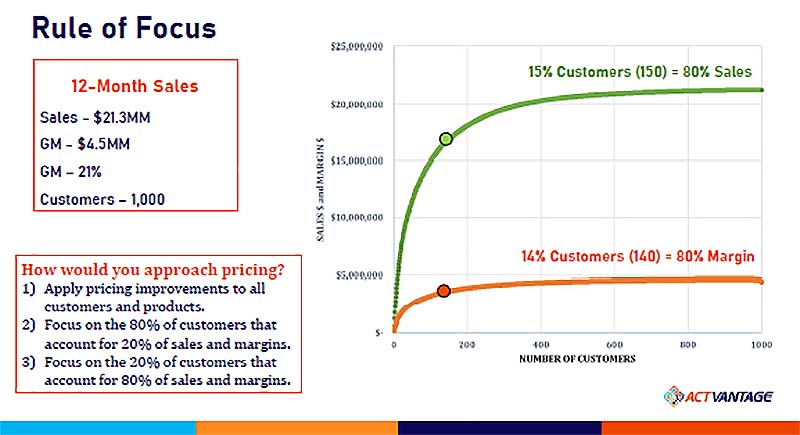
Krishnadevarajan showed attendees a sample 12-month sales chart for a company with 1,000 customers. It roughly followed the “classic curve” where a fairly small percentage of customers generate the overwhelming majority of the company’s business. From there, he asked, how might an owner approach pricing? He presented three options:
- Apply pricing improvements to all customers and products.
- Focus on the 80% of customers that account for 20% of sales and margins.
- Focus on 20% of the customers that account for 80% of sales and margins.
So, Krishnadevarajan said, that could translate to increasing prices 10% across the board. Difficult.
Or raising prices by up to 25% on the 80% that constitute lower-revenue customers. That only applies to 20% of revenue, he said, so it does provide a bump but not much impact.
On the other hand, he argued, if a distributor can raise margin by 0.1% on the customers who are driving 80% of the revenue, then the company has just paid for its pricing pro.
If pricing is not No. 1 or No. 2 on your list of priorities, he summarized, you are missing a key for 2021.
Click chart to enlarge
THE RIGHT AND WRONG OF RAISING PRICES: Increasing the margins just a little bit for a smartly targeted slice of your existing revenue mix can pay off in more ways than one.
What to Discount?
The duo fielded a couple of noteworthy follow-ups from attendees. The first question asked how sales goals and compensation can reflect the recommended adoption of the model where the sales manager is feeding proscriptive intel to the sales team.
The presenters recommended choosing five to seven customers from each quadrant of that opportunistic/resource-drain graph. Set goals based on that customer sample and monitor performance every quarter.
Another attendee asked if there is a best way to discount products.
Krishnadevarajan and Gunasekaran’s first step is to look at products to see how many unique customers are buying each product.
Their rule of thumb: If more than 15 unique customers are buying it, then that might be something to discount, especially if the discount can serve to increase market share or volume. That unique customer data (e.g., “single-customer item report”) can shed light on what is worth discounting.
Looking for a reprint of this article?
From high-res PDFs to custom plaques, order your copy today!